Li Haiyan, Luo Xinni, Ke Xiaoyin, Dai Qing, Zheng Wei, Zhang Chanjuan, Cassidy Ryan M, Soares Jair C, Zhang XiangYang, Ning Yuping
Southern Medical University, Guangzhou, China.
Guangzhou Medical University Affiliated Brain Hospital, Guangzhou Huiai Hospital, Guangzhou, China.
PLoS One. 2017 Oct 10;12(10):e0186143. doi: 10.1371/journal.pone.0186143. eCollection 2017.
Somatic complaints are often the presenting symptoms of major depressive disorder (MDD) in the outpatient context, because this may go unrecognized. It is well understood that MDD carries an increased risk of suicide. This study aimed to identify the risk factors and association with both MDD and suicidality among Han Chinese outpatients.
A multicenter study was carried out in 5189 outpatient adults (≥18 years old) in four general hospitals in Guangzhou, China. The 1392 patients who had the Patient Health Questionnaire-9 (PHQ-9) score ≥ 5, indicating depressive symptoms were offered an interview with a psychiatrist by the Mini International Neuropsychiatric Interview (MINI); 819 patients consented and completed the MINI interview. MINI module B was used to assess suicidality. Stepwise binary logistic models were used to estimate the relationship between a significant risk factor and suicide or MDD. According to with or without MDD, the secondary analysis was performed using the logistic regression model for the risk of suicidility.
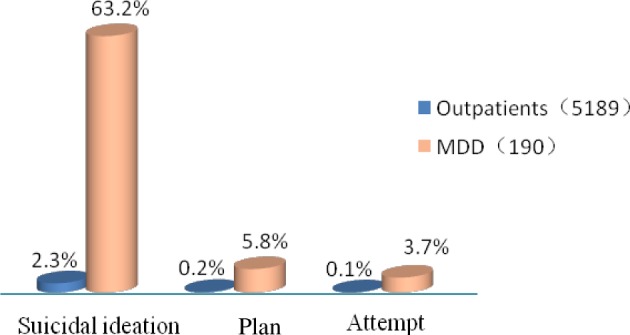
The current prevalence of MDD and the one month prevalence of suicidality were 3.7% and 2.3% respectively. The odds ratio of suicidality in women was more than twice that in men (OR = 2.62; 95% CI 1.45-4.76). Other risk factors which were significantly associated with suicidality were: living alone, higher education, self-reported depression, getting psychiatric diagnoses (MDD, anxiety disorders, and bipolar disorders). Significant risk factors for MDD were also noticed, such as comorbid anxiety disorders, self-reported anxiety, insomnia, suicidal ideation.
It's a cross-sectional study in outpatient clinics using self-report questionnaires.
This study provides valuable data about the risk factors and association of MDD and suicide risk in adult outpatients in Han Chinese. Those factors allow better the employment of preventative measures.
在门诊环境中,躯体不适常常是重度抑郁症(MDD)的首发症状,因为这种情况可能未被识别。众所周知,MDD会增加自杀风险。本研究旨在确定汉族门诊患者中与MDD和自杀倾向相关的危险因素及关联。
在中国广州的四家综合医院对5189名门诊成年患者(≥18岁)进行了一项多中心研究。1392名患者的患者健康问卷-9(PHQ-9)评分≥5,表明有抑郁症状,通过迷你国际神经精神病学访谈(MINI)接受精神科医生的访谈;819名患者同意并完成了MINI访谈。使用MINI模块B评估自杀倾向。采用逐步二元逻辑模型估计显著危险因素与自杀或MDD之间的关系。根据是否患有MDD,使用逻辑回归模型对自杀倾向风险进行二次分析。
MDD的当前患病率和自杀倾向的1个月患病率分别为3.7%和2.3%。女性自杀倾向的比值比是男性的两倍多(OR = 2.62;95%CI 1.45 - 4.76)。与自杀倾向显著相关的其他危险因素包括:独居、高等教育、自我报告的抑郁、接受精神科诊断(MDD、焦虑症和双相情感障碍)。还发现了MDD的显著危险因素,如共病焦虑症、自我报告的焦虑、失眠、自杀意念。
这是一项在门诊诊所使用自我报告问卷的横断面研究。
本研究提供了关于汉族成年门诊患者中MDD的危险因素以及与自杀风险的关联的有价值数据。这些因素有助于更好地采取预防措施。