Clinical Psychopharmacology Division, Peking University Sixth Hospital, National Clinical Research Center for Mental Disorders and Key Laboratory of Mental Health, Ministry of Health (Peking University), Beijing 100191, China.
National Engineering Research Center for Software Engineering, Peking University, Beijing 100871, China.
Chin Med J (Engl). 2018 Apr 20;131(8):912-919. doi: 10.4103/0366-6999.229898.
Patients with major depressive disorder (MDD) usually have high risk of suicidality. Few studies have investigated the effects of stressful life events (SLEs) on the risk of suicide in Chinese patients who have developed MDD. This study aimed to investigate the impact of SLEs on suicidal risk in Chinese patients with MDD.
In total, 1029 patients with MDD were included from nine psychiatric hospitals to evaluate the impact of SLEs on suicidal risk. Patients fulfilling the Mini-International Neuropsychiatric Interview (MINI) criteria for MDD were included in the study. Patients were excluded if they had lifetime or current diagnoses of psychotic disorder, bipolar disorder, and alcohol or substance dependence. Depressive symptoms were assessed by the 17-item Hamilton Depression Scale (HAMD-17). The suicidal risk of MDD patients was determined by the suicide risk module of MINI. SLEs were assessed by the Life Events Scale.
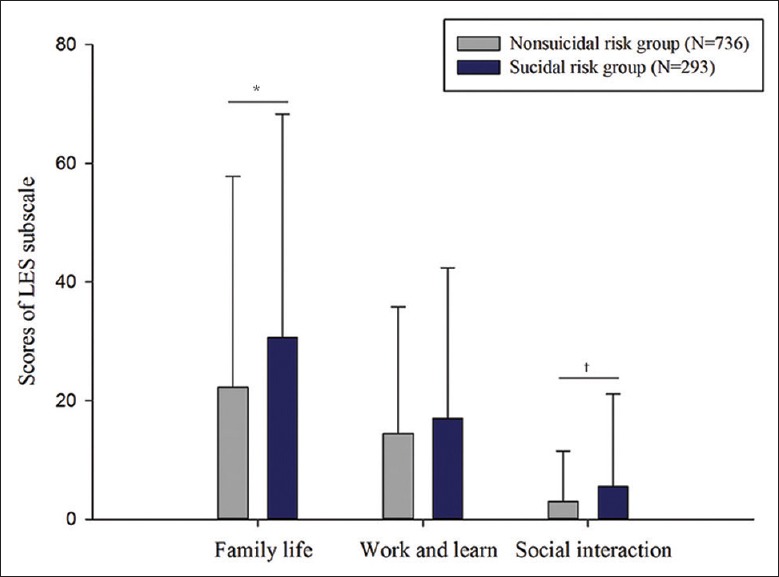
No gender difference was found for suicidal risk in MDD patients. Patients with suicidal risk had younger ages, lower education levels, more drinking behavior, and lower marriage rate, and fewer people had child and more severe depressive symptoms than nonsuicidal risk group. High-level perceived stressfulness (HPS) and number of SLEs that patients were exposed to were significantly greater in patients with suicidal risk than patients without. In multivariate logistic analysis, HPS of SLEs (odds ratio [OR] = 1.54, 95% confidence interval [CI]: 1.16-2.05, P = 0.003) and depressive symptoms (OR = 1.08, 95% CI: 1.05-1.11, P < 0.001) were associated with suicidal risk even after adjustment of gender, age, marriage, drinking behavior, and childless.
HPS of SLEs is associated with suicide risk in Chinese patients with MDD. Further suicide prevention programs targeting this risk factor are needed.
ClinicalTrials.gov: NCT02023567; https://clinicaltrials.gov/ct2/show/NCT02023567?term=NCT02023567&rank=1.
患有重度抑郁症(MDD)的患者通常有很高的自杀风险。很少有研究调查应激性生活事件(SLEs)对中国 MDD 患者自杀风险的影响。本研究旨在调查 SLEs 对中国 MDD 患者自杀风险的影响。
共纳入来自 9 家精神病院的 1029 例 MDD 患者,评估 SLEs 对自杀风险的影响。符合 Mini-国际神经精神访谈(MINI)MDD 诊断标准的患者纳入研究。排除有精神分裂症、双相情感障碍和酒精或物质依赖病史的患者。采用 17 项汉密尔顿抑郁量表(HAMD-17)评估抑郁症状。采用 MINI 的自杀风险模块评估 MDD 患者的自杀风险。采用生活事件量表评估 SLEs。
MDD 患者的自杀风险无性别差异。有自杀风险的患者年龄较小,受教育程度较低,饮酒行为较多,婚姻率较低,有孩子的人较少,抑郁症状更严重。与非自杀风险组相比,有自杀风险的患者感知到的应激性生活事件的应激水平较高(HPS)和暴露的 SLEs 数量更多。多变量逻辑回归分析显示,SLEs 的 HPS(比值比[OR] = 1.54,95%置信区间[CI]:1.16-2.05,P = 0.003)和抑郁症状(OR = 1.08,95% CI:1.05-1.11,P < 0.001)与自杀风险相关,即使在调整了性别、年龄、婚姻、饮酒行为和无子女后也是如此。
SLEs 的 HPS 与中国 MDD 患者的自杀风险相关。需要进一步针对这一风险因素制定自杀预防计划。
ClinicalTrials.gov:NCT02023567;https://clinicaltrials.gov/ct2/show/NCT02023567?term=NCT02023567&rank=1。