Department of Epidemiology and Biostatistics, Amsterdam Public Health Research Institute, VU University Medical Center, De Boelelaan 1089a, 1081 HV, Amsterdam, the Netherlands.
Julius Center for Health Sciences and Primary Care, University Medical Center Utrecht, Utrecht, the Netherlands.
Diabetologia. 2018 Jan;61(1):93-100. doi: 10.1007/s00125-017-4452-7. Epub 2017 Oct 10.
AIMS/HYPOTHESIS: Glycaemic markers and fasting insulin are frequently measured outcomes of intervention studies. To extrapolate accurately the impact of interventions on the risk of diabetes incidence, we investigated the size and shape of the associations of fasting plasma glucose (FPG), 2 h post-load glucose (2hPG), HbA, fasting insulin and HOMA-IR with incident type 2 diabetes mellitus.
The study population included 1349 participants aged 50-75 years without diabetes at baseline (1989) from a population-based cohort in Hoorn, the Netherlands. Incident type 2 diabetes was defined by the WHO 2011 criteria or known diabetes at follow-up. Logistic regression models were used to determine the associations of the glycaemic markers, fasting insulin and HOMA-IR with incident type 2 diabetes. Restricted cubic spline logistic regressions were conducted to investigate the shape of the associations.
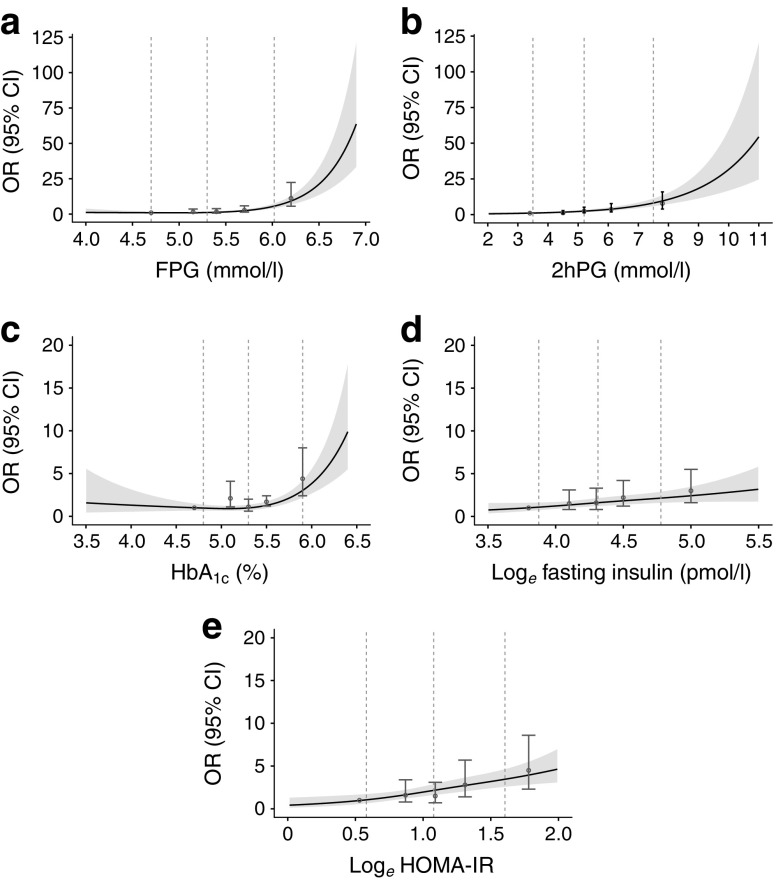
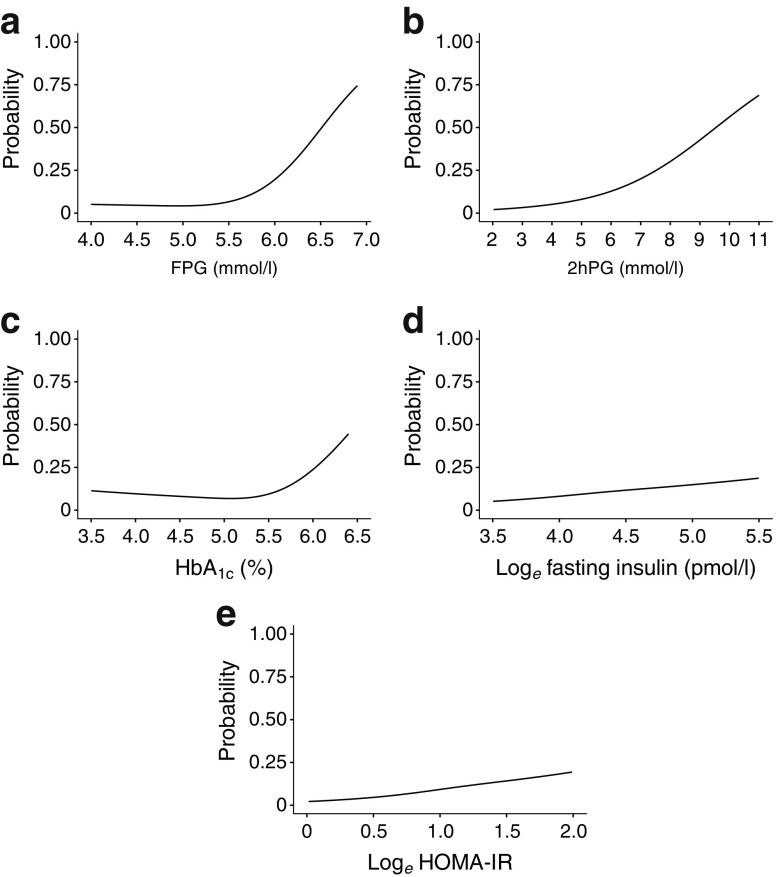
After a mean follow-up duration of 6.4 (SD 0.5) years, 152 participants developed diabetes (11.3%); the majority were screen detected by high FPG. In multivariate adjusted models, ORs (95% CI) for incident type 2 diabetes for the highest quintile in comparison with the lowest quintile were 9.0 (4.4, 18.5) for FPG, 6.1 (2.9, 12.7) for 2hPG, 3.8 (2.0, 7.2) for HbA, 1.9 (0.9, 3.6) for fasting insulin and 2.8 (1.4, 5.6) for HOMA-IR. The associations of FPG and HbA with incident diabetes were non-linear, rising more steeply at higher values.
CONCLUSIONS/INTERPRETATION: FPG was most strongly associated with incident diabetes, followed by 2hPG, HbA, HOMA-IR and fasting insulin. The strong association with FPG is probably because FPG is the most frequent marker for diabetes diagnosis. Non-linearity of associations between glycaemic markers and incident type 2 diabetes should be taken into account when estimating future risk of type 2 diabetes based on glycaemic markers.
目的/假设:血糖标志物和空腹胰岛素是干预研究中经常测量的结果。为了准确推断干预措施对糖尿病发病率的影响,我们研究了空腹血浆葡萄糖(FPG)、负荷后 2 小时血糖(2hPG)、HbA、空腹胰岛素和 HOMA-IR 与 2 型糖尿病发病风险的关联的大小和形状。
研究人群包括来自荷兰霍恩的一项基于人群的队列中 1349 名年龄在 50-75 岁且基线时(1989 年)无糖尿病的参与者。2 型糖尿病的发病由世界卫生组织 2011 年标准或随访时已知糖尿病定义。使用逻辑回归模型确定血糖标志物、空腹胰岛素和 HOMA-IR 与 2 型糖尿病发病的关联。进行受限立方样条逻辑回归以研究关联的形状。
在平均 6.4(SD 0.5)年的随访后,152 名参与者发生糖尿病(11.3%);大多数是通过高 FPG 筛查发现的。在多变量调整模型中,与最低五分位相比,最高五分位的 2 型糖尿病发病的比值比(95%CI)分别为 FPG 9.0(4.4,18.5)、2hPG 6.1(2.9,12.7)、HbA 3.8(2.0,7.2)、空腹胰岛素 1.9(0.9,3.6)和 HOMA-IR 2.8(1.4,5.6)。FPG 和 HbA 与糖尿病发病的关联是非线性的,随着值的升高上升更陡峭。
结论/解释:FPG 与糖尿病发病的相关性最强,其次是 2hPG、HbA、HOMA-IR 和空腹胰岛素。与 FPG 强关联的原因可能是 FPG 是诊断糖尿病最常见的标志物。在基于血糖标志物估计 2 型糖尿病未来风险时,应考虑血糖标志物与 2 型糖尿病发病之间的关联的非线性。