Department of Gastroenterology, Hospital of South West Jutland, Esbjerg, Denmark.
Department for Gastrointestinal diseases, Odense University Hospital, Sdr. Boulevard 29, Odense C, Denmark.
PLoS One. 2017 Oct 11;12(10):e0185412. doi: 10.1371/journal.pone.0185412. eCollection 2017.
Minimal hepatic encephalopathy (MHE) is clinically undetectable and the diagnosis requires psychometric tests. However, a lack of clarity exists as to whether the tests are in fact able to detect changes in cognition.
To examine if the continuous reaction time test (CRT) can detect changes in cognition with anti-HE intervention in patients with cirrhosis and without clinically manifest hepatic encephalopathy (HE).
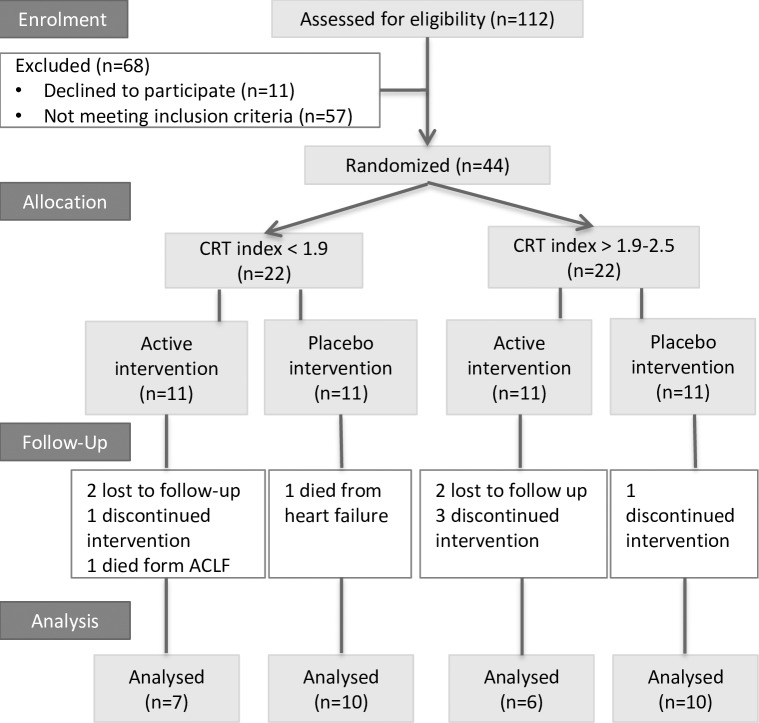
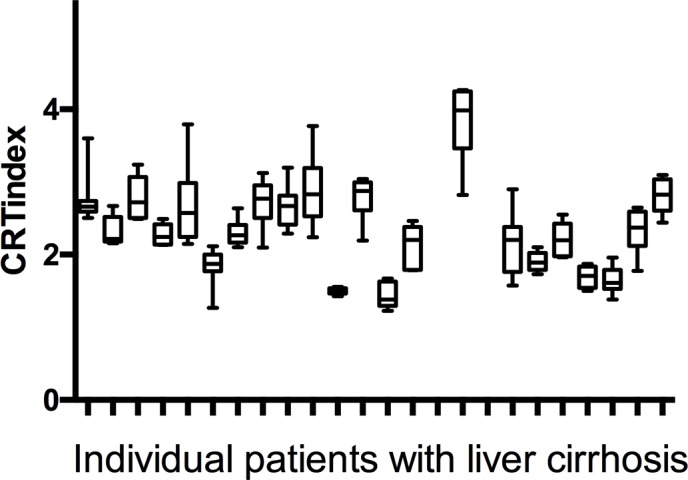
Firstly, we conducted a reproducibility analysis and secondly measured change in CRT induced by anti-HE treatment in a randomized controlled pilot study: We stratified 44 patients with liver cirrhosis and without clinically manifest HE according to a normal (n = 22) or abnormal (n = 22) CRT. Each stratum was then block randomized to receive multimodal anti-HE intervention (lactulose+branched-chain amino acids+rifaximin) or triple placebos for 3 months in a double-blinded fashion. The CRT is a simple PC-based test and the test result, the CRT index (normal threshold > 1.9), describes the patient's stability of alertness during the 10-minute test. Our study outcome was the change in CRT index in each group at study exit. The portosystemic encephalopathy (PSE) test, a paper-and-pencil test battery (normal threshold above -5), was used as a comparator test according to international guidelines.
The patients with an abnormal CRT index who were randomized to receive the active intervention normalized or improved their CRT index (mean change 0.92 ± 0.29, p = 0.01). Additionally, their PSE improved (change 3.85 ± 1.83, p = 0.03). There was no such effect in any of the other study groups.
In this cohort of patients with liver cirrhosis and no manifest HE, the CRT identified a group in whom cognition improved with intensive anti-HE intervention. This finding infers that the CRT can detect a response to treatment and might help in selecting patients for treatment.
轻微型肝性脑病(MHE)临床上无法检测到,其诊断需要进行心理测试。然而,目前尚不清楚这些测试是否真的能够检测到认知的变化。
在没有明显肝性脑病(HE)的肝硬化患者中,检查连续反应时间测试(CRT)是否能在抗 HE 干预下检测到认知变化。
首先,我们进行了重复性分析,其次在一项随机对照试验中测量了 CRT 对抗 HE 治疗的变化:我们根据正常(n=22)或异常(n=22)的 CRT 将 44 例无明显 HE 的肝硬化患者分层。然后,每个分层均以盲法随机分为接受多模式抗 HE 干预(乳果糖+支链氨基酸+利福昔明)或三重安慰剂治疗 3 个月。CRT 是一种简单的基于 PC 的测试,测试结果即 CRT 指数(正常阈值>1.9),描述了患者在 10 分钟测试期间警觉性的稳定性。我们的研究结果是每组在研究结束时 CRT 指数的变化。根据国际指南,我们使用纸和笔测试电池(正常阈值高于-5)作为比较测试的脑病测试(PSE)。
随机接受活性干预的 CRT 指数异常患者的 CRT 指数正常化或改善(平均变化 0.92±0.29,p=0.01)。此外,他们的 PSE 也得到改善(变化 3.85±1.83,p=0.03)。在其他任何研究组中均未出现这种效果。
在这组无明显 HE 的肝硬化患者中,CRT 确定了一组患者的认知能力在强化抗 HE 干预下得到改善。这一发现推断 CRT 可以检测到对治疗的反应,并且可能有助于选择治疗患者。