Malisoux Laurent, Gette Paul, Urhausen Axel, Bomfim Joao, Theisen Daniel
Sports Medicine Research Laboratory, Luxembourg Institute of Health, Luxembourg, Grand-Duchy of Luxembourg.
Sports Clinic, Centre Hospitalier de Luxembourg, Luxembourg, Grand-Duchy of Luxembourg.
PLoS One. 2017 Oct 11;12(10):e0186297. doi: 10.1371/journal.pone.0186297. eCollection 2017.
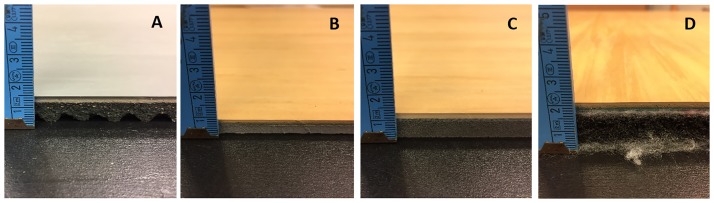
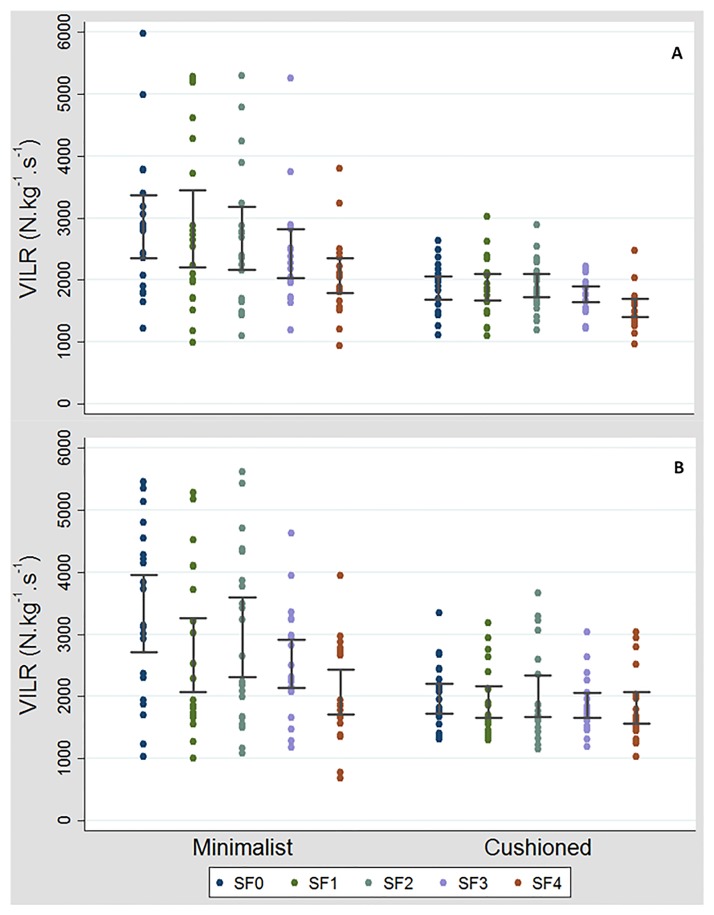
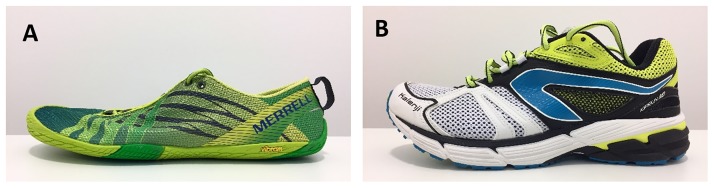
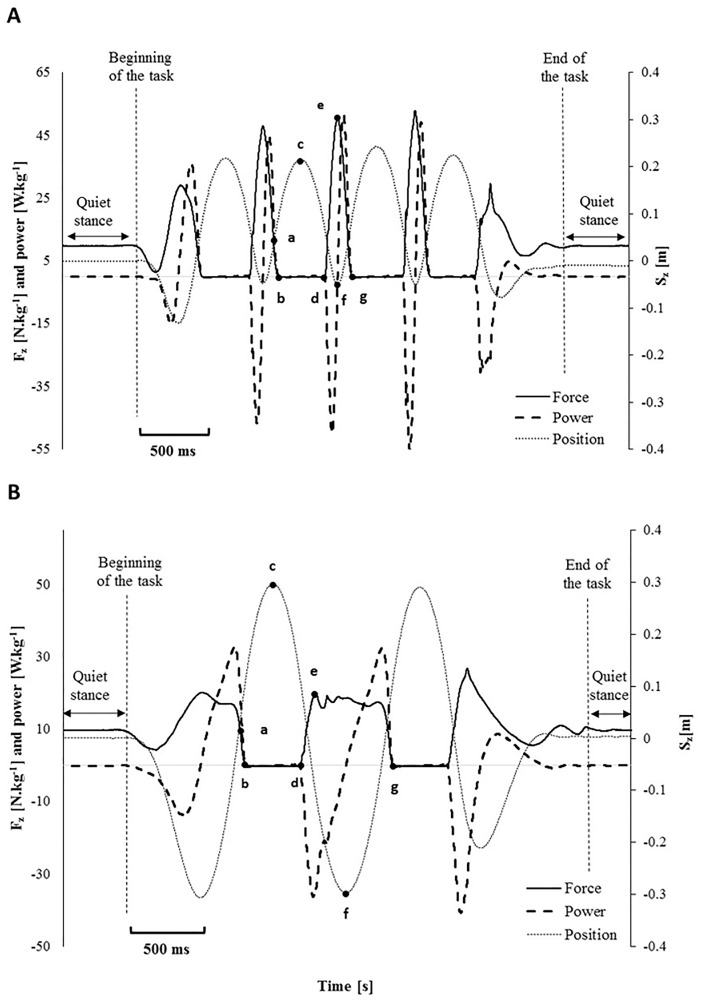
We aim to determine the influence of sports floorings and sports shoes on impact mechanics and performance during standardised jump tasks. Twenty-one male volunteers performed ankle jumps (four consecutive maximal bounds with very dynamic ankle movements) and multi-jumps (two consecutive maximal counter-movement jumps) on force plates using minimalist and cushioned shoes under 5 sports flooring (SF) conditions. The shock absorption properties of the SF, defined as the proportion of peak impact force absorbed by the tested flooring when compared with a concrete hard surface, were: SF0 = 0% (no flooring), SF1 = 19%, SF2 = 26%, SF3 = 37% and SF4 = 45%. Shoe and flooring effects were compared using 2x5 repeated-measures ANOVA with post-hoc Bonferroni-corrected comparisons. A significant interaction between SF and shoe conditions was found for VILR only (p = 0.003). In minimalist shoes, SF influenced Vertical Instantaneous Loading Rate (VILR) during ankle jumps (p = 0.006) and multi-jumps (p<0.001), in accordance with shock absorption properties. However, in cushioned shoes, SF influenced VILR during ankle jumps only (p<0.001). Contact Time was the only additional variable affected by SF, but only during multi-jumps in minimalist shoes (p = 0.037). Cushioned shoes induced lower VILR (p<0.001) and lower Contact Time (p≤0.002) during ankle jumps and multi-jumps compared to minimalist shoes. During ankle jumps, cushioned shoes induced greater Peak Vertical Ground Reaction Force (PVGRF, p = 0.002), greater Vertical Average Loading Rate (p<0.001), and lower eccentric (p = 0.008) and concentric (p = 0.004) work. During multi-jumps, PVGRF was lower (p<0.001) and jump height was higher (p<0.001) in cushioned compared to minimalist shoes. In conclusion, cushioning influenced impact forces during standardised jump tasks, whether it was provided by the shoes or the sports flooring. VILR is the variable that was the most affected.
我们旨在确定运动地板和运动鞋对标准化跳跃任务期间的冲击力学和表现的影响。21名男性志愿者穿着极简主义鞋和缓冲鞋,在5种运动地板(SF)条件下,在测力板上进行了脚踝跳跃(连续四次最大幅度的跳跃,脚踝动作非常有力)和多级跳跃(连续两次最大幅度的反向运动跳跃)。SF的减震特性定义为与混凝土硬表面相比,被测地板吸收的峰值冲击力的比例,分别为:SF0 = 0%(无地板),SF1 = 19%,SF2 = 26%,SF3 = 37%,SF4 = 45%。使用2×5重复测量方差分析及事后Bonferroni校正比较来比较鞋子和地板的影响。仅发现VILR在SF和鞋子条件之间存在显著交互作用(p = 0.003)。在极简主义鞋中,SF影响脚踝跳跃(p = 0.006)和多级跳跃(p<0.001)期间的垂直瞬时加载率(VILR),这与减震特性一致。然而,在缓冲鞋中,SF仅影响脚踝跳跃期间的VILR(p<0.001)。接触时间是受SF影响的唯一其他变量,但仅在极简主义鞋的多级跳跃期间(p = 0.037)。与极简主义鞋相比,缓冲鞋在脚踝跳跃和多级跳跃期间导致更低的VILR(p<0.001)和更短的接触时间(p≤0.002)。在脚踝跳跃期间,缓冲鞋导致更大的峰值垂直地面反作用力(PVGRF,p = 0.002)、更大的垂直平均加载率(p<0.001)以及更低的离心(p = 0.008)和向心(p = 0.004)功。在多级跳跃期间,与极简主义鞋相比,缓冲鞋的PVGRF更低(p<0.001)且跳跃高度更高(p<0.001)。总之,缓冲影响标准化跳跃任务期间的冲击力,无论这种缓冲是由鞋子还是运动地板提供。VILR是受影响最大的变量。