Department of Bioengineering, University of Pennsylvania, 240 Skirkanich Hall, 210 S. 33rd Street, Philadelphia, Pennsylvania 19104, USA.
Department of Chemical Engineering, David H. Koch Institute for Integrated Cancer Research, Massachusetts Institute of Technology, 77 Massachusetts Avenue, Cambridge, Massachusetts 02139, USA.
Nat Rev Cancer. 2017 Nov;17(11):659-675. doi: 10.1038/nrc.2017.83. Epub 2017 Oct 13.
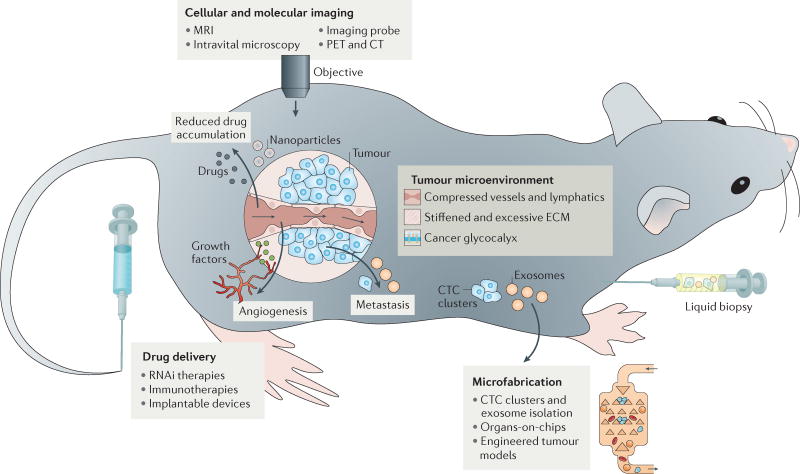
The principles of engineering and physics have been applied to oncology for nearly 50 years. Engineers and physical scientists have made contributions to all aspects of cancer biology, from quantitative understanding of tumour growth and progression to improved detection and treatment of cancer. Many early efforts focused on experimental and computational modelling of drug distribution, cell cycle kinetics and tumour growth dynamics. In the past decade, we have witnessed exponential growth at the interface of engineering, physics and oncology that has been fuelled by advances in fields including materials science, microfabrication, nanomedicine, microfluidics, imaging, and catalysed by new programmes at the National Institutes of Health (NIH), including the National Institute of Biomedical Imaging and Bioengineering (NIBIB), Physical Sciences in Oncology, and the National Cancer Institute (NCI) Alliance for Nanotechnology. Here, we review the advances made at the interface of engineering and physical sciences and oncology in four important areas: the physical microenvironment of the tumour and technological advances in drug delivery; cellular and molecular imaging; and microfluidics and microfabrication. We discussthe research advances, opportunities and challenges for integrating engineering and physical sciences with oncology to develop new methods to study, detect and treat cancer, and we also describe the future outlook for these emerging areas.
近 50 年来,工程学和物理学的原理已被应用于肿瘤学。工程师和物理科学家为癌症生物学的各个方面做出了贡献,从肿瘤生长和进展的定量理解到癌症的改善检测和治疗。许多早期的努力都集中在药物分布、细胞周期动力学和肿瘤生长动力学的实验和计算建模上。在过去的十年中,我们见证了工程学、物理学和肿瘤学之间的界面呈指数级增长,这得益于材料科学、微制造、纳米医学、微流控、成像等领域的进步,并得到了美国国立卫生研究院(NIH)包括国家生物医学影像和生物工程研究所(NIBIB)、肿瘤学中的物理科学以及国家癌症研究所(NCI)纳米技术联盟等新计划的推动。在这里,我们回顾了工程学和物理科学与肿瘤学在四个重要领域的界面上取得的进展:肿瘤的物理微环境和药物输送的技术进步;细胞和分子成像;以及微流控和微制造。我们讨论了将工程学和物理科学与肿瘤学相结合以开发新方法来研究、检测和治疗癌症的研究进展、机遇和挑战,还描述了这些新兴领域的未来展望。