Department of Molecular and Cell Biology, Cancer Research Laboratory, Immunotherapy and Vaccine Research Initiative, University of California, Berkeley, Berkeley, CA, USA.
Immunol Rev. 2017 Nov;280(1):93-101. doi: 10.1111/imr.12600.
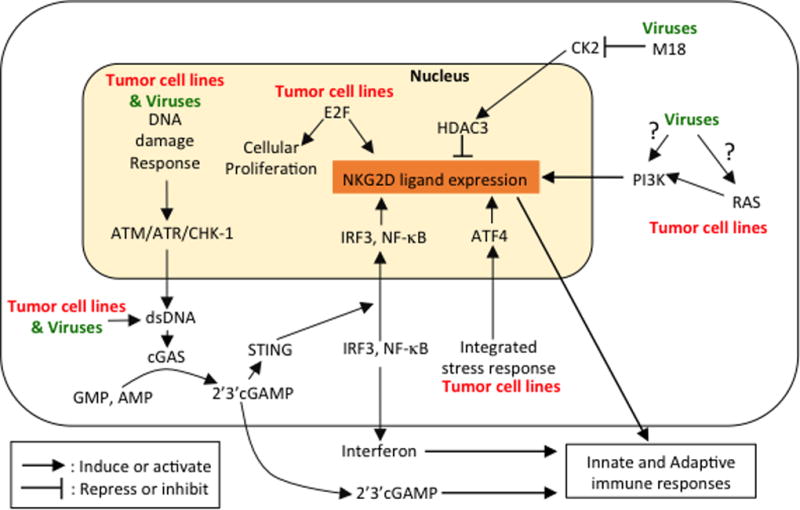
Natural killer (NK) cells recognize and kill cancer cells and infected cells by engaging cell surface ligands that are induced preferentially or exclusively on these cells. These ligands are recognized by activating receptors on NK cells, such as NKG2D. In addition to activation by cell surface ligands, the acquisition of optimal effector activity by NK cells is driven in vivo by cytokines and other signals. This review addresses a developing theme in NK cell biology: that NK-activating ligands on cells, and the provision of cytokines and other signals that drive high effector function in NK cells, are driven by abnormalities that arise from transformation or the infected state. The pathways include genomic damage, which causes self DNA to be exposed in the cytosol of affected cells, where it activates the DNA sensor cGAS. The resulting signaling induces NKG2D ligands and also mobilizes NK cell activation. Other key pathways that regulate NKG2D ligands include PI-3 kinase activation, histone acetylation, and the integrated stress response. This review summarizes the roles of these pathways and their relevance in both viral infections and cancer.
自然杀伤 (NK) 细胞通过识别细胞表面配体来识别和杀死癌细胞和受感染的细胞,这些配体优先或专门在这些细胞上诱导。这些配体被 NK 细胞上的激活受体识别,例如 NKG2D。除了通过细胞表面配体激活外,NK 细胞在体内获得最佳效应功能还受到细胞因子和其他信号的驱动。本综述探讨了 NK 细胞生物学中的一个发展主题:即细胞上的 NK 激活配体,以及提供细胞因子和其他信号以驱动 NK 细胞高效应功能,是由转化或感染状态引起的异常所驱动的。这些途径包括基因组损伤,导致自身 DNA 在受影响细胞的细胞质中暴露,从而激活 DNA 传感器 cGAS。由此产生的信号诱导 NKG2D 配体,并动员 NK 细胞激活。调节 NKG2D 配体的其他关键途径包括 PI-3 激酶激活、组蛋白乙酰化和综合应激反应。本综述总结了这些途径的作用及其在病毒感染和癌症中的相关性。