Abraham Hrudya, Thomas Sajan, Srivastava Amit
Internal Medicine Residency Program, MacNeal Hospital, Berwyn, Illinois, USA.
Transitional Year Residency Program, MacNeal Hospital, Berwyn, Illinois, USA.
Case Rep Gastroenterol. 2017 Aug 4;11(2):428-433. doi: 10.1159/000477335. eCollection 2017 May-Aug.
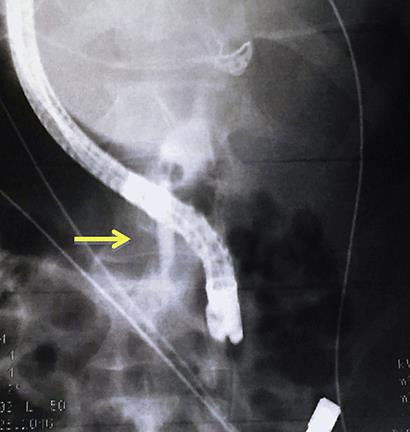
Biliary sump syndrome is a rare condition. It is seen as a rare long-term complication in patients with a history of a side-to-side choledochoduodenostomy. In the era before endoscopic retrograde cholangiopancreatography, side-to-side choledochoduodenostomy was a common surgical procedure for the management of biliary obstruction. In the setting of a side-to-side choledochoduodenostomy, the bile does not drain through the distal common bile duct anymore. Therefore, the part of the common bile duct distal from the choledochoduodenostomy anastomosis consequently transforms into a poorly drained reservoir, making this so-called "sump" prone to accumulation of debris. These patients are prone to cholangitis. We present a 64-year-old man with a history of side-to-side choledochoduodenostomy who presented with manifestations of cholangitis. An endoscopic retrograde cholangiopancreatography confirmed a diagnosis of sump syndrome. The etiology, clinical manifestations, and treatment of biliary sump syndrome are discussed in this article.
胆肠吻合口盲端综合征是一种罕见疾病。它被视为有胆肠侧侧吻合术病史患者的一种罕见长期并发症。在内镜逆行胰胆管造影术出现之前的时代,胆肠侧侧吻合术是治疗胆道梗阻的常见外科手术。在胆肠侧侧吻合的情况下,胆汁不再通过胆总管远端引流。因此,胆总管胆肠吻合口远端的部分会转变为引流不畅的储液囊,使得这个所谓的“盲端”易于碎屑堆积。这些患者易患胆管炎。我们报告一名64岁有胆肠侧侧吻合术病史的男性,他出现了胆管炎的表现。内镜逆行胰胆管造影术确诊为盲端综合征。本文讨论了胆肠吻合口盲端综合征的病因、临床表现及治疗。