Bertarelli Foundation Chair in Translational Neuroengineering, Center for Neuroprosthetics and Institute of Bioengineering, School of Engineering, École Polytechnique Fédérale de Lausanne (EPFL), Lausanne, 1015, Switzerland.
Wyss Center for Bio- and Neuro- Engineering, Geneva, 1202, Switzerland.
Sci Rep. 2017 Oct 16;7(1):13229. doi: 10.1038/s41598-017-13482-1.
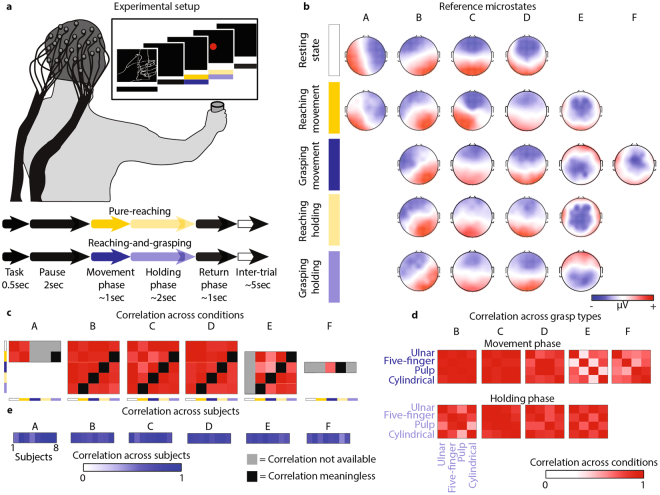
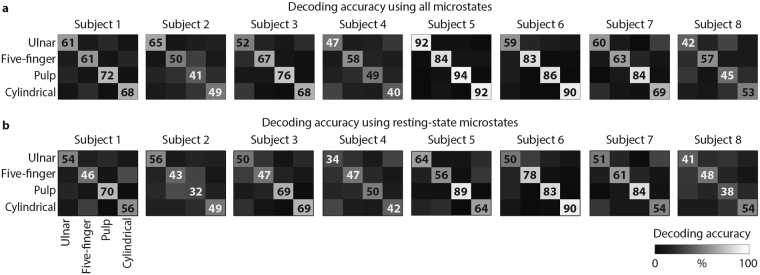
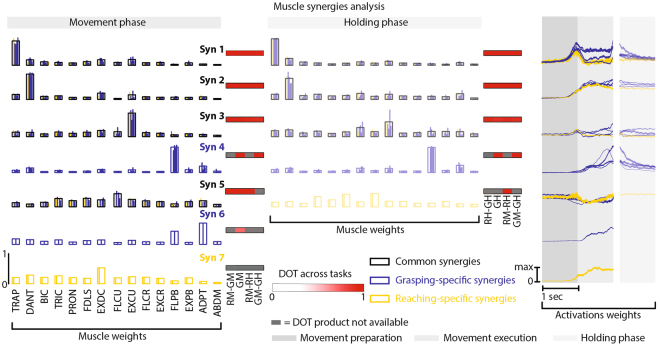
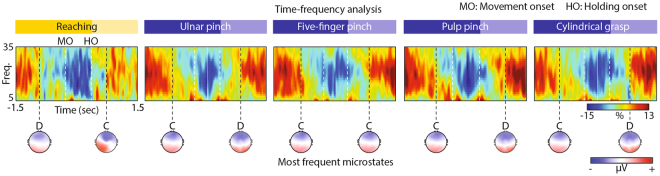
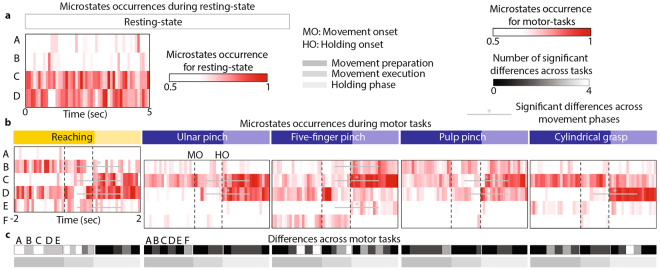
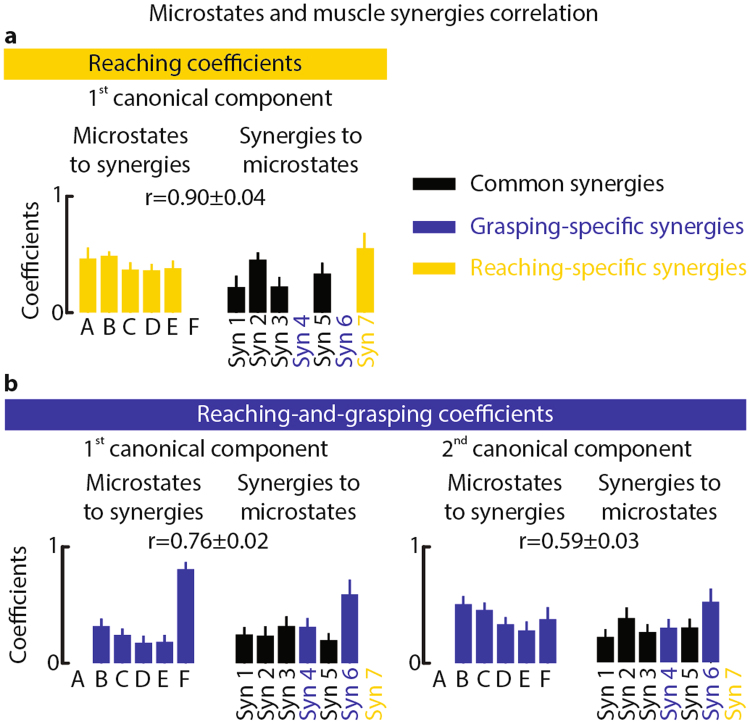
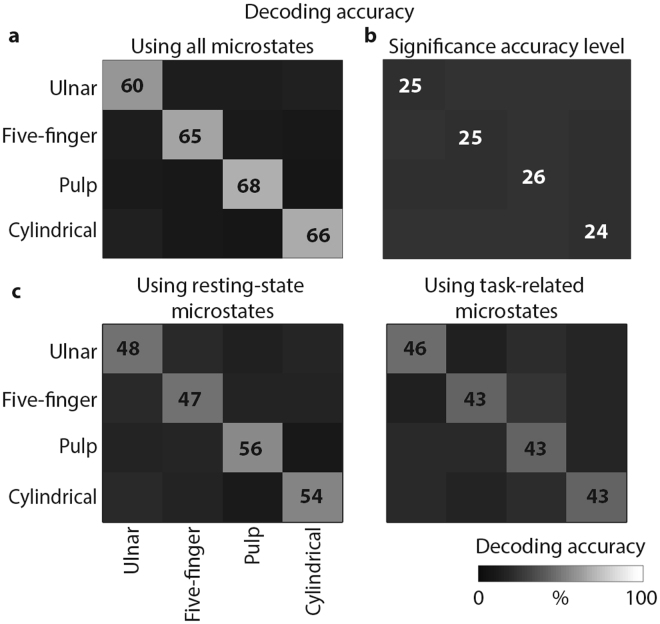
Electroencephalography (EEG) of brain activity can be represented in terms of dynamically changing topographies (microstates). Notably, spontaneous brain activity recorded at rest can be characterized by four distinctive topographies. Despite their well-established role during resting state, their implication in the generation of motor behavior is debated. Evidence of such a functional role of spontaneous brain activity would provide support for the design of novel and sensitive biomarkers in neurological disorders. Here we examined whether and to what extent intrinsic brain activity contributes and plays a functional role during natural motor behaviors. For this we first extracted subject-specific EEG microstates and muscle synergies during reaching-and-grasping movements in healthy volunteers. We show that, in every subject, well-known resting-state microstates persist during movement execution with similar topographies and temporal characteristics, but are supplemented by novel task-related microstates. We then show that the subject-specific microstates' dynamical organization correlates with the activation of muscle synergies and can be used to decode individual grasping movements with high accuracy. These findings provide first evidence that spontaneous brain activity encodes detailed information about motor control, offering as such the prospect of a novel tool for the definition of subject-specific biomarkers of brain plasticity and recovery in neuro-motor disorders.
脑电活动(EEG)可以用动态变化的拓扑结构(微状态)来表示。值得注意的是,在休息时记录的自发脑活动可以用四种独特的拓扑结构来描述。尽管它们在静息状态下的作用已经得到了很好的证实,但它们在运动行为产生中的作用仍存在争议。自发脑活动具有这种功能作用的证据将为神经障碍的新型和敏感生物标志物的设计提供支持。在这里,我们研究了内在脑活动是否以及在何种程度上有助于并在自然运动行为中发挥功能作用。为此,我们首先在健康志愿者进行伸手抓握动作期间提取了特定于个体的脑电微状态和肌肉协同作用。我们表明,在每个被试中,在运动执行期间,众所周知的静息状态微状态以相似的拓扑结构和时间特征持续存在,但会补充新的与任务相关的微状态。然后,我们表明,特定于个体的微状态的动态组织与肌肉协同作用的激活相关,并且可以用于以高精度解码个体的抓握运动。这些发现首次提供了证据,表明自发脑活动编码了有关运动控制的详细信息,从而提供了一种新的工具,用于定义神经运动障碍中大脑可塑性和恢复的特定于个体的生物标志物。