• 文献检索
  • 文档翻译
  • 深度研究
  • 学术资讯
  • Suppr Zotero 插件Zotero 插件
  • 邀请有礼
  • 套餐&价格
  • 历史记录
应用&插件
Suppr Zotero 插件Zotero 插件浏览器插件Mac 客户端Windows 客户端微信小程序
定价
高级版会员购买积分包购买API积分包
服务
文献检索文档翻译深度研究API 文档MCP 服务
关于我们
关于 Suppr公司介绍联系我们用户协议隐私条款
关注我们

Suppr 超能文献

核心技术专利:CN118964589B侵权必究
粤ICP备2023148730 号-1Suppr @ 2026

文献检索

告别复杂PubMed语法,用中文像聊天一样搜索,搜遍4000万医学文献。AI智能推荐,让科研检索更轻松。

立即免费搜索

文件翻译

保留排版,准确专业,支持PDF/Word/PPT等文件格式,支持 12+语言互译。

免费翻译文档

深度研究

AI帮你快速写综述,25分钟生成高质量综述,智能提取关键信息,辅助科研写作。

立即免费体验

文化因素对欧洲辅助生殖技术使用的影响大于经济和人口因素。

Cultural determinants influence assisted reproduction usage in Europe more than economic and demographic factors.

机构信息

Department of Sociology and Nuffield College, University of Oxford, Manor Road, Oxford OX1 3UQ, UK.

出版信息

Hum Reprod. 2017 Nov 1;32(11):2305-2314. doi: 10.1093/humrep/dex298.

DOI:10.1093/humrep/dex298
PMID:29040579
原文链接:https://pmc.ncbi.nlm.nih.gov/articles/PMC5850226/
Abstract

STUDY QUESTION

To what extent do financial, demographic and cultural determinants explain the vast cross-national differences in ART treatments in Europe?

SUMMARY ANSWER

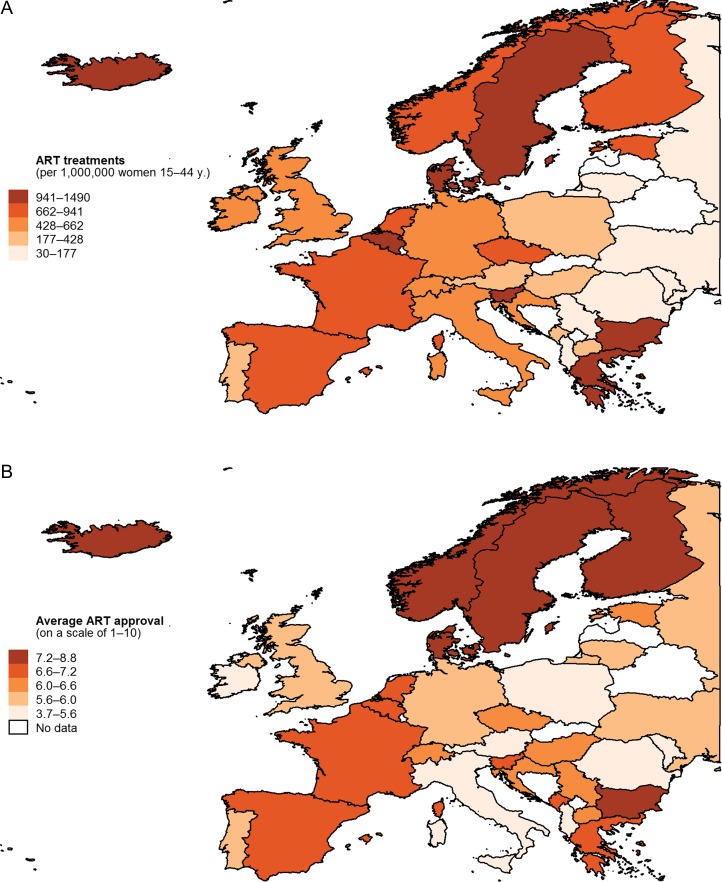
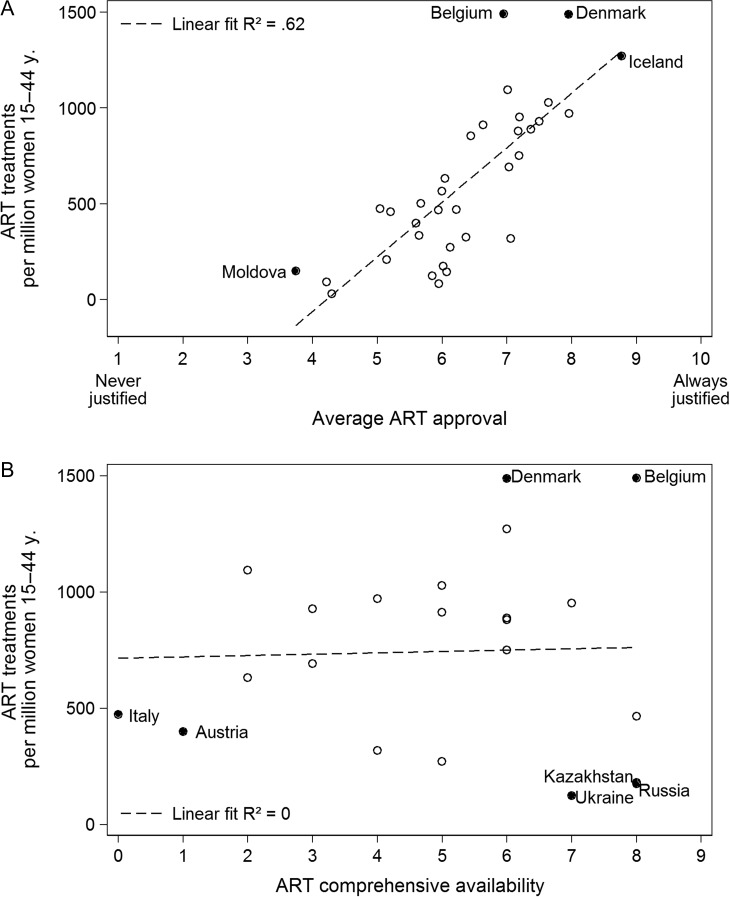
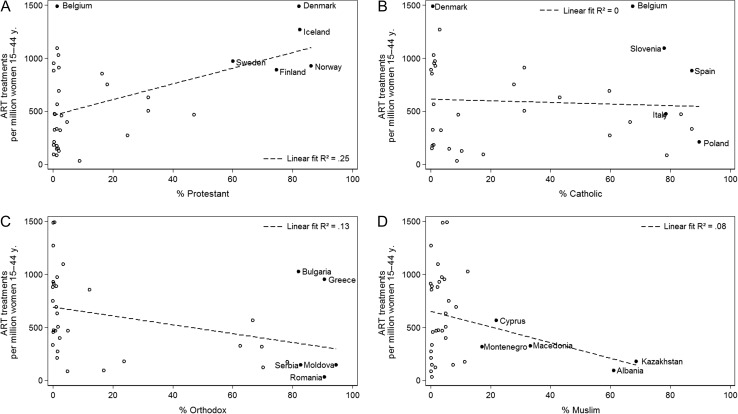
The normative cultural acceptance of ART is a major driver of ART treatments in Europe, above and beyond differences in country wealth, demographic aspects and religious composition.

WHAT IS KNOWN ALREADY

There are vast differences in the number of ART treatments across European countries, which are to some extent related to country affluence, regulation, and insurance coverage and costs. The role and impact of cultural and normative factors has not been explored in a larger cross-national comparison.

STUDY DESIGN, SIZE, DURATION: A descriptive and comparative cross-national analysis of ART treatment prevalence in over 30 European countries in 2010, with the outcome defined as the total number of ART cycles per million women of reproductive age (15-44 years). Data is drawn from multiple sources (ICMART, US Census Bureau Library, World Bank, Barro-Lee Educational Attainment Dataset, IFFS Surveillance reports, European Values Study and World Religion Database).

PARTICIPANTS/MATERIALS, SETTING, METHODS: Our sample includes data from 35 European countries, where we describe the associations between demographic and cultural factors and the prevalence of ART treatments. Bivariate correlation and ordinary least squares multiple regression analysis serves to establish the relationships between predictor variables and the number of ART treatments per million women aged 15-44 years in a country.

MAIN RESULTS AND THE ROLE OF CHANCE

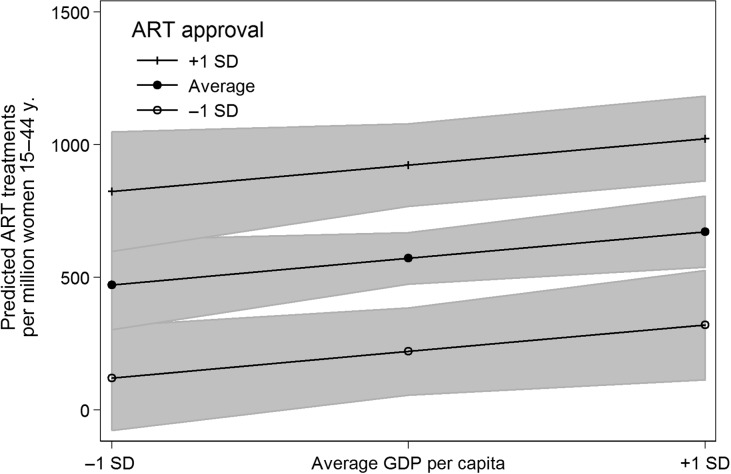
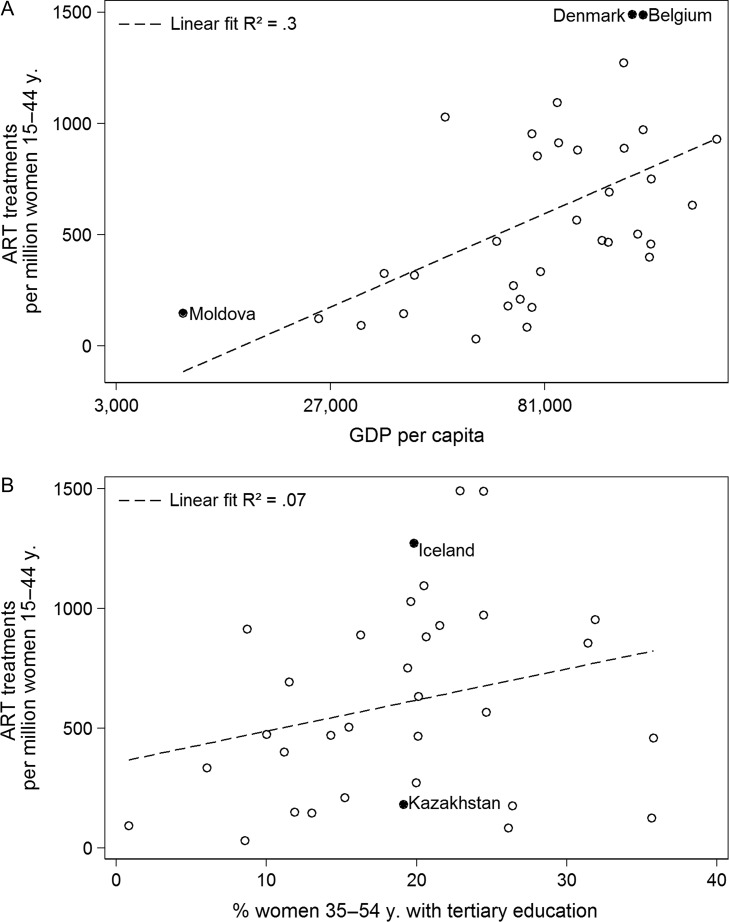
A one-percent increase in national GDP is associated with 382 (95% CI: 177-587) additional ART procedures per million women of reproductive age, yet this effect is reduced to 99 (-92 to 290) treatments once cultural values and demographic factors are accounted for. In our fully adjusted model, normative cultural values measuring the acceptability of ART are the strongest predictor of ART usage, with a one-point increase of average approval in a country associated with 276 (167-385) additional ART treatments per million women of reproductive age.

LIMITATIONS, REASONS FOR CAUTION: Findings are based on a cross-sectional, cross-national analysis, making formal tests of causality impossible and prohibiting inferences to the individual level.

WIDER IMPLICATIONS OF THE FINDINGS

Results indicate that reproductive health policy should openly acknowledge the importance of cultural norms in informally shaping and regulating the wider availability of ART treatment.

STUDY FUNDING/COMPETING INTEREST(S): Funding for this project was provided by the European Union's Seventh Framework Program (FP7 2007-2013) (No. 320116 Families and Societies), European Research Council for the SOCIOGENOME Consolidator Grant (ERC-2013-CoG-615603) and the Wellcome Trust Institutional Strategic Support Fund (all to M.C.M.). The authors have no conflicts of interest to declare.

TRIAL REGISTRATION NUMBER

N/A.

https://cdn.ncbi.nlm.nih.gov/pmc/blobs/0799/5850226/664af390a61d/dex298f06.jpg
https://cdn.ncbi.nlm.nih.gov/pmc/blobs/0799/5850226/607c49b7ddaa/dex298f01.jpg
https://cdn.ncbi.nlm.nih.gov/pmc/blobs/0799/5850226/2385c0b3ee5e/dex298f02.jpg
https://cdn.ncbi.nlm.nih.gov/pmc/blobs/0799/5850226/2ce81222abc7/dex298f03.jpg
https://cdn.ncbi.nlm.nih.gov/pmc/blobs/0799/5850226/d792783a1e03/dex298f04.jpg
https://cdn.ncbi.nlm.nih.gov/pmc/blobs/0799/5850226/80f77b1fa347/dex298f05.jpg
https://cdn.ncbi.nlm.nih.gov/pmc/blobs/0799/5850226/664af390a61d/dex298f06.jpg
https://cdn.ncbi.nlm.nih.gov/pmc/blobs/0799/5850226/607c49b7ddaa/dex298f01.jpg
https://cdn.ncbi.nlm.nih.gov/pmc/blobs/0799/5850226/2385c0b3ee5e/dex298f02.jpg
https://cdn.ncbi.nlm.nih.gov/pmc/blobs/0799/5850226/2ce81222abc7/dex298f03.jpg
https://cdn.ncbi.nlm.nih.gov/pmc/blobs/0799/5850226/d792783a1e03/dex298f04.jpg
https://cdn.ncbi.nlm.nih.gov/pmc/blobs/0799/5850226/80f77b1fa347/dex298f05.jpg
https://cdn.ncbi.nlm.nih.gov/pmc/blobs/0799/5850226/664af390a61d/dex298f06.jpg
摘要

研究问题

在多大程度上,金融、人口和文化因素可以解释欧洲国家在辅助生殖技术(ART)治疗方面的巨大差异?

总结答案

除了国家财富、人口方面和宗教构成的差异之外,对 ART 的规范文化接受程度是欧洲 ART 治疗的主要驱动因素。

已知内容

欧洲各国的 ART 治疗数量存在巨大差异,这在一定程度上与国家富裕程度、法规以及保险覆盖范围和成本有关。在更大的跨国比较中,文化和规范因素的作用和影响尚未得到探索。

研究设计、规模、持续时间:这是一项关于 2010 年欧洲 30 多个国家 ART 治疗流行率的描述性和比较性跨国分析,其结果定义为每百万育龄妇女(15-44 岁)的 ART 周期总数。数据来自多个来源(ICMART、美国人口普查局图书馆、世界银行、Barro-Lee 教育程度数据集、IFFS 监测报告、欧洲价值观研究和世界宗教数据库)。

参与者/材料、设置、方法:我们的样本包括来自 35 个欧洲国家的数据,其中我们描述了人口和文化因素与 ART 治疗流行率之间的关联。单变量相关和普通最小二乘多元回归分析用于确定国家每百万 15-44 岁育龄妇女的 ART 治疗数量与预测变量之间的关系。

主要结果和机会的作用

国家 GDP 增长 1%,与每百万育龄妇女的 ART 治疗增加 382 次(95%CI:177-587)有关,但考虑到文化价值观和人口因素后,这种影响降至 99 次(-92 至 290 次)。在我们完全调整的模型中,衡量对 ART 可接受性的规范文化价值观是 ART 使用的最强预测因素,国家平均认可程度增加一个点,与每百万育龄妇女的 ART 治疗增加 276 次(167-385 次)有关。

局限性、谨慎的原因:研究结果基于横断面、跨国分析,因此无法进行正式的因果关系检验,也无法推断到个体水平。

研究结果的更广泛意义

结果表明,生殖健康政策应公开承认文化规范在非正式塑造和规范更广泛的 ART 治疗可用性方面的重要性。

研究资金/利益冲突:本项目的资金由欧盟第七框架计划(FP7 2007-2013)(第 320116 号家庭和社会)、欧洲研究理事会的 SOCIOGENOME 整合者赠款(ERC-2013-CoG-615603)和惠康信托基金机构战略支持基金(均为 M.C.M.)提供。作者没有利益冲突需要申报。

试验注册编号

无。

相似文献

1
Cultural determinants influence assisted reproduction usage in Europe more than economic and demographic factors.文化因素对欧洲辅助生殖技术使用的影响大于经济和人口因素。
Hum Reprod. 2017 Nov 1;32(11):2305-2314. doi: 10.1093/humrep/dex298.
2
International Committee for Monitoring Assisted Reproductive Technologies world report: assisted reproductive technology, 2014†.国际辅助生殖技术监测委员会世界报告:辅助生殖技术,2014 年†。
Hum Reprod. 2021 Oct 18;36(11):2921-2934. doi: 10.1093/humrep/deab198.
3
International Committee for Monitoring Assisted Reproductive Technologies world report: assisted reproductive technology 2012†.国际辅助生殖技术监测委员会世界报告:辅助生殖技术 2012 年报告†。
Hum Reprod. 2020 Aug 1;35(8):1900-1913. doi: 10.1093/humrep/deaa090.
4
International Committee for Monitoring Assisted Reproductive Technologies (ICMART): world report for cycles conducted in 2017-2018.国际辅助生殖技术监测委员会(ICMART):2017 - 2018年周期的世界报告
Hum Reprod. 2025 Apr 16. doi: 10.1093/humrep/deaf049.
5
Assisted reproductive technology in Europe, 2010: results generated from European registers by ESHRE†.2010年欧洲辅助生殖技术:欧洲人类生殖与胚胎学会(ESHRE)†基于欧洲登记处的数据得出的结果
Hum Reprod. 2014 Oct 10;29(10):2099-113. doi: 10.1093/humrep/deu175. Epub 2014 Jul 27.
6
Survey on ART and IUI: legislation, regulation, funding, and registries in European countries-an update.ART 和 IUI 调查:欧洲国家的立法、监管、资金和注册情况更新。
Hum Reprod. 2024 Sep 1;39(9):1909-1924. doi: 10.1093/humrep/deae163.
7
International Committee for Monitoring Assisted Reproductive Technologies (ICMART) world report: assisted reproductive technology 2004.国际辅助生殖技术监测委员会(ICMART)世界报告:辅助生殖技术 2004 年报告。
Hum Reprod. 2013 May;28(5):1375-90. doi: 10.1093/humrep/det036. Epub 2013 Feb 26.
8
Preterm birth in assisted reproduction: the mediating role of hypertensive disorders in pregnancy.辅助生殖中的早产:妊娠期高血压疾病的中介作用
Hum Reprod. 2025 Jan 1;40(1):167-177. doi: 10.1093/humrep/deae261.
9
International Committee for Monitoring Assisted Reproductive Technologies world report: Assisted Reproductive Technology 2006.国际辅助生殖技术监测委员会世界报告:辅助生殖技术 2006 年报告。
Hum Reprod. 2014 Jul;29(7):1536-51. doi: 10.1093/humrep/deu084. Epub 2014 May 2.
10
ART in Europe, 2014: results generated from European registries by ESHRE: The European IVF-monitoring Consortium (EIM) for the European Society of Human Reproduction and Embryology (ESHRE).ART 在欧洲,2014:ESHRE 欧洲注册处产生的结果:欧洲人类生殖与胚胎学学会(ESHRE)的欧洲 IVF 监测联合组织(EIM)。
Hum Reprod. 2018 Sep 1;33(9):1586-1601. doi: 10.1093/humrep/dey242.

引用本文的文献

1
Spatiotemporal evolution of online interest in assisted reproductive technology: a two-decade global analysis through google trends.辅助生殖技术在线关注度的时空演变:通过谷歌趋势进行的二十年全球分析
BMC Public Health. 2025 Aug 18;25(1):2822. doi: 10.1186/s12889-025-23990-9.
2
Alignment, Anticipation, Adaptation, or Lagging Behind? Age-Based Regulations in Assisted Reproduction and Late Fertility.对齐、预期、适应还是落后?辅助生殖与晚育中基于年龄的规定
Popul Dev Rev. 2024 Dec;50(4):1319-1351. doi: 10.1111/padr.12658. Epub 2024 Sep 30.
3
Survey on ART and IUI: legislation, regulation, funding, and registries in European countries-an update.

本文引用的文献

1
Assisted reproductive technology in Europe, 2013: results generated from European registers by ESHRE.欧洲 2013 年辅助生殖技术:ESHRE 欧洲注册中心获得的结果。
Hum Reprod. 2017 Oct 1;32(10):1957-1973. doi: 10.1093/humrep/dex264.
2
Cognitive development in children up to age 11 years born after ART-a longitudinal cohort study.ART 后出生的 11 岁以下儿童的认知发展:一项纵向队列研究。
Hum Reprod. 2017 Jul 1;32(7):1482-1488. doi: 10.1093/humrep/dex102.
3
Data collection systems in ART must follow the pace of change in clinical practice.
ART 和 IUI 调查:欧洲国家的立法、监管、资金和注册情况更新。
Hum Reprod. 2024 Sep 1;39(9):1909-1924. doi: 10.1093/humrep/deae163.
4
Care-seeking for difficulties conceiving in sub-Saharan Africa: findings from population-based surveys in eight geographies.撒哈拉以南非洲地区不孕求诊情况:八个地理位置的基于人群调查结果。
Hum Reprod. 2024 Aug 1;39(8):1712-1723. doi: 10.1093/humrep/deae084.
5
Main topics in assisted reproductive market: A scoping review.辅助生殖市场的主要议题:范围综述。
PLoS One. 2023 Aug 1;18(8):e0284099. doi: 10.1371/journal.pone.0284099. eCollection 2023.
6
Mapping international research output within ethical, legal, and social implications (ELSI) of assisted reproductive technologies.绘制辅助生殖技术伦理、法律和社会影响(ELSI)领域的国际研究产出图谱。
J Assist Reprod Genet. 2023 Sep;40(9):2023-2043. doi: 10.1007/s10815-023-02834-8. Epub 2023 Jun 29.
7
Mapping ethical, legal, & social implications (ELSI) of assisted reproductive technologies.辅助生殖技术的伦理、法律和社会影响(ELSI)研究。
J Assist Reprod Genet. 2023 Sep;40(9):2045-2062. doi: 10.1007/s10815-023-02854-4. Epub 2023 Jun 29.
8
Use of Population-Level Administrative Data in Developmental Science.发育科学中人群水平行政数据的应用。
Annu Rev Dev Psychol. 2022 Dec;4(1):447-468. doi: 10.1146/annurev-devpsych-120920-023709. Epub 2022 Sep 14.
9
Residential proximity to a fertility clinic is independently associated with likelihood of women having ART and IUI treatment.住宅与生育诊所的距离与女性接受辅助生殖技术(ART)和宫腔内人工授精(IUI)治疗的可能性独立相关。
Hum Reprod. 2022 Oct 31;37(11):2662-2671. doi: 10.1093/humrep/deac205.
10
Maternal, Perinatal and Neonatal Outcomes of Triplet Pregnancies According to Chorionicity: A Systematic Review of the Literature and Meta-Analysis.根据绒毛膜性分析三胎妊娠的孕产妇、围产期和新生儿结局:文献系统评价与荟萃分析
J Clin Med. 2022 Mar 28;11(7):1871. doi: 10.3390/jcm11071871.
抗逆转录病毒治疗中的数据收集系统必须跟上临床实践的变化步伐。
Hum Reprod. 2016 Oct;31(10):2160-3. doi: 10.1093/humrep/dew199. Epub 2016 Sep 2.
4
International Committee for Monitoring Assisted Reproductive Technologies world report: Assisted Reproductive Technology 2008, 2009 and 2010.国际辅助生殖技术监测委员会世界报告:2008年、2009年及2010年辅助生殖技术情况
Hum Reprod. 2016 Jul;31(7):1588-609. doi: 10.1093/humrep/dew082. Epub 2016 May 20.
5
Demographic relevancy of increased use of assisted reproduction in European countries.欧洲国家辅助生殖技术使用增加的人口统计学相关性。
Reprod Health. 2014 May 26;11:37. doi: 10.1186/1742-4755-11-37.
6
The impact of consumer affordability on access to assisted reproductive technologies and embryo transfer practices: an international analysis.消费者负担能力对辅助生殖技术和胚胎移植实践的可及性的影响:国际分析。
Fertil Steril. 2014 Jan;101(1):191-198.e4. doi: 10.1016/j.fertnstert.2013.09.005. Epub 2013 Oct 21.
7
Fertility in Advanced Societies: A Review of Research: La fécondité dans les sociétés avancées: un examen des recherches.发达社会中的生育能力:研究综述:发达社会中的生育力:研究考察。
Eur J Popul. 2013 Feb;29(1):1-38. doi: 10.1007/s10680-012-9277-y. Epub 2012 Sep 12.
8
The diversity of regulation and public financing of IVF in Europe and its impact on utilization.欧洲体外受精的监管和公共融资的多样性及其对利用率的影响。
Hum Reprod. 2013 Mar;28(3):666-75. doi: 10.1093/humrep/des418. Epub 2012 Dec 6.
9
Why do people postpone parenthood? Reasons and social policy incentives.为什么人们会推迟生育?原因和社会政策激励措施。
Hum Reprod Update. 2011 Nov-Dec;17(6):848-60. doi: 10.1093/humupd/dmr026. Epub 2011 Jun 7.
10
Social age deadlines for the childbearing of women and men.社会规定的男女初育年龄界限。
Hum Reprod. 2011 Mar;26(3):616-22. doi: 10.1093/humrep/deq360. Epub 2010 Dec 15.