Department of Demography, University of Vienna, Vienna, Austria.
School of Demography, Australian National University, Canberra, Australia.
Hum Reprod. 2022 Oct 31;37(11):2662-2671. doi: 10.1093/humrep/deac205.
Is geographic proximity to a fertility clinic associated with the likelihood of women of reproductive age undertaking different forms of medically assisted fertility treatment?
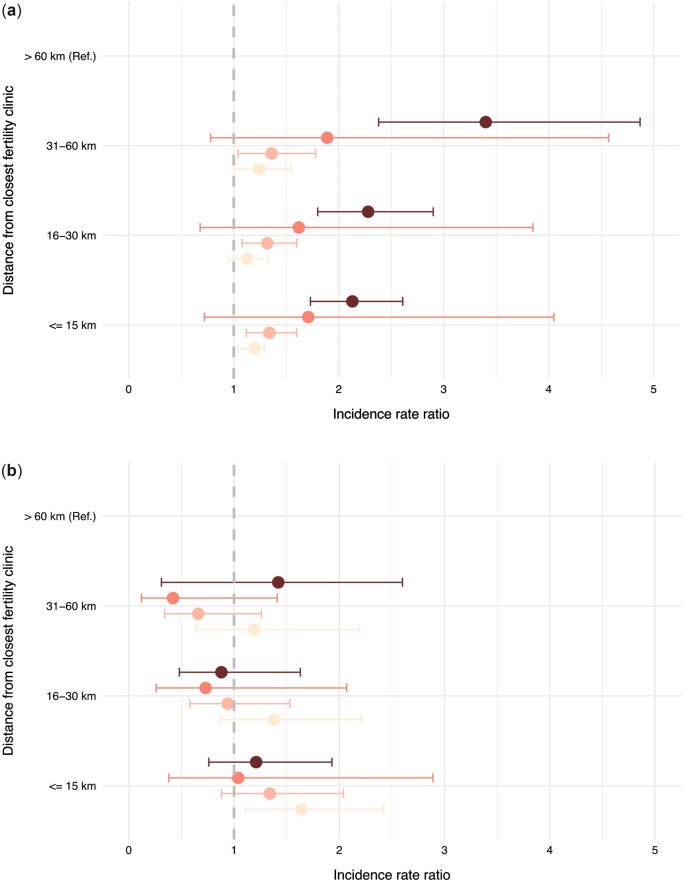
After adjusting for socioeconomic status (SES) and other confounders including a proxy for the need for infertility treatment, women who lived within 15 km of a fertility clinic were 21% more likely to undergo ART treatment and 68% more likely to undergo IUI treatment than those who lived further than 60 km away.
In most countries, patients living outside of metropolitan areas are more likely to be more socio-economically disadvantaged and to have less equitable access to healthcare. However, how a woman's residential proximity to fertility clinics predicts utilization of high-cost/high-technology treatment (ART) and low-cost/low-technology treatment (IUI) is limited, and whether socio-economic disadvantage explains much of the hypothesized lower utilization is unknown. Australia's universal insurance scheme provides supportive reimbursement for almost all ART and IUI treatment regardless of age or number of cycles, providing a unique setting to investigate disparities in access to infertility treatment.
STUDY DESIGN, SIZE, DURATION: National population-based observation study of ART and IUI treatment utilization by women across socio-economic gradients and Australian residential locations between August 2015 and December 2017.
PARTICIPANTS/MATERIALS, SETTING, METHODS: Universal insurance claims information on female patients who underwent ART or IUI were provided by Services Australia, comprising 67 670 female patients who accessed 162 795 ART treatments, and 10 211 female patients who accessed 19 615 IUI treatments over a 29-month period. Incidence rates by SES and proximity to fertility clinics were calculated to describe the number of women undergoing at least one ART or IUI treatment cycle per 1000 women of reproductive age (25-44). Treatment frequencies were calculated to describe the average number of ART or IUI treatment cycles per woman of reproductive age who had undergone at least one ART or IUI treatment during the study period. Poisson regression analyses were used to estimate the independent effect on accessibility to infertility treatment by geographic proximity (based on small area locations) to the closest fertility clinic after adjusting for SES, childbearing delay, remoteness area, and marital status.
On average, 19.1 women per 1000 women of reproductive age underwent at least one fresh or frozen ART cycle, with an average 2.3 ART cycles each, while 3.0 women per 1000 women of reproductive age received at least one IUI cycle, with an average of 1.6 IUI cycles each. After adjusting for SES and other confounders including a proxy for the need for infertility treatment, women who lived within 15 km of a fertility clinic were 21% more likely to undergo ART treatment and 68% more likely to undergo IUI than those who lived over 60 km away. Regardless of geographic location, there was a steady and independent gradient in access to ART treatment based on increasing SES, with women residing in the most advantaged residential quartile having a 37% higher rate of receiving ART treatment compared to those in the most disadvantaged quartile. The negative effect of social disadvantage on ART use became more pronounced as distance from a fertility clinic grew, indicating that the barriers to access to ART care caused by distance were further compounded by the level of socioeconomic advantage of the women's residential location. In contrast, socioeconomic status did not modify the likelihood of using IUI over and above the distance from a fertility clinic. In relation to IUI treatment, differences in utilization by SES disappeared after adjusting for geographic proximity to a fertility clinic, childbearing delay, remoteness area, and marital status.
LIMITATIONS, REASONS FOR CAUTION: Information is aggregated by small geographic areas and it therefore may not reflect individual characteristics. Australia provides partial but comparably supportive reimbursement for both ART and IUI through its universal healthcare system and thus the results may not be fully generalizable to other settings.
Residential proximity to a fertility clinic is a persistent barrier to accessing ART and IUI treatment, regardless of SES, even in countries characterized by supportive public funding, such as Australia. SES is less of a barrier to accessing IUI than ART, presumably driven by the lower cost and fewer clinic visits required with IUI treatment. Safe and effective fertility treatment should be available to all women regardless of where they live.
STUDY FUNDING/COMPETING INTEREST(S): This work was supported by the Australian National University Research scholarship and by the Higher Degree Research Fee Merit Scholarship. The authors have no conflict of interest.
N/A.
生育诊所的地理位置是否与育龄妇女接受不同形式的医学辅助生育治疗的可能性相关?
在调整社会经济地位(SES)和包括不孕症治疗需求代理在内的其他混杂因素后,距离生育诊所 15 公里以内的女性接受辅助生殖技术(ART)治疗的可能性增加 21%,接受 IUI 治疗的可能性增加 68%,而距离生育诊所 60 公里以上的女性则不然。
在大多数国家,居住在大都市以外地区的患者往往社会经济地位较低,获得医疗保健的机会也较少。然而,女性居住的接近生育诊所的程度如何预测高成本/高科技治疗(ART)和低成本/低技术治疗(IUI)的利用情况尚不清楚,社会经济劣势是否在很大程度上解释了这种较低利用率也尚不清楚。澳大利亚的全民保险计划几乎为所有的 ART 和 IUI 治疗提供了支持性报销,无论年龄或周期数如何,这为调查不孕症治疗机会的差异提供了一个独特的环境。
研究设计、规模、持续时间:这是一项基于全国性的观察性研究,在 2015 年 8 月至 2017 年 12 月期间,研究了社会经济梯度和澳大利亚居住地点的女性对 ART 和 IUI 治疗的利用情况。
参与者/材料、设置、方法:澳大利亚服务局提供了女性接受 ART 或 IUI 治疗的全民保险索赔信息,其中包括 67670 名接受 162795 次 ART 治疗的女性患者,以及 10211 名接受 19615 次 IUI 治疗的女性患者,研究期间共进行了 29 个月。根据 SES 和生育诊所的接近程度计算发病率,以描述每 1000 名育龄妇女(25-44 岁)中至少进行一次 ART 或 IUI 治疗的人数。治疗频率的计算方法是描述在研究期间至少接受过一次 ART 或 IUI 治疗的育龄妇女平均接受的 ART 或 IUI 治疗周期数。使用泊松回归分析估计地理接近(基于小区域位置)对生育诊所的影响,在调整 SES、生育延迟、偏远地区和婚姻状况后,评估对不孕症治疗的可及性的独立影响。
平均而言,每 1000 名育龄妇女中有 19.1 人至少进行了一次新鲜或冷冻的 ART 周期,平均每人进行 2.3 次 ART 周期,而每 1000 名育龄妇女中有 3.0 人至少进行了一次 IUI 周期,平均每人进行 1.6 次 IUI 周期。在调整 SES 和包括不孕症治疗需求代理在内的其他混杂因素后,距离生育诊所 15 公里以内的女性接受 ART 治疗的可能性增加 21%,接受 IUI 治疗的可能性增加 68%,而距离生育诊所 60 公里以上的女性则不然。无论地理位置如何,根据 SES 的增加,接受 ART 治疗的机会都有一个稳定的、独立的梯度,与 SES 最不利的四分位相比,居住在最有利的四分位的女性接受 ART 治疗的比率要高 37%。随着距离生育诊所的增加,社会劣势对 ART 使用的负面影响变得更加明显,这表明距离造成的获得 ART 护理的障碍进一步加剧了女性居住地点的社会经济优势程度。相比之下,SES 并不能改变距离生育诊所对 IUI 治疗的利用程度。在 IUI 治疗方面,调整生育诊所的接近程度后,SES 差异消失,同时还调整了生育延迟、偏远地区和婚姻状况。
局限性、谨慎的原因:信息是通过小的地理区域进行汇总的,因此可能无法反映个人特征。澳大利亚通过其全民医疗保健系统为 ART 和 IUI 提供部分但相对支持性的报销,因此结果可能不完全适用于其他环境。SES 对接受 IUI 的障碍小于接受 ART 的障碍,这可能是由于 IUI 治疗所需的成本和诊所就诊次数较少所致。无论女性居住在哪里,安全有效的生育治疗都应该提供给所有女性。
研究资助/利益冲突:这项工作得到了澳大利亚国立大学奖学金和高等学位研究费奖学金的支持。作者没有利益冲突。
无。
