Bertran Kateri, Balzli Charles, Kwon Yong-Kuk, Tumpey Terrence M, Clark Andrew, Swayne David E
Emerg Infect Dis. 2017 Nov;23(11):1806-1814. doi: 10.3201/eid2311.170672.
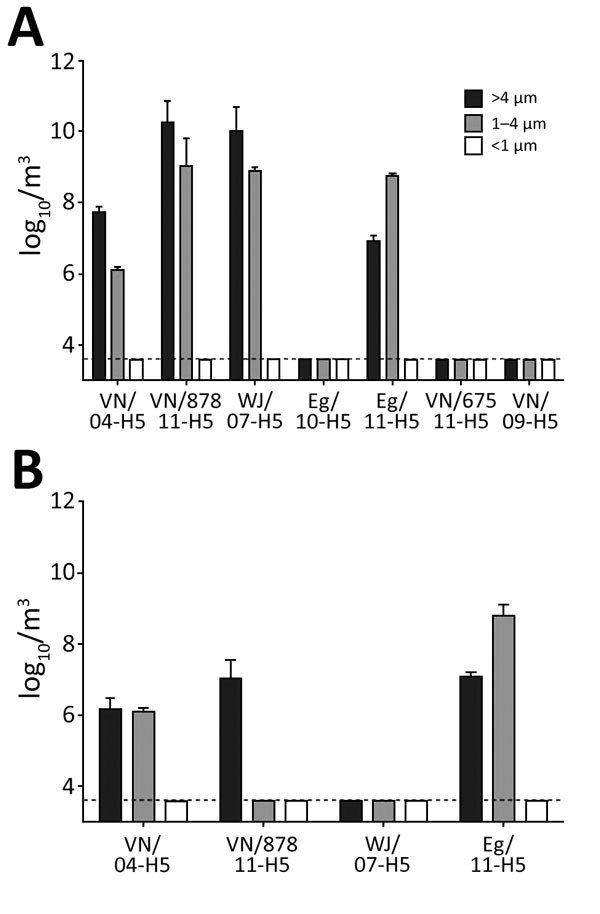
Exposure to infected poultry is a suspected cause of avian influenza (H5N1) virus infections in humans. We detected infectious droplets and aerosols during laboratory-simulated processing of asymptomatic chickens infected with human- (clades 1 and 2.2.1) and avian- (clades 1.1, 2.2, and 2.1) origin H5N1 viruses. We detected fewer airborne infectious particles in simulated processing of infected ducks. Influenza virus-naive chickens and ferrets exposed to the air space in which virus-infected chickens were processed became infected and died, suggesting that the slaughter of infected chickens is an efficient source of airborne virus that can infect birds and mammals. We did not detect consistent infections in ducks and ferrets exposed to the air space in which virus-infected ducks were processed. Our results support the hypothesis that airborne transmission of HPAI viruses can occur among poultry and from poultry to humans during home or live-poultry market slaughter of infected poultry.
接触受感染家禽被怀疑是人类感染甲型禽流感(H5N1)病毒的原因。我们在对感染了人源(1和2.2.1分支)和禽源(1.1、2.2和2.1分支)H5N1病毒的无症状鸡进行实验室模拟处理过程中,检测到了传染性飞沫和气溶胶。在对感染鸭子的模拟处理中,我们检测到的空气传播感染性颗粒较少。暴露于处理过感染鸡的空气空间中的未接触过流感病毒的鸡和雪貂被感染并死亡,这表明宰杀感染鸡是空气传播病毒的一个有效来源,可感染禽类和哺乳动物。我们在暴露于处理过感染鸭子的空气空间中的鸭子和雪貂身上未检测到持续感染。我们的结果支持以下假设:在家庭或活禽市场宰杀感染家禽期间,高致病性禽流感病毒可在家禽之间以及从家禽传播给人类。