Li Peng, Qu Li-Ping, Qi Dong, Shen Bo, Wang Yi-Mei, Xu Jia-Rui, Jiang Wu-Hua, Zhang Hao, Ding Xiao-Qiang, Teng Jie
Department of Nephrology, Yantai Yuhuangding Hospital, Qingdao University, Yantai, Shandong, China.
Department of Obstetrics, Yantai Yuhuangding Hospital, Qingdao University, Yantai, Shandong, China.
BMJ Open. 2017 Oct 22;7(10):e014171. doi: 10.1136/bmjopen-2016-014171.
The purpose of this study was to perform a systematic review and meta-analysis to evaluate the effect of high-dose versus low-dose haemofiltration on the survival of critically ill patients with acute kidney injury (AKI). We hypothesised that high-dose treatments are not associated with a higher risk of mortality.
Meta-analysis.
Randomised controlled trials and two-arm prospective and retrospective studies were included.
Critically ill patients with AKI.
Continuous renal replacement therapy.
Primary outcomes: 90-day mortality, intensive care unit (ICU) mortality, hospital mortality; secondary outcomes: length of ICU and hospital stay.
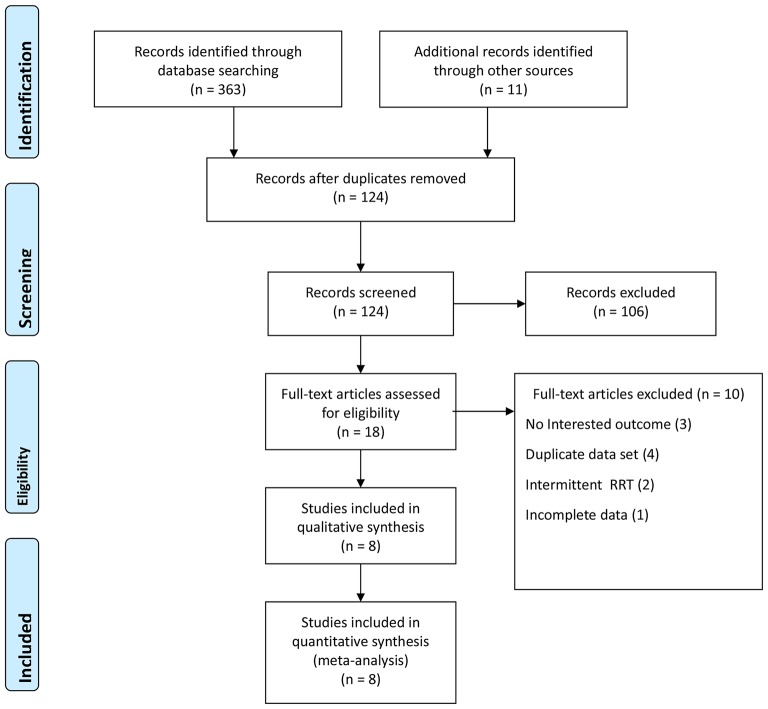
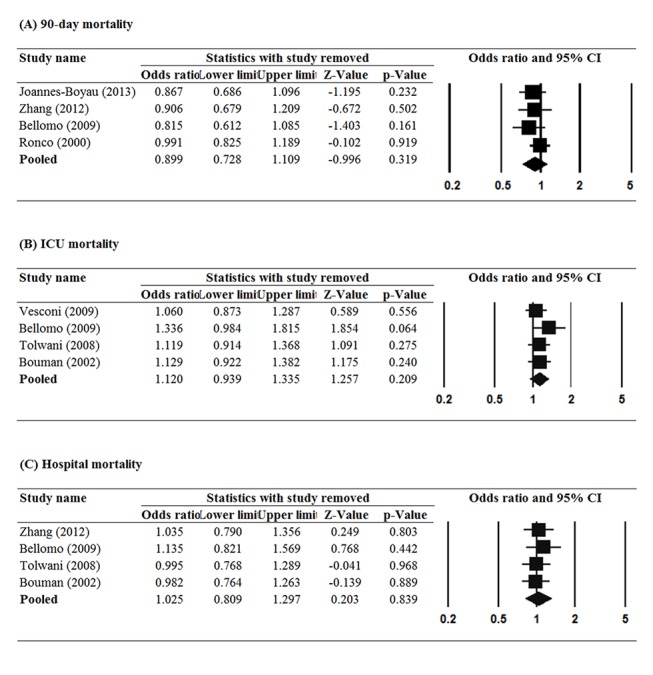
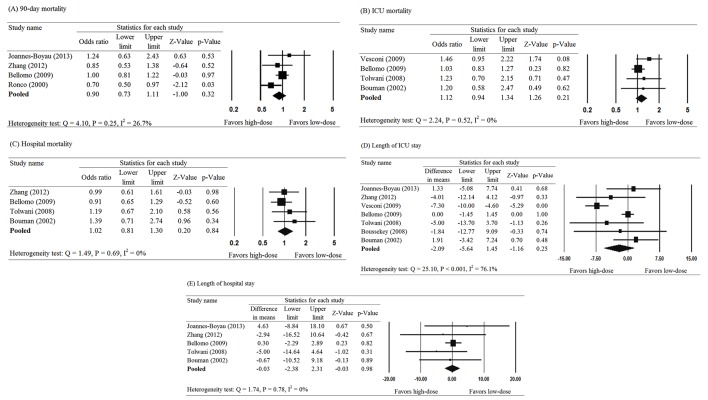
Eight studies including 2970 patients were included in the analysis. Pooled results showed no significant difference in the 90-mortality rate between patients treated with high-dose or low-dose haemofiltration (pooled OR=0.90, 95% CI 0.73 to 1.11, p=0.32). Findings were similar for ICU (pooled OR=1.12, 95% CI 0.94 to 1.34, p=0.21) and hospital mortality (pooled OR=1.03, 95% CI 0.81 to 1.30, p=0.84). Length of ICU and hospital stay were similar between high-dose and low-dose groups. Pooled results are not overly influenced by any one study, different cut-off points of prescribed dose or different cut-off points of delivered dose. Meta-regression analysis indicated that the results were not affected by the percentage of patients with sepsis or septic shock.
High-dose and low-dose haemofiltration produce similar outcomes with respect to mortality and length of ICU and hospital stay in critically ill patients with AKI.This study was not registered at the time the data were collected and analysed. It has since been registered on 17 February 2017 at http://www.researchregistry.com/, registration number: reviewregistry211.
本研究旨在进行一项系统评价和荟萃分析,以评估高剂量与低剂量血液滤过对急性肾损伤(AKI)危重症患者生存的影响。我们假设高剂量治疗与更高的死亡风险无关。
荟萃分析。
纳入随机对照试验以及双臂前瞻性和回顾性研究。
AKI危重症患者。
连续性肾脏替代治疗。
主要结局:90天死亡率、重症监护病房(ICU)死亡率、医院死亡率;次要结局:ICU和医院住院时间。
分析纳入了8项研究,共2970例患者。汇总结果显示,接受高剂量或低剂量血液滤过治疗的患者90天死亡率无显著差异(汇总OR = 0.90,95%CI 0.73至1.11,p = 0.32)。ICU死亡率(汇总OR = 1.12,95%CI 0.94至1.34,p = 0.21)和医院死亡率(汇总OR = 1.03,95%CI 0.81至1.30,p = 0.84)的结果相似。高剂量组和低剂量组的ICU和医院住院时间相似。汇总结果未受到任何一项研究、规定剂量的不同截断点或实际给予剂量的不同截断点的过度影响。Meta回归分析表明,结果不受脓毒症或脓毒性休克患者百分比的影响。
对于AKI危重症患者,高剂量和低剂量血液滤过在死亡率以及ICU和医院住院时间方面产生相似的结果。本研究在收集和分析数据时未进行注册。此后于2017年2月17日在http://www.researchregistry.com/注册,注册号:reviewregistry211。