
基因组挖掘揭示了海洋来源菌株M10的生物合成潜力。
Genome mining reveals the biosynthetic potential of the marine-derived strain M10.
作者信息
Chen Liangyu, Lai Ying-Mi, Yang Yu-Liang, Zhao Xinqing
机构信息
School of Life Science and Biotechnology, Dalian University of Technology, Dalian 116024, China.
Agricultural Biotechnology Research Center, Academia Sinica, Taipei 11529, Taiwan.
出版信息
Synth Syst Biotechnol. 2016 Apr 6;1(1):56-65. doi: 10.1016/j.synbio.2016.02.005. eCollection 2016 Mar.
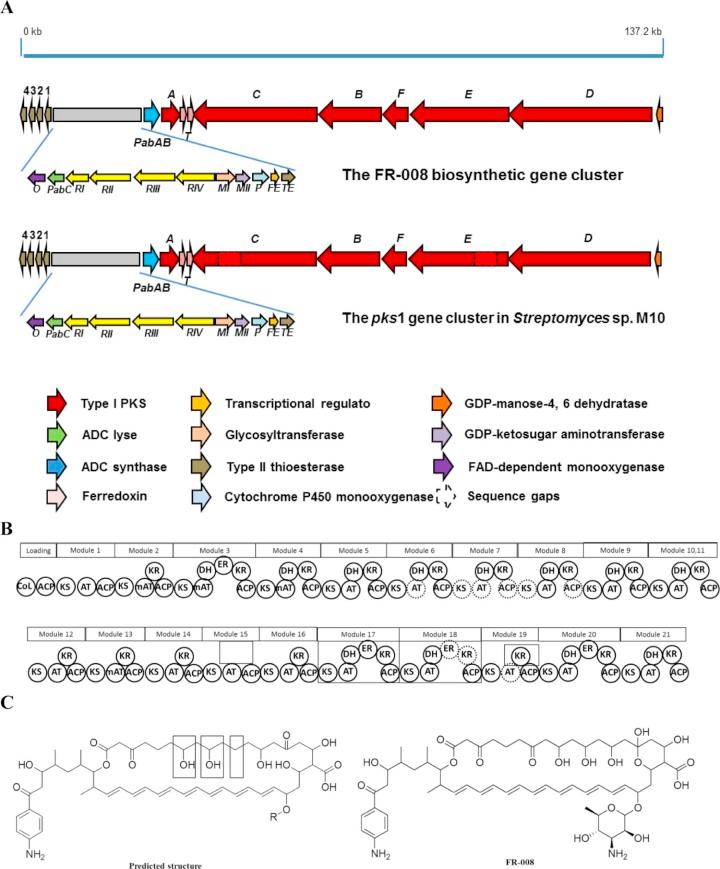
Marine streptomycetes are rich sources of natural products with novel structures and interesting biological activities, and genome mining of marine streptomycetes facilitates rapid discovery of their useful products. In this study, a marine-derived sp. M10 was revealed to share a 99.02% 16S rDNA sequence identity with that of s Ap1, and was thus named s M10. To further evaluate its biosynthetic potential, the 7,207,169 bps of s M10 genome was sequenced. Genomic sequence analysis for potential secondary metabolite-associated gene clusters led to the identification of at least three polyketide synthases (PKSs), six non-ribosomal peptide synthases (NRPSs), one hybrid NRPS-PKS, two lantibiotic and five terpene biosynthetic gene clusters. One type I PKS gene cluster was revealed to share high nucleotide similarity with the candicidin/FR008 gene cluster, indicating the capacity of this microorganism to produce polyene macrolides. This assumption was further verified by isolation of two polyene family compounds PF1 and PF2, which have the characteristic UV adsorption at 269, 278, 290 nm (PF1) and 363, 386 and 408 nm (PF2), respectively. s M10 is therefore a new source of polyene metabolites. Further studies on s M10 will provide more insights into natural product biosynthesis potential of related streptomycetes. This is also the first report to describe the genome sequence of s-related strain.
海洋链霉菌是具有新颖结构和有趣生物活性的天然产物的丰富来源,对海洋链霉菌进行基因组挖掘有助于快速发现其有用产物。在本研究中,一株海洋来源的菌株M10被发现与链霉菌Ap1的16S rDNA序列同一性为99.02%,因此被命名为链霉菌M10。为了进一步评估其生物合成潜力,对链霉菌M10的7,207,169 bp基因组进行了测序。对潜在的次级代谢产物相关基因簇进行基因组序列分析,鉴定出至少三个聚酮合酶(PKS)、六个非核糖体肽合成酶(NRPS)、一个杂合NRPS-PKS、两个羊毛硫抗生素和五个萜类生物合成基因簇。一个I型PKS基因簇被发现与杀假丝菌素/FR008基因簇具有高度核苷酸相似性,表明该微生物具有产生多烯大环内酯类化合物的能力。通过分离出两种多烯家族化合物PF1和PF2进一步验证了这一假设,它们分别在269、278、290 nm(PF1)和363、386和408 nm(PF2)处具有特征性紫外吸收。因此,链霉菌M10是多烯代谢产物的新来源。对链霉菌M10的进一步研究将为相关链霉菌的天然产物生物合成潜力提供更多见解。这也是第一篇描述与链霉菌相关菌株基因组序列的报告。




 Zotero 插件