Jia Xiaoqiang, Liu Chang, Song Hao, Ding Mingzhu, Du Jin, Ma Qian, Yuan Yingjin
Key Laboratory of Systems Bioengineering, Ministry of Education, School of Chemical Engineering and Technology, Collaborative Innovation Centre of Chemical Science and Engineering (Tianjin), Tianjin University, Tianjin 300072, China.
Synth Syst Biotechnol. 2016 May 2;1(2):109-117. doi: 10.1016/j.synbio.2016.02.001. eCollection 2016 Jun.
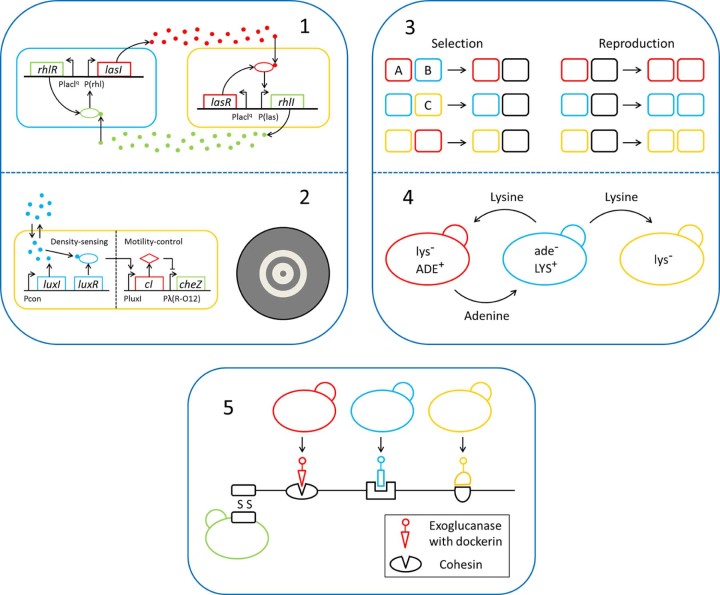
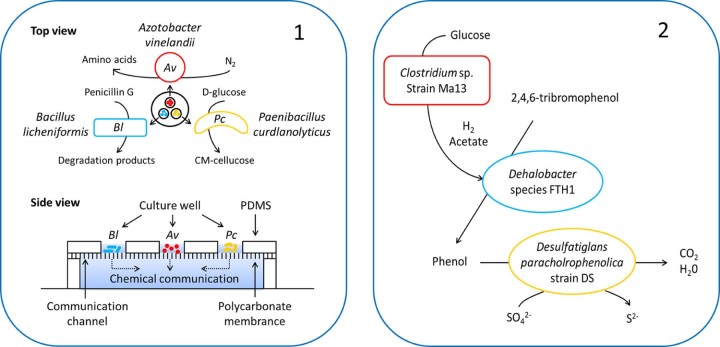
The rapid development of synthetic biology has conferred almost perfect modification on single cells, and provided methodological support for synthesizing microbial consortia, which have a much wider application potential than synthetic single cells. Co-cultivating multiple cell populations with rational strategies based on interacting relationships within natural microbial consortia provides theoretical as well as experimental support for the successful obtaining of synthetic microbial consortia, promoting it into extensive research on both industrial applications in plenty of areas and also better understanding of natural microbial consortia. According to their composition complexity, synthetic microbial consortia are summarized in three aspects in this review and are discussed in principles of design and construction, insights and methods for analysis, and applications in energy, healthcare, etc.
合成生物学的迅速发展已实现了对单细胞近乎完美的改造,并为合成微生物群落的构建提供了方法学支持,而合成微生物群落比合成单细胞具有更广泛的应用潜力。基于自然微生物群落内部相互作用关系,采用合理策略共同培养多个细胞群体,为成功获得合成微生物群落提供了理论和实验支持,推动其在众多领域的工业应用及对自然微生物群落的深入理解等方面展开广泛研究。根据其组成复杂性,本综述从三个方面对合成微生物群落进行了总结,并在设计与构建原理、分析思路与方法以及在能源、医疗保健等方面的应用进行了讨论。