Yoon Jin Gu, Choi Min Joo, Yoon Jae Won, Noh Ji Yun, Song Joon Young, Cheong Hee Jin, Kim Woo Joo
Division of Infectious Diseases, Department of Internal Medicine, Korea University College of Medicine, Seoul, Korea.
PLoS One. 2017 Oct 24;12(10):e0186257. doi: 10.1371/journal.pone.0186257. eCollection 2017.
Adult seroprevalence of HAV is decreasing in developed countries including South Korea, due to general sanitation improvement. Although hepatitis A vaccination was introduced in South Korea more than 20 years ago, recent infection rates have not decreased. In this study, we investigate the seroprevalence of anti-HAV IgG, and estimate the national disease burden of acute hepatitis A in adult population.
Seroprevalence data were collected from health promotion center of Korea University Guro Hospital, in Seoul, Korea from 2010 to 2014. Data from adults (≥20-years) being tested for anti-HAV IgG were included. In addition, epidemiological and clinical data of patients diagnosed with acute hepatitis A from 2009 to 2013, were collected from Korean Statistical Information Service (KOSIS) and the National Health Insurance Service (NHIS) database. Data were stratified and compared by age groups.
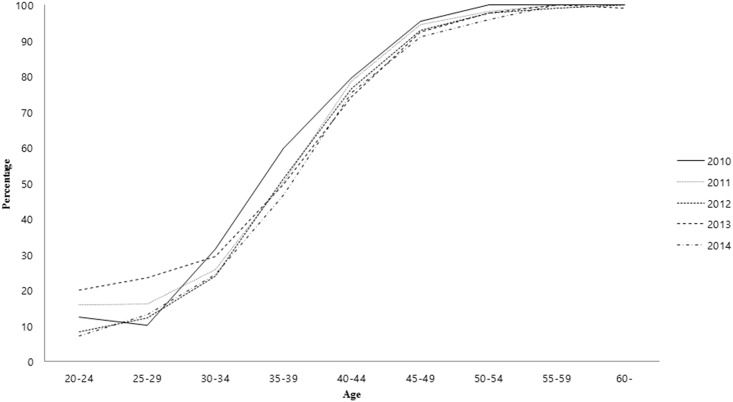
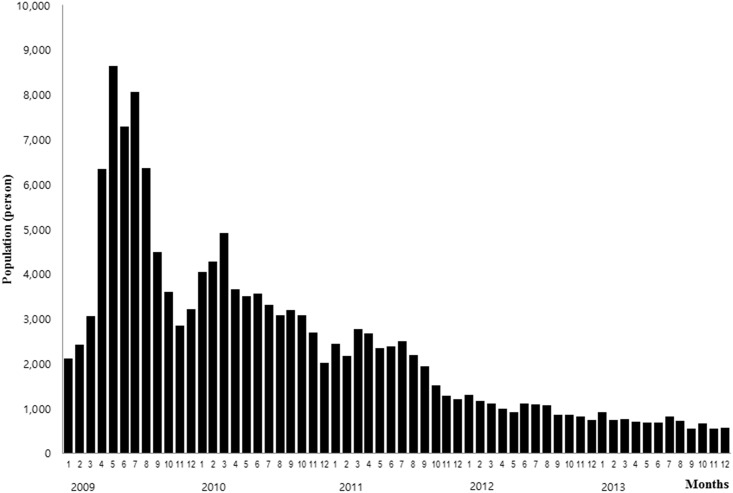
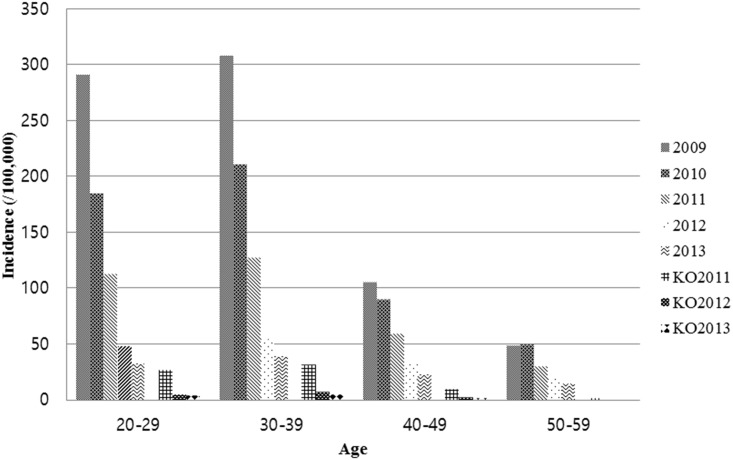
A total of 11,177 subjects were tested for anti-HAV IgG from 2010 to 2014. Age-related seroprevalence showed relatively low seropositivity in young adults. Incidence of acute hepatitis A was highest in 2009 and lowest in 2013. When categorized by age group, adults in their 20s and 30s had more HAV infections and related-admissions than older adults. However, ICU admission rate and average insurance-covered cost was high in older adults.
The anti-HAV IgG seropositivity in Korean younger adult population was low while the incidence of acute hepatitis A was high, especially in the 20-39 aged. However, a substantial number of older adults were infected, and required more intensive procedures and incurred higher insurance-covered medical costs.
由于总体卫生条件的改善,在包括韩国在内的发达国家,甲型肝炎(HAV)的成人血清阳性率正在下降。尽管韩国在20多年前就引入了甲型肝炎疫苗接种,但近期的感染率并未下降。在本研究中,我们调查了抗-HAV IgG的血清阳性率,并估计了成年人群中急性甲型肝炎的全国疾病负担。
血清阳性率数据收集自韩国首尔高丽大学九老医院健康促进中心2010年至2014年的数据。纳入检测抗-HAV IgG的成年人(≥20岁)的数据。此外,2009年至2013年诊断为急性甲型肝炎患者的流行病学和临床数据,从韩国统计信息服务(KOSIS)和国民健康保险服务(NHIS)数据库中收集。数据按年龄组进行分层和比较。
2010年至2014年共有11177名受试者检测了抗-HAV IgG。年龄相关的血清阳性率在年轻人中显示出相对较低的血清阳性。急性甲型肝炎的发病率在2009年最高,2013年最低。按年龄组分类时,20多岁和30多岁的成年人比老年人有更多的HAV感染和相关入院。然而,老年人的重症监护病房入院率和平均保险覆盖费用较高。
韩国年轻成年人群中的抗-HAV IgG血清阳性率较低,而急性甲型肝炎的发病率较高,尤其是在20-39岁年龄段。然而,相当数量的老年人被感染,并需要更强化的治疗程序,且产生了更高的保险覆盖医疗费用。