Yang Wei, Li Yun, Tian Tian, Wang Li, Lee Pearl, Hua Qi
Department of Geriatric Medicine, Capital Medical University, Xuan Wu Hospital, Beijing, 100053, China.
Department of Endocrine, Capital Medical University, Xuan Wu Hospital, Beijing, 100053, China.
BMC Endocr Disord. 2017 Oct 24;17(1):67. doi: 10.1186/s12902-017-0216-0.
Adipose tissue, an endocrine organ of the body, is involved in some obesity-related disease states such as insulin resistance, diabetes mellitus, and atherosclerosis. Vaspin is a novel adipocyte with insulin sensitizing effects. In this study, we planned to estimate serum vaspin concentrations as related to glycemic status and the presence of macrovascular complications among elderly patients with type-2 diabetes mellitus (T2DM).
A total of 230 elderly patients with T2DM were evaluated. These patients were divided into two groups: patients without complications (T2DM group, n = 110), and patients with macrovascular complications (T2DM + MC group, n = 120). In addition, 60 healthy elderly subjects were enrolled and assigned into the control group (NC group). Relevant parameters were matched for age and gender ratio. Serum vaspin concentrations were measured by Enzyme-linked immunosorbent assay (ELISA). Anthropometric measurements, plasma glucose and HbA levels, insulin concentration, liver and kidney functions, and lipid profile were measured for each participant.
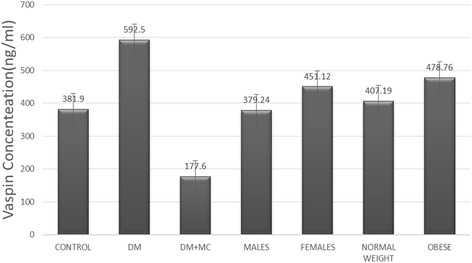
Serum vaspin concentrations were significantly higher in the T2DM group than in the T2DM + MC group (F = 13.122, P < 0.01). These concentrations were also significantly higher among females, compared to males (T = 3.567, P < 0.05). Logistic regression analysis revealed that serum vaspin concentration, systolic blood pressure, HDL-C and T2DM duration were independent influencing factors for diabetic macrovascular complications.
Serum vaspin may be considered as a potential marker to assess the status of elderly patients with T2DM and the risk of developing serious macrovascular complications. Further prospective studies are warranted.
ChiCTR-OPC-14005698 , retrospectively registered on 20 Dec. 2014.
脂肪组织作为人体的一个内分泌器官,参与了一些与肥胖相关的疾病状态,如胰岛素抵抗、糖尿病和动脉粥样硬化。内脏脂肪素是一种具有胰岛素增敏作用的新型脂肪细胞因子。在本研究中,我们计划评估老年2型糖尿病(T2DM)患者血清内脏脂肪素浓度与血糖状态及大血管并发症的关系。
共评估了230例老年T2DM患者。这些患者被分为两组:无并发症患者(T2DM组,n = 110)和有大血管并发症患者(T2DM + MC组,n = 120)。此外,纳入60例健康老年受试者并分为对照组(NC组)。对年龄和性别比例进行了相关参数匹配。采用酶联免疫吸附测定(ELISA)法检测血清内脏脂肪素浓度。对每位参与者进行人体测量、血浆葡萄糖和糖化血红蛋白水平、胰岛素浓度、肝肾功能及血脂谱检测。
T2DM组血清内脏脂肪素浓度显著高于T2DM + MC组(F = 13.122,P < 0.01)。女性的这些浓度也显著高于男性(T = 3.567,P < 0.05)。逻辑回归分析显示,血清内脏脂肪素浓度、收缩压、高密度脂蛋白胆固醇(HDL-C)和T2DM病程是糖尿病大血管并发症的独立影响因素。
血清内脏脂肪素可被视为评估老年T2DM患者病情及发生严重大血管并发症风险的潜在标志物。有必要进行进一步的前瞻性研究。
ChiCTR - OPC - 14005698,于2014年12月20日进行回顾性注册。