Molecular, Cellular, and Developmental Biology Department, University of California, Santa Barbara, CA, USA.
BMC Biol. 2017 Oct 24;15(1):92. doi: 10.1186/s12915-017-0441-z.
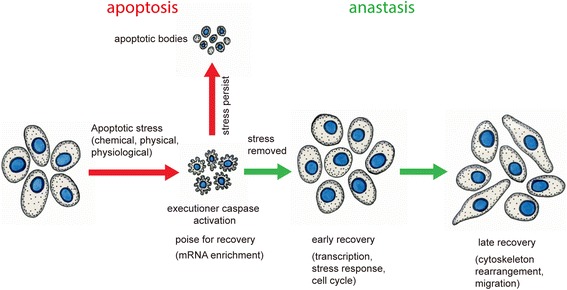
Apoptosis is a form of programmed cell death that is carried out by proteolytic enzymes called caspases. Executioner caspase activity causes cells to shrink, bleb, and disintegrate into apoptotic bodies and has been considered a point of no return for apoptotic cells. However, relatively recent work has shown that cells can survive transient apoptotic stimuli, even after executioner caspase activation. This process is called anastasis. In this Q&A, we answer common questions that arise regarding anastasis, including how it is defined, the origin of the name, the potential physiological consequences, molecular mechanisms, and open questions for this new field of study.
细胞凋亡是一种由称为半胱天冬酶的蛋白水解酶执行的程序性细胞死亡形式。执行者半胱天冬酶的活性导致细胞收缩、起泡,并分解成凋亡小体,被认为是细胞凋亡的不可逆转点。然而,最近的研究表明,细胞可以在短暂的凋亡刺激下存活,即使在执行者半胱天冬酶激活后也是如此。这个过程被称为复苏。在这个问答中,我们回答了关于复苏的常见问题,包括它是如何定义的、名字的由来、可能的生理后果、分子机制以及这个新研究领域的悬而未决的问题。