Zhang Hao, Tao Yanling, Ren Saisai, Liu Haihui, Zhou Hui, Hu Jiangwei, Tang Yongyong, Zhang Bin, Chen Hu
Department of Hematopoietic Stem Cell Transplantation, Affiliated Hospital of Academy of Military Medical Sciences, Beijing 100071, P.R. China.
Department of Hematology, Affiliated Hospital of Jining Medical University, Jining, Shandong 272000, P.R. China.
Exp Ther Med. 2017 Nov;14(5):4160-4166. doi: 10.3892/etm.2017.5035. Epub 2017 Aug 25.
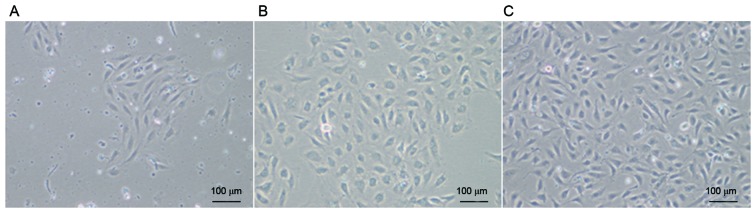
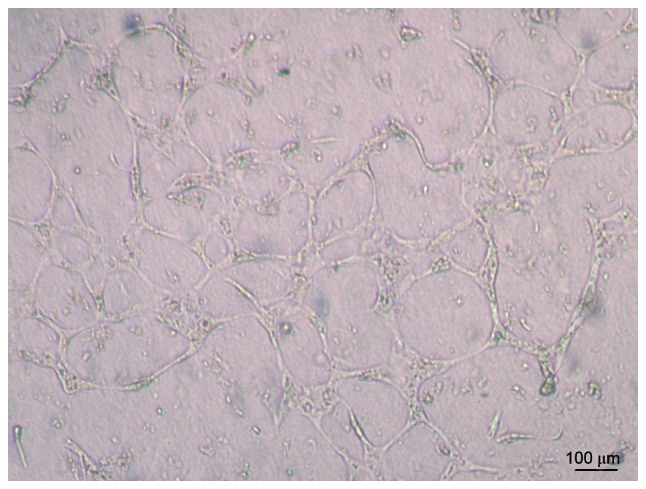
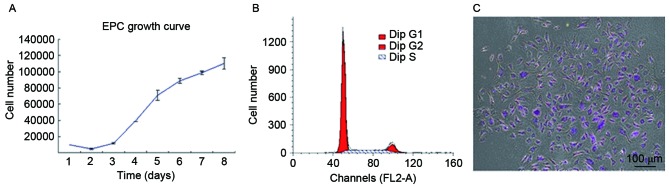
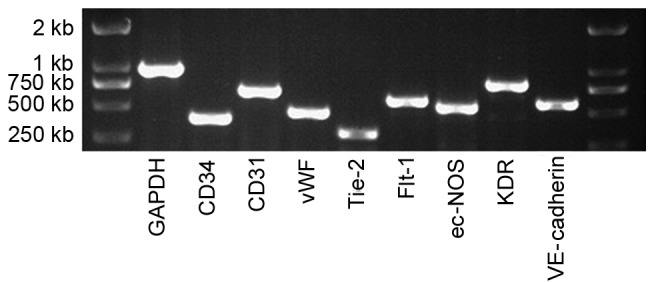
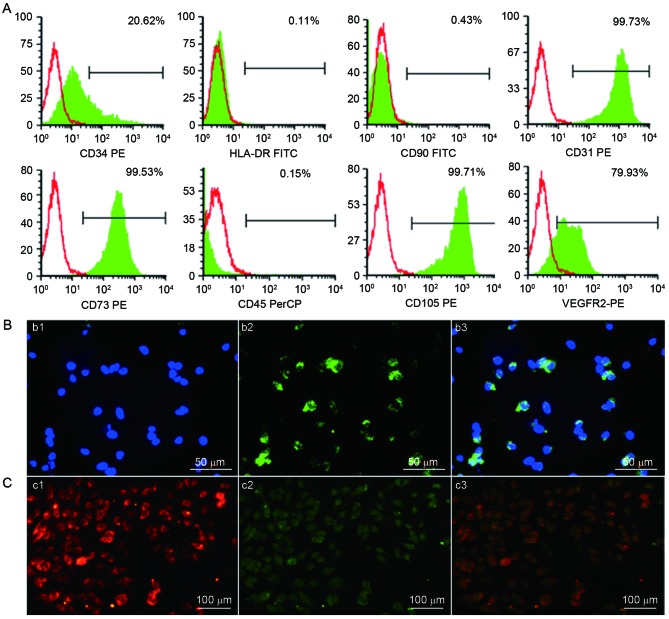
Endothelial colony-forming cells (ECFCs) are a population of endothelial progenitor cells (EPCs) that display robust proliferative potential and vessel-forming capability. Previous studies have demonstrated that a limited number of ECFCs may be obtained from adult bone marrow, peripheral blood and umbilical cord (UC) blood. The present study describes an effective method for isolating ECFCs from human UC. The ECFCs derived from human UC displayed the full properties of EPCs. Analysis of the growth kinetics, cell cycle and colony-forming ability of the isolated human UC-ECFCs indicated that the cells demonstrated properties of stem cells, including relative stability and rapid proliferation . Gene expression of Fms related tyrosine kinase 1, kinase insert domain receptor, vascular endothelial cadherin, cluster of differentiation , , epidermal growth factor homology domains-2, von Willebrand factor and endothelial nitric oxide synthase was assessed by reverse transcription-polymerase chain reaction. The cells were positive for and vascular endothelial growth factor receptor-2, and negative for and human leukocyte antigen-antigen D related protein according to flow cytometry. 1,1'-dioctadecyl-3,3,3',3'-tetra-methyl-indocarbocyanine perchlorate-labeled acetylated low-density lipoprotein and fluorescein isothiocyanate--l were used to verify the identity of the UC-ECFCs. Matrigel was used to investigate tube formation capability. The results demonstrated that the reported technique is a valuable method for isolating human UC-ECFCs, which have potential for use in vascular regeneration.
内皮祖细胞集落形成细胞(ECFCs)是一群内皮祖细胞(EPCs),具有强大的增殖潜能和血管形成能力。先前的研究表明,可从成人骨髓、外周血和脐带血中获取数量有限的ECFCs。本研究描述了一种从人脐带中分离ECFCs的有效方法。源自人脐带的ECFCs展现出EPCs的全部特性。对分离出的人脐带ECFCs的生长动力学、细胞周期和集落形成能力的分析表明,这些细胞具有干细胞特性,包括相对稳定性和快速增殖能力。通过逆转录聚合酶链反应评估Fms相关酪氨酸激酶1、激酶插入结构域受体、血管内皮钙黏蛋白、分化簇、表皮生长因子同源结构域-2、血管性血友病因子和内皮型一氧化氮合酶的基因表达。根据流式细胞术,这些细胞血管内皮生长因子受体-2呈阳性,而和人类白细胞抗原-D相关蛋白呈阴性。使用1,1'-二辛基-3,3,3',3'-四甲基吲哚羰花青高氯酸盐标记的乙酰化低密度脂蛋白和异硫氰酸荧光素-来验证脐带ECFCs的特性。使用基质胶研究血管生成能力。结果表明,所报道的技术是分离人脐带ECFCs的一种有价值的方法,这些细胞具有用于血管再生的潜力。