Rui Qing, Jiang Yufeng, Chen Min, Zhang Nannan, Yang Huajia, Zhou Yafeng
Department of Cardiology, the First Affiliated Hospital of Soochow University, Suzhou City, Jiangsu Province, P.R. China.
Medicine (Baltimore). 2017 Oct;96(43):e8402. doi: 10.1097/MD.0000000000008402.
Guidelines recommend that norepinephrine (NA) should be used to reach the target mean arterial pressure (MAP) during cardiogenic shock (CS), rather than epinephrine and dopamine (DA). However, there has actually been few studies on comparing norepinephrine with dopamine and their results conflicts. These studies raise a heat discussion. This study aimed to validate the effectiveness of norepinephrine for treating CS in comparison with dopamine.
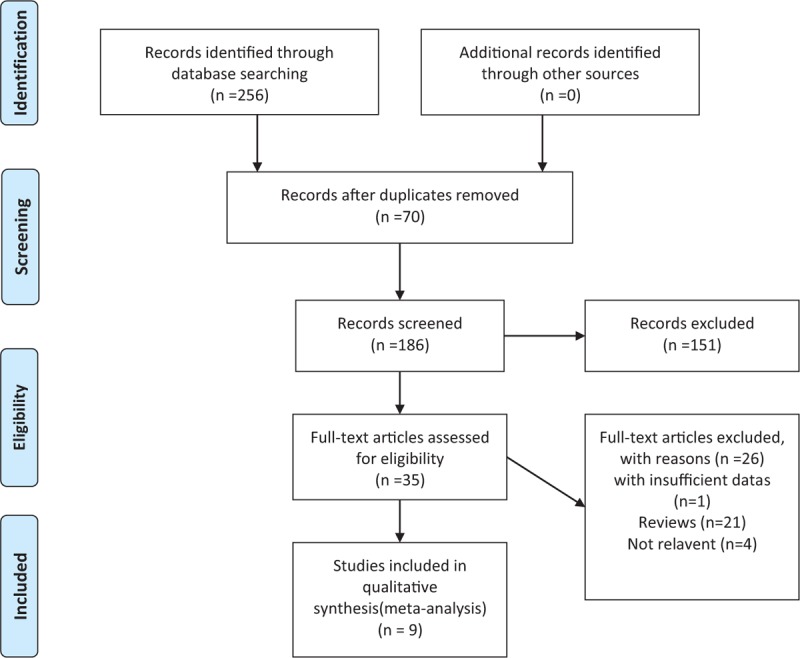
We performed a meta-analysis of randomized controlled trials (RCTs) to assess pooled estimates of risk ratio (RR) and 95% confidence interval (CI) for 28-day mortality, incidence of arrhythmic events, gastrointestinal reaction, and some indexes after treatment.
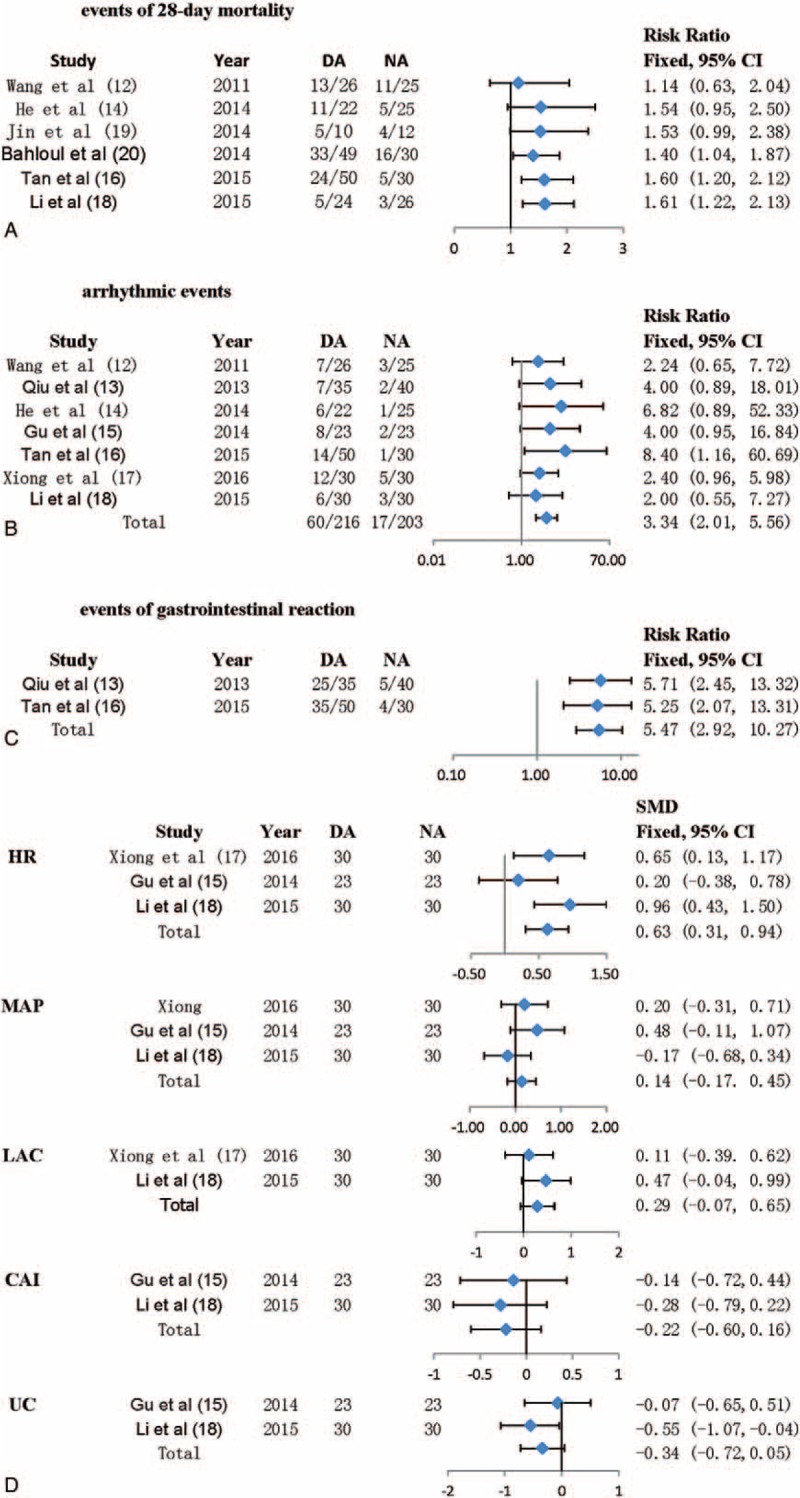
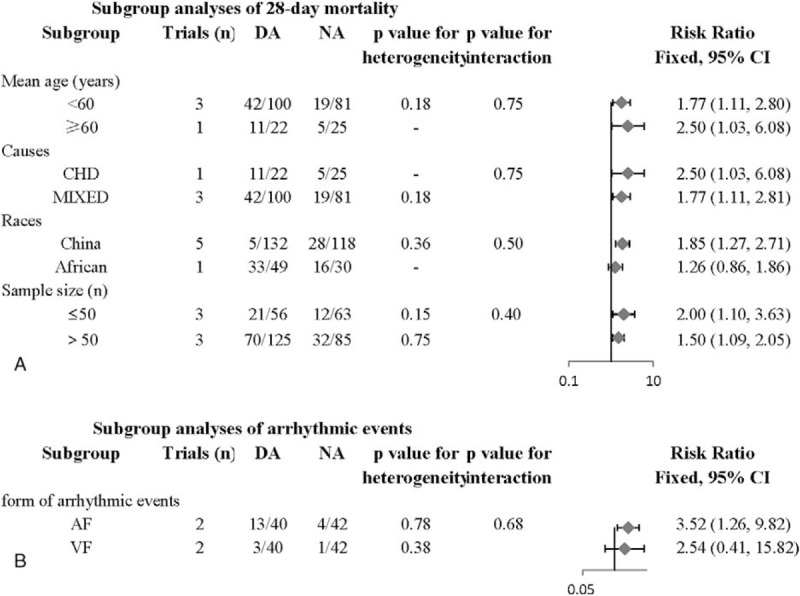
Compared with dopamine, patients receiving norepinephrine had a lower 28-day mortality (RR 1.611 [95% CI 1.219-2.129]; P < .001; P heterogeneity = .01), a lower risk of arrhythmic events (RR 3.426 [95% CI 2.120-5.510]; P < .001; P heterogeneity = .875) and a lower risk of gastrointestinal reaction (RR 5.474 [95% CI 2.917-10.273]; P < .001; P heterogeneity = 0). In subgroup analyses on 28-day mortality by causes of CS, there were more benefits from norepinephrine than dopamine in 2 subgroups.
Our analysis revealed that norepinephrine was associated with a lower 28-day mortality, a lower risk of arrhythmic events, and gastrointestinal reaction. No matter whether CS is caused by coronary heart disease or not, norepinephrine is superior to dopamine for correcting CS on the 28-day mortality.
指南建议在心源性休克(CS)期间应使用去甲肾上腺素(NA)来达到目标平均动脉压(MAP),而非肾上腺素和多巴胺(DA)。然而,实际上很少有关于比较去甲肾上腺素与多巴胺的研究,且研究结果相互矛盾。这些研究引发了热烈讨论。本研究旨在验证与多巴胺相比,去甲肾上腺素治疗CS的有效性。
我们对随机对照试验(RCT)进行了荟萃分析,以评估28天死亡率、心律失常事件发生率、胃肠道反应以及治疗后一些指标的风险比(RR)和95%置信区间(CI)的合并估计值。
与多巴胺相比,接受去甲肾上腺素治疗的患者28天死亡率更低(RR 1.611 [95% CI 1.219 - 2.129];P <.001;P异质性 =.01),心律失常事件风险更低(RR 3.426 [95% CI 2.120 - 5.510];P <.001;P异质性 =.875),胃肠道反应风险更低(RR 5.474 [95% CI 2.917 - 10.273];P <.001;P异质性 = 0)。在按CS病因进行的28天死亡率亚组分析中,有2个亚组中去甲肾上腺素比多巴胺更有益。
我们的分析表明,去甲肾上腺素与更低的28天死亡率、更低的心律失常事件风险和胃肠道反应相关。无论CS是否由冠心病引起 在28天死亡率方面,去甲肾上腺素在纠正CS方面优于多巴胺。