Silva R, Damasceno M, Cruz R, Silva-Cavalcante M D, Lima-Silva A E, Bishop D J, Bertuzzi R
Grupo de Estudos do Desempenho Aeróbio (GEADE-USP), Departamento de Esportes Escola de Educação Física e Esportes, Universidade de São Paulo, São Paulo, Brasil.
Grupo de Pesquisa em Ciência do Esporte, Faculdade de Nutrição, Universidade Federal de Pernambuco, Pernambuco, Brasil.
Braz J Med Biol Res. 2017 Oct 19;50(12):e6335. doi: 10.1590/1414-431X20176335.
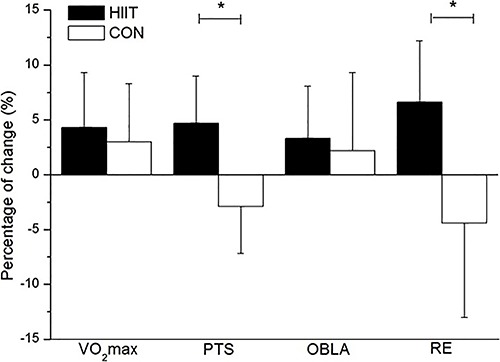
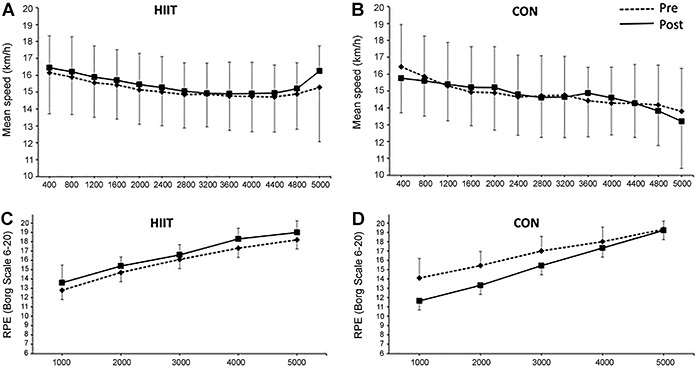
This study analyzed the influence of a 4-week high-intensity interval training on the pacing strategy adopted by runners during a 5-km running trial. Sixteen male recreational long-distance runners were randomly assigned to a control group (CON, n=8) or a high-intensity interval training group (HIIT, n=8). The HIIT group performed high-intensity interval-training twice per week, while the CON group maintained their regular training program. Before and after the training period, the runners performed an incremental exercise test to exhaustion to measure the onset of blood lactate accumulation, maximal oxygen uptake (VO2max), and peak treadmill speed (PTS). A submaximal constant-speed test to measure the running economy (RE) and a 5-km running trial on an outdoor track to establish pacing strategy and performance were also done. During the 5-km running trial, the rating of perceived exertion (RPE) and time to cover the 5-km trial (T5) were registered. After the training period, there were significant improvements in the HIIT group of ∼7 and 5% for RE (P=0.012) and PTS (P=0.019), respectively. There was no significant difference between the groups for VO2max (P=0.495) or onset of blood lactate accumulation (P=0.101). No difference was found in the parameters measured during the 5-km trial before the training period between HIIT and CON (P>0.05). These findings suggest that 4 weeks of HIIT can improve some traditional physiological variables related to endurance performance (RE and PTS), but it does not alter the perception of effort, pacing strategy, or overall performance during a 5-km running trial.
本研究分析了为期4周的高强度间歇训练对跑步者在5公里跑步试验中采用的配速策略的影响。16名男性业余长跑运动员被随机分为对照组(CON,n = 8)或高强度间歇训练组(HIIT,n = 8)。HIIT组每周进行两次高强度间歇训练,而CON组维持其常规训练计划。在训练期前后,跑步者进行递增运动测试直至力竭,以测量血乳酸积累起始点、最大摄氧量(VO2max)和跑步机峰值速度(PTS)。还进行了次最大恒定速度测试以测量跑步经济性(RE),并在室外跑道上进行了5公里跑步试验以确定配速策略和成绩。在5公里跑步试验期间,记录了主观用力程度分级(RPE)和完成5公里试验的时间(T5)。训练期后,HIIT组的RE(P = 0.012)和PTS(P = 0.019)分别有显著改善,提高了约7%和5%。两组在VO2max(P = 0.495)或血乳酸积累起始点(P = 0.101)方面无显著差异。训练期前,HIIT组和CON组在5公里试验期间测量的参数无差异(P>0.05)。这些结果表明,4周的HIIT可改善一些与耐力表现相关的传统生理变量(RE和PTS),但在5公里跑步试验中不会改变用力感知、配速策略或整体表现。