Wang Lei, Huang Fengchun, Cai Gaozhe, Yao Lan, Zhang Huilin, Lin Jianhan
Key Laboratory of Agricultural Information Acquisition Technology, Ministry of Agriculture, China Agricultural University, 17 East Qinghua Road, Beijing, 100083 China.
Key Laboratory on Modern Precision Agriculture System Integration Research, Ministry of Education, China Agricultural University, 17 East Qinghua Road, Beijing, 100083 China.
Nanotheranostics. 2017 Oct 9;1(4):403-414. doi: 10.7150/ntno.22079. eCollection 2017.
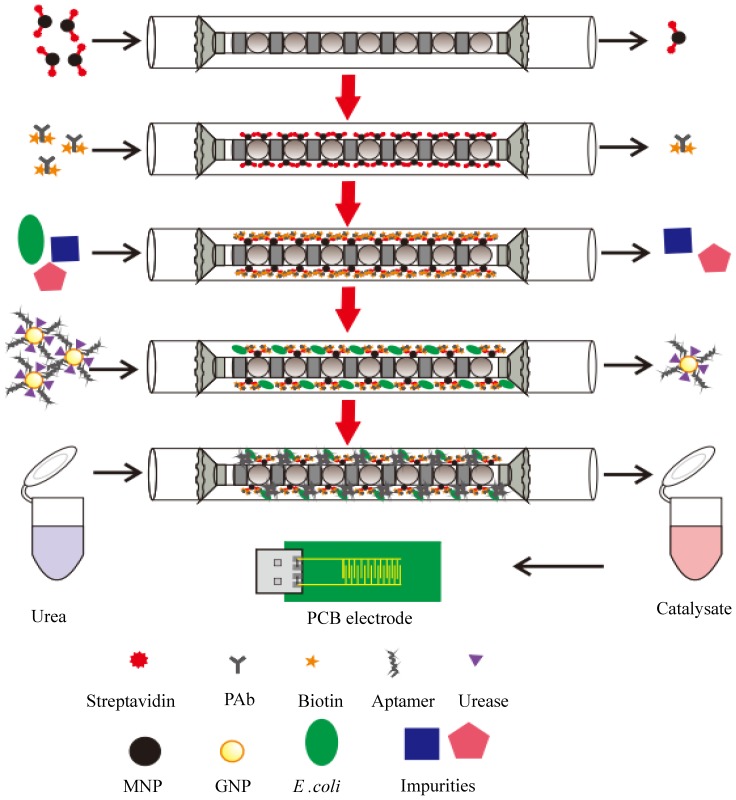
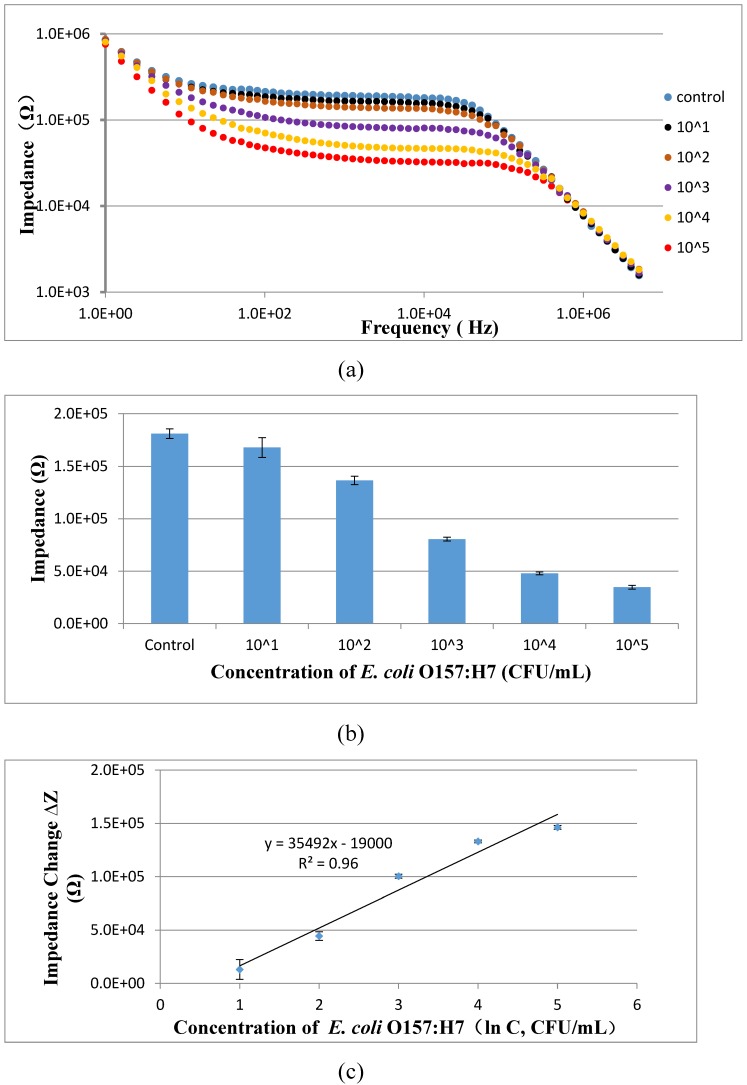
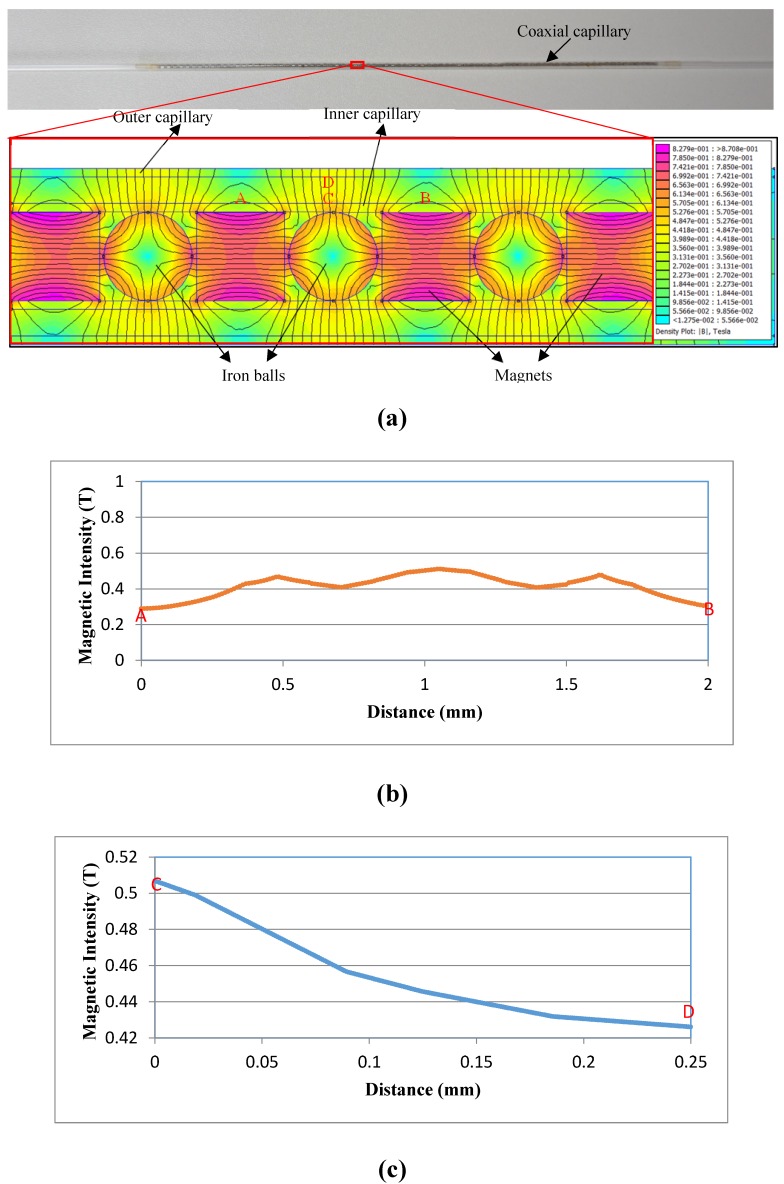
The continuous outbreaks of foodborne diseases have drawn public attentions to food safety. Early screening of foodborne pathogens is crucial to prevent and control of foodborne diseases. In this study, a novel electrochemical aptasensor was developed for rapid and sensitive detection of O157:H7 using the coaxial capillary with immune magnetic nanoparticles (MNPs) for specific separation of the target bacteria, the urease with urea for amplification of the impedance signals, and the PCB gold electrode for measurement of the impedance change. The streptavidin modified MNPs were conjugated with the biotinylated polyclonal antibodies (PAbs) to form the immune MNPs, and captured in the coaxial capillary with the line-up high gradient magnetic fields to separate the bacteria from the large volume of sample. Then, the gold nanoparticles (GNPs) were modified with the aptamers against and the urease, and injected into the capillary to react with the bacteria and form the MNP-PAb-bacteria-aptamer-GNP-urease complexes. Finally, the urease on the complexes was used to catalyze the hydrolysis of urea into ammonium ions and carbonate ions in the capillary, leading to the decrease in the impedance of the catalysate, which was measured by the gold plating PCB electrode. The impedance change of the catalysate and the concentration of the bacteria had a good linear relationship. This aptasensor was able to detect as low as 10 CFU/mL in 3 h, and the mean recovery of in the spiked pasteurized milk was ~99%. This proposed aptasensor has the potential for practical applications of foodborne pathogen detection due to its short detection time, high sensitivity and low cost.
食源性疾病的持续爆发引起了公众对食品安全的关注。食源性病原体的早期筛查对于预防和控制食源性疾病至关重要。在本研究中,开发了一种新型电化学适体传感器,用于快速灵敏地检测O157:H7,该传感器使用同轴毛细管与免疫磁性纳米颗粒(MNPs)特异性分离目标细菌,利用脲酶和尿素放大阻抗信号,并使用印刷电路板金电极测量阻抗变化。链霉亲和素修饰的MNPs与生物素化的多克隆抗体(PAbs)结合形成免疫MNPs,并在同轴毛细管中利用排列的高梯度磁场捕获,以从大量样品中分离细菌。然后,用抗O157:H7的适体和脲酶修饰金纳米颗粒(GNPs),并注入毛细管中与细菌反应,形成MNP-PAb-细菌-适体-GNP-脲酶复合物。最后,复合物上的脲酶用于催化毛细管中尿素水解为铵离子和碳酸根离子,导致催化产物的阻抗降低,通过镀金印刷电路板电极测量。催化产物的阻抗变化与细菌浓度具有良好的线性关系。这种适体传感器能够在3小时内检测低至10 CFU/mL的O157:H7,在加标的巴氏杀菌牛奶中的平均回收率约为99%。由于其检测时间短、灵敏度高和成本低,这种提出的适体传感器具有用于食源性病原体检测实际应用的潜力。