Nam Beomwoo, Bae Sujin, Kim Sun Mi, Hong Ji Seon, Han Doug Hyun
Department of Psychiatry, Konkuk University School of Medicine, Chungju, Korea.
Industry Academic Cooperation Foundation, Chung-Ang University, Seoul, Korea.
Clin Psychopharmacol Neurosci. 2017 Nov 30;15(4):361-368. doi: 10.9758/cpn.2017.15.4.361.
Several studies have suggested the efficacy of bupropion and escitalopram on reducing the excessive internet game play. We hypothesized that both bupropion and escitalopram would be effective on reducing the severity of depressive symptoms and internet gaming disorder (IGD) symptoms in patients with both major depressive disorder and IGD. However, the changes in brain connectivity between the default mode network (DMN) and the salience network were different between bupropion and escitalopram due to their different pharmacodynamics.
This study was designed as a 12-week double blind prospective trial. Thirty patients were recruited for this research (15 bupropion group+15 escitalopram group). To assess the differential functional connectivity (FC) between the hubs of the DMN and the salience network, we selected 12 regions from the automated anatomical labeling in PickAtals software.
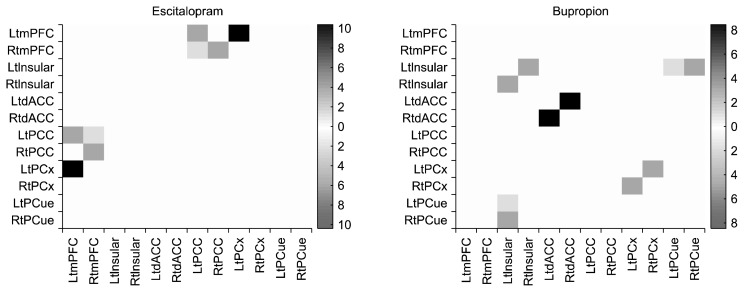
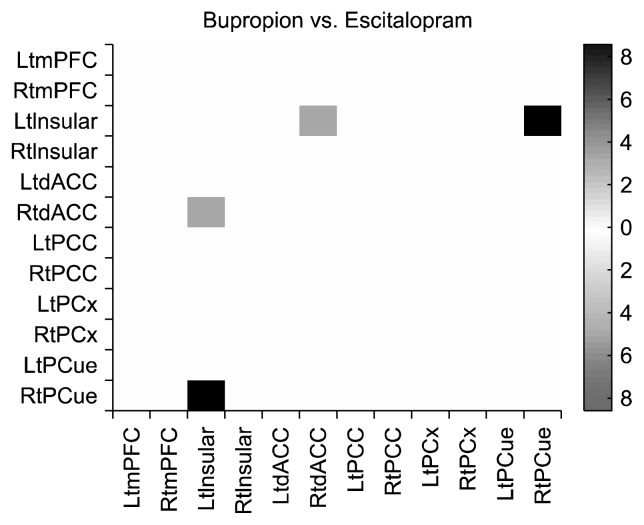
After drug treatment, the depressive symptoms and IGD symptoms in both groups were improved. Impulsivity and attentional symptoms in the bupropion group were significantly decreased, compared to the escitalopram group. After treatment, FC within only the DMN in escitalopram decreased while FC between DMN and salience network in bupropion group decreased. Bupropion was associated with significantly decreased FC within the salience network and between the salience network and the DMN, compared to escitalopram.
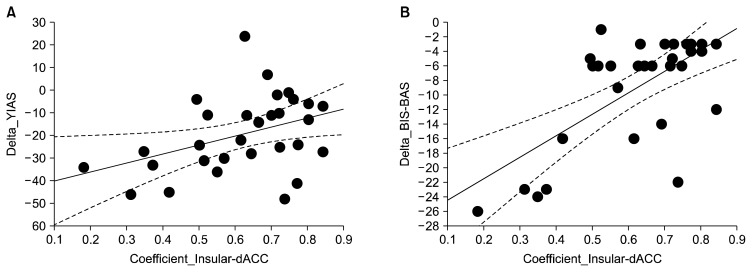
Bupropion showed greater effects than escitalopram on reducing impulsivity and attentional symptoms. Decreased brain connectivity between the salience network and the DMN appears to be associated with improved excessive IGD symptoms and impulsivity in MDD patients with IGD.
多项研究表明安非他酮和艾司西酞普兰在减少过度网络游戏方面具有疗效。我们假设安非他酮和艾司西酞普兰对同时患有重度抑郁症和网络游戏障碍(IGD)的患者在减轻抑郁症状和IGD症状严重程度方面均有效。然而,由于它们不同的药效学,安非他酮和艾司西酞普兰在默认模式网络(DMN)和突显网络之间的脑连接变化有所不同。
本研究设计为一项为期12周的双盲前瞻性试验。招募了30名患者参与本研究(15名安非他酮组 + 15名艾司西酞普兰组)。为了评估DMN和突显网络枢纽之间的差异功能连接(FC),我们从PickAtals软件中的自动解剖标记中选择了12个区域。
药物治疗后,两组的抑郁症状和IGD症状均得到改善。与艾司西酞普兰组相比,安非他酮组的冲动性和注意力症状显著降低。治疗后,艾司西酞普兰组仅DMN内的FC降低,而安非他酮组DMN和突显网络之间的FC降低。与艾司西酞普兰相比,安非他酮与突显网络内以及突显网络与DMN之间的FC显著降低有关。
在减少冲动性和注意力症状方面,安非他酮比艾司西酞普兰显示出更大的效果。突显网络和DMN之间脑连接的减少似乎与IGD的MDD患者过度IGD症状和冲动性的改善有关。