Leis Benedikt, Held Claudia, Bergkemper Fabian, Dennemarck Katharina, Steinbauer Robert, Reiter Alarich, Mechelke Matthias, Moerch Matthias, Graubner Sigrid, Liebl Wolfgang, Schwarz Wolfgang H, Zverlov Vladimir V
Department of Microbiology, Technische Universität München, Emil-Ramann-Str. 4, 85354 Freising, Germany.
Institute of Molecular Genetics, Russian Academy of Science, Kurchatov Sq. 2, Moscow, 123182 Russia.
Biotechnol Biofuels. 2017 Oct 23;10:240. doi: 10.1186/s13068-017-0928-4. eCollection 2017.
is a paradigm for efficient cellulose degradation and a promising organism for the production of second generation biofuels. It owes its high degradation rate on cellulosic substrates to the presence of supra-molecular cellulase complexes, cellulosomes, which comprise over 70 different single enzymes assembled on protein-backbone molecules of the scaffold protein CipA.
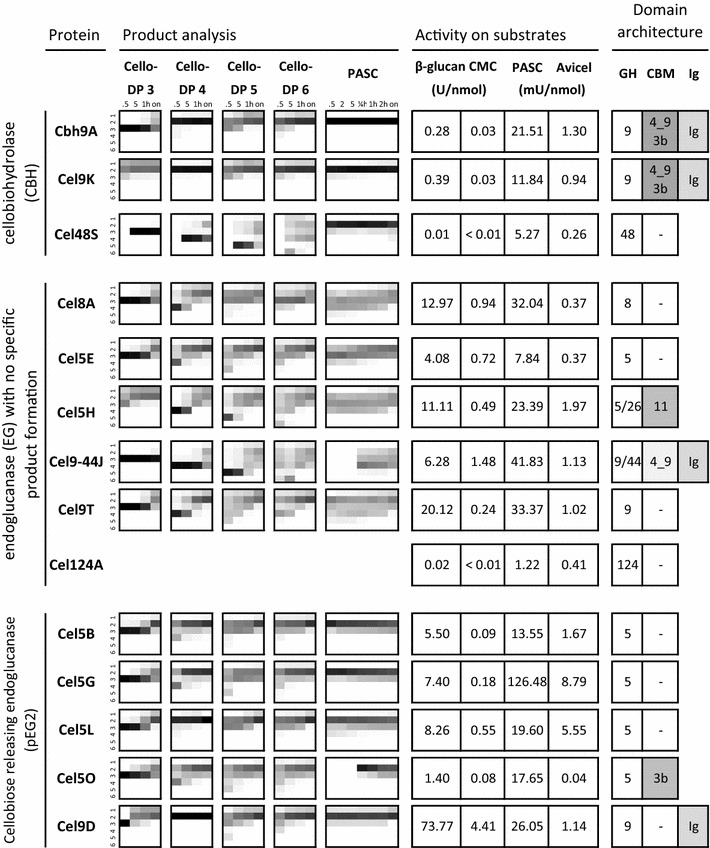
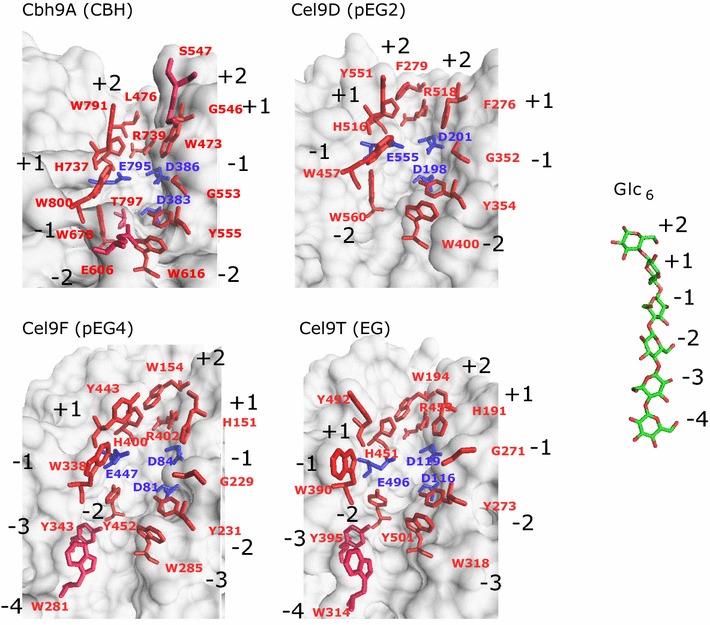
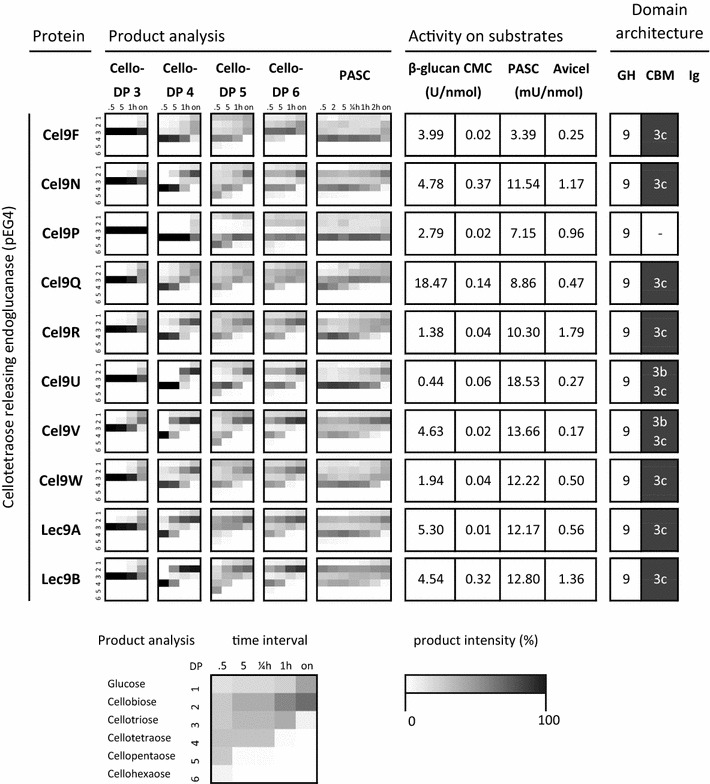
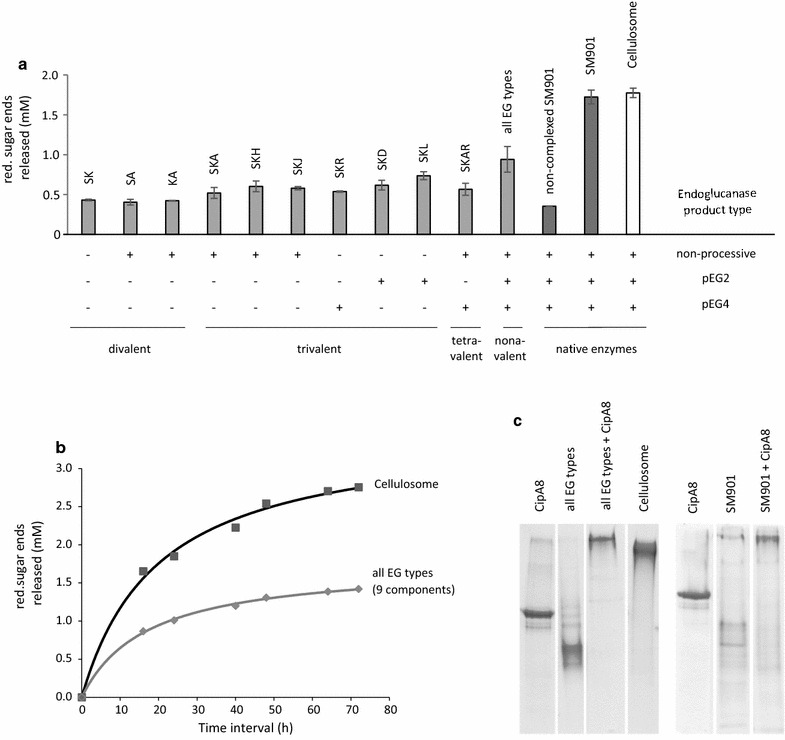
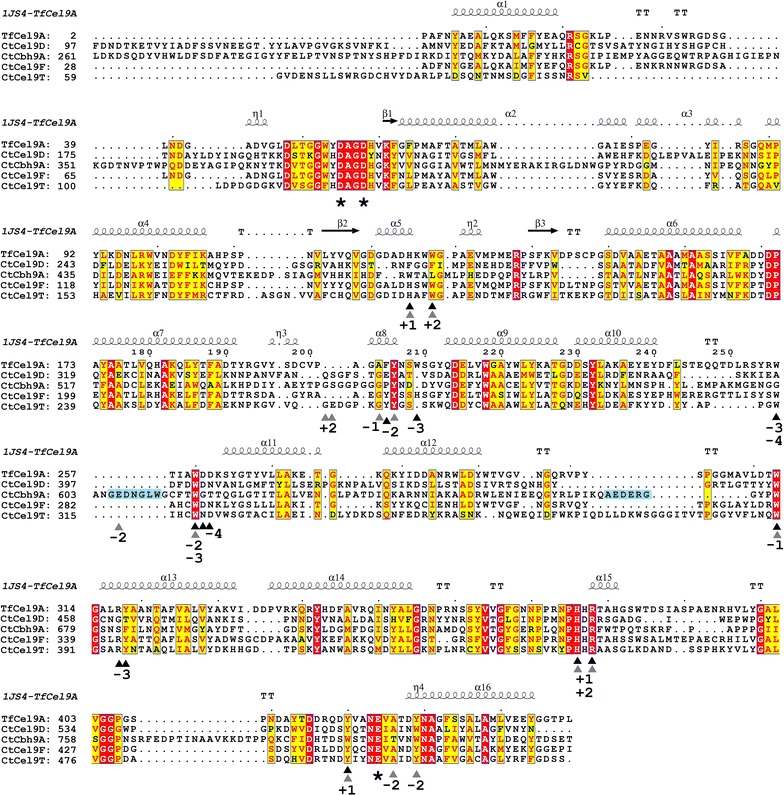
Although all 24 single-cellulosomal cellulases were described previously, we present the first comparative catalogue of all these enzymes together with a comprehensive analysis under identical experimental conditions, including enzyme activity, binding characteristics, substrate specificity, and product analysis. In the course of our study, we encountered four types of distinct enzymatic hydrolysis modes denoted by substrate specificity and hydrolysis product formation: (i) exo-mode cellobiohydrolases (CBH), (ii) endo-mode cellulases with no specific hydrolysis pattern, endoglucanases (EG), (iii) processive endoglucanases with cellotetraose as intermediate product (pEG4), and (iv) processive endoglucanases with cellobiose as the main product (pEG2). These modes are shown on amorphous cellulose and on model cello-oligosaccharides (with degree of polymerization DP 3 to 6). Artificial mini-cellulosomes carrying combinations of cellulases showed their highest activity when all four endoglucanase-groups were incorporated into a single complex. Such a modeled nonavalent complex ( = 9 enzymes bound to the recombinant scaffolding protein CipA) reached half of the activity of the native cellulosome. Comparative analysis of the protein architecture and structure revealed characteristics that play a role in product formation and enzyme processivity.
The identification of a new endoglucanase type expands the list of known cellulase functions present in the cellulosome. Our study shows that the variety of processivities in the enzyme complex is a key enabler of its high cellulolytic efficiency. The observed synergistic effect may pave the way for a better understanding of the enzymatic interactions and the design of more active lignocellulose-degrading cellulase cocktails in the future.
是高效纤维素降解的范例,也是生产第二代生物燃料的有前景的生物体。它在纤维素底物上的高降解率归因于超分子纤维素酶复合物即纤维小体的存在,纤维小体由70多种不同的单一酶组装在支架蛋白CipA的蛋白质骨架分子上。
尽管之前已描述了所有24种单一纤维小体纤维素酶,但我们首次给出了所有这些酶的比较目录,并在相同实验条件下进行了全面分析,包括酶活性、结合特性、底物特异性和产物分析。在我们的研究过程中,我们遇到了四种由底物特异性和水解产物形成所表征的不同酶促水解模式:(i)外切模式纤维二糖水解酶(CBH),(ii)无特定水解模式的内切模式纤维素酶即内切葡聚糖酶(EG),(iii)以纤维四糖为中间产物的连续内切葡聚糖酶(pEG4),以及(iv)以纤维二糖为主要产物的连续内切葡聚糖酶(pEG2)。这些模式在无定形纤维素和模型纤维寡糖(聚合度DP为3至6)上得以展现。携带纤维素酶组合的人工微型纤维小体在将所有四个内切葡聚糖酶组整合到单个复合物中时显示出最高活性。这样一个模拟的九价复合物(= 9种酶与重组支架蛋白CipA结合)达到了天然纤维小体活性的一半。对蛋白质结构和架构的比较分析揭示了在产物形成和酶连续性中起作用的特征。
新类型内切葡聚糖酶的鉴定扩展了纤维小体中已知纤维素酶功能的列表。我们的研究表明,酶复合物中多种连续性是其高纤维素分解效率的关键促成因素。观察到的协同效应可能为未来更好地理解酶促相互作用以及设计更具活性的木质纤维素降解纤维素酶混合物铺平道路。