Parag Kris V, Vinnicombe Glenn
Control Group, Department of Engineering, University of Cambridge, United Kingdom.
PLoS Comput Biol. 2017 Oct 27;13(10):e1005687. doi: 10.1371/journal.pcbi.1005687. eCollection 2017 Oct.
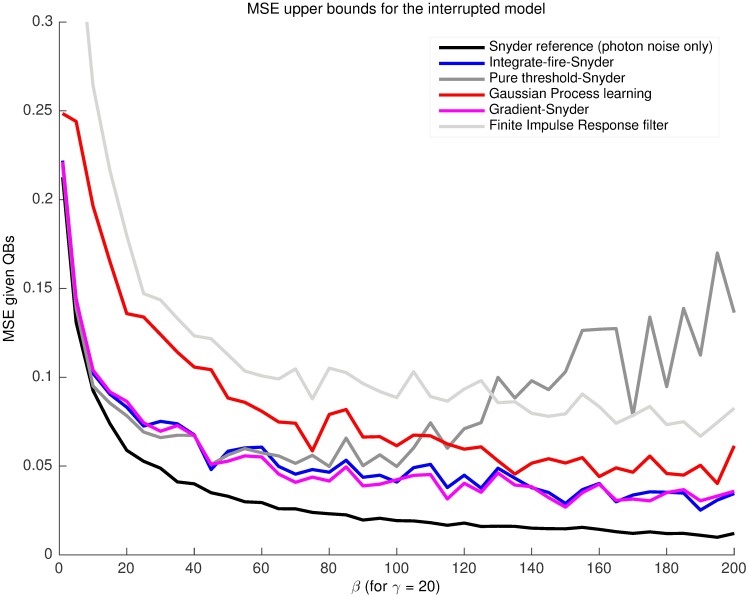
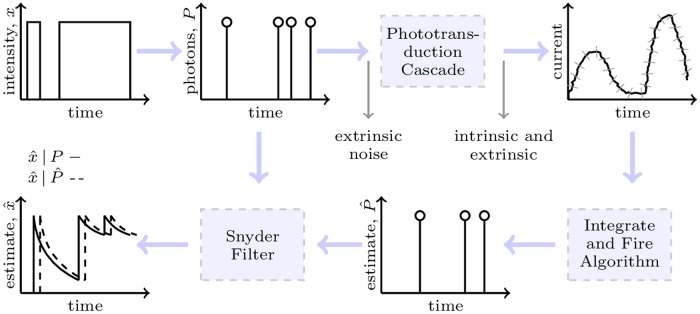
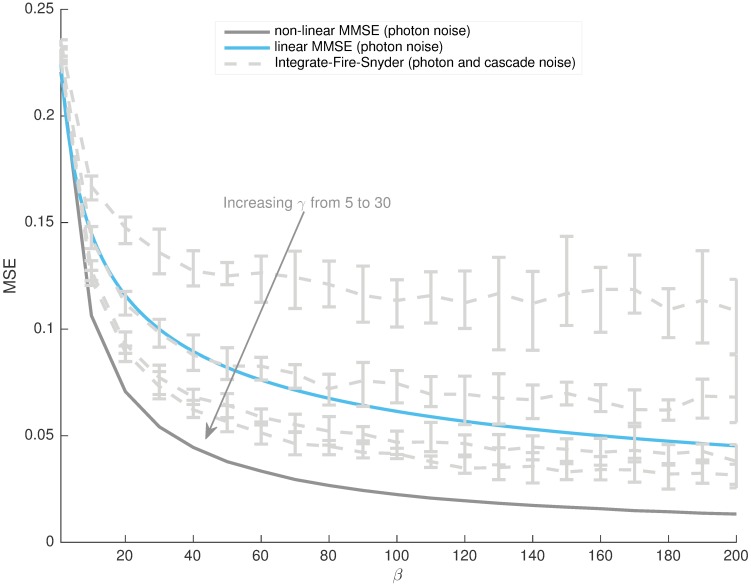
Noise is a prevalent and sometimes even dominant aspect of many biological processes. While many natural systems have adapted to attenuate or even usefully integrate noise, the variability it introduces often still delimits the achievable precision across biological functions. This is particularly so for visual phototransduction, the process responsible for converting photons of light into usable electrical signals (quantum bumps). Here, randomness of both the photon inputs (regarded as extrinsic noise) and the conversion process (intrinsic noise) are seen as two distinct, independent and significant limitations on visual reliability. Past research has attempted to quantify the relative effects of these noise sources by using approximate methods that do not fully account for the discrete, point process and time ordered nature of the problem. As a result the conclusions drawn from these different approaches have led to inconsistent expositions of phototransduction noise performance. This paper provides a fresh and complete analysis of the relative impact of intrinsic and extrinsic noise in invertebrate phototransduction using minimum mean squared error reconstruction techniques based on Bayesian point process (Snyder) filters. An integrate-fire based algorithm is developed to reliably estimate photon times from quantum bumps and Snyder filters are then used to causally estimate random light intensities both at the front and back end of the phototransduction cascade. Comparison of these estimates reveals that the dominant noise source transitions from extrinsic to intrinsic as light intensity increases. By extending the filtering techniques to account for delays, it is further found that among the intrinsic noise components, which include bump latency (mean delay and jitter) and shape (amplitude and width) variance, it is the mean delay that is critical to noise performance. As the timeliness of visual information is important for real-time action, this delay could potentially limit the speed at which invertebrates can respond to stimuli. Consequently, if one wants to increase visual fidelity, reducing the photoconversion lag is much more important than improving the regularity of the electrical signal.
噪声是许多生物过程中普遍存在、有时甚至占主导地位的一个方面。虽然许多自然系统已经适应了减弱甚至有效地整合噪声,但它所引入的变异性往往仍然限制了生物功能可实现的精度。视觉光转导尤其如此,这一过程负责将光的光子转换为可用的电信号(量子脉冲)。在这里,光子输入(视为外部噪声)和转换过程(内部噪声)的随机性被视为对视觉可靠性的两个不同、独立且显著的限制因素。过去的研究试图通过使用近似方法来量化这些噪声源的相对影响,但这些方法并未充分考虑该问题离散、点过程和时间顺序的性质。因此,从这些不同方法得出的结论导致了对光转导噪声性能的不一致阐述。本文基于贝叶斯点过程(斯奈德)滤波器,使用最小均方误差重建技术,对无脊椎动物光转导中内部和外部噪声的相对影响进行了全新且完整的分析。开发了一种基于积分发放的算法来从量子脉冲可靠地估计光子时间,然后使用斯奈德滤波器因果估计光转导级联前端和后端的随机光强度。这些估计值的比较表明,随着光强度增加,主导噪声源从外部噪声转变为内部噪声。通过扩展滤波技术以考虑延迟因素,进一步发现,在包括脉冲潜伏期(平均延迟和抖动)和形状(幅度和宽度)方差在内的内部噪声成分中,平均延迟对噪声性能至关重要。由于视觉信息及时对于实时行动很重要,这种延迟可能会潜在地限制无脊椎动物对刺激做出反应的速度。因此,如果想要提高视觉保真度,减少光转换延迟比改善电信号的规律性更为重要。