Ahmed Umar Ijaz, Ying Liu, Bashir Muhammad Khalid, Abid Muhammad, Zulfiqar Farhad
Department of Agricultural and Resource Economics, Faculty of Social Sciences and Humanities, Muhammad Nawaz Shareef University of Agriculture, Multan, Pakistan.
College of Economics and Management, Huazhong Agricultural University, Hubei, Wuhan, P.R. China.
PLoS One. 2017 Oct 27;12(10):e0185466. doi: 10.1371/journal.pone.0185466. eCollection 2017.
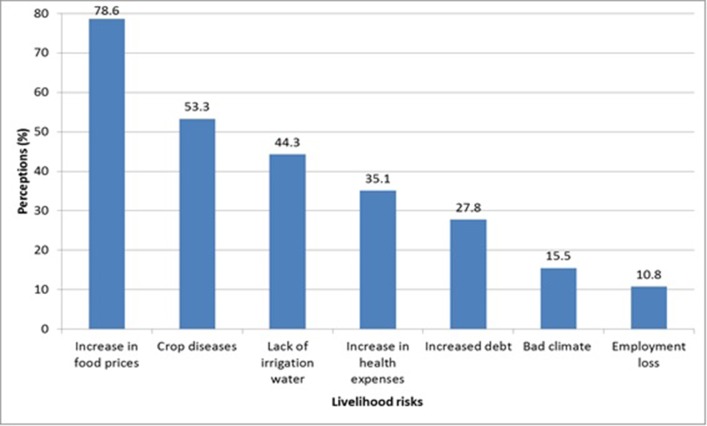
In most of the developing countries, lack of resources and little market accessibility are among the major factors that affect small farming household food security. This study aims to investigate the status of small farming households' food security, and its determinants including the role of market accessibility factors in enhancing food security at household level. In addition, this study also determines the households' perception about different kinds of livelihoods risks. This study is based on a household survey of 576 households conducted through face-to-face interviews using structured interviews in Punjab, Pakistan. Food security status is calculated using dietary intake method. The study findings show that one-fourth of the households are food insecure. The study findings reveal that farm households perceive increase in food prices, crop diseases, lack of irrigation water and increase in health expenses as major livelihood risks. Further, the results of logistic regression show that family size, monthly income, food prices, health expenses and debt are main factors influencing the food security status of rural households. Furthermore, the market accessibility factors (road distance and transportation cost) do significantly affect the small farming household food security. The results suggest that local food security can be enhanced by creating off-farm employment opportunities, improved transportation facilities and road infrastructure.
在大多数发展中国家,资源匮乏和市场准入机会有限是影响小农户粮食安全的主要因素。本研究旨在调查小农户粮食安全状况及其决定因素,包括市场准入因素在家庭层面增强粮食安全方面的作用。此外,本研究还确定了家庭对不同类型生计风险的认知。本研究基于对巴基斯坦旁遮普邦576户家庭的入户调查,通过面对面访谈采用结构化问卷进行。粮食安全状况采用膳食摄入法计算。研究结果表明,四分之一的家庭粮食不安全。研究结果显示,农户将食品价格上涨、作物病害、灌溉用水短缺和医疗费用增加视为主要生计风险。此外,逻辑回归结果表明,家庭规模、月收入、食品价格、医疗费用和债务是影响农村家庭粮食安全状况的主要因素。此外,市场准入因素(道路距离和运输成本)对小农户粮食安全有显著影响。结果表明,通过创造非农业就业机会、改善交通设施和道路基础设施,可以增强当地的粮食安全。