Institute of Crop Sciences/National Key Facility for Crop Gene Resources and Genetic Improvement, Chinese Academy of Agricultural Sciences, Beijing, 100081, China.
Agricultural Genomics Institute, Chinese Academy of Agricultural Sciences, Shenzhen, 518120, China.
BMC Genomics. 2017 Oct 27;18(1):828. doi: 10.1186/s12864-017-4221-5.
Ferrous iron (Fe) and zinc (Zn) at high concentration in the soil cause heavy metal toxicity and greatly affect rice yield and quality. To improve rice production, understanding the genetic and molecular resistance mechanisms to excess Fe and Zn in rice is essential. Genome-wide association study (GWAS) is an effective way to identify loci and favorable alleles governing Fe and Zn toxicty as well as dissect the genetic relationship between them in a genetically diverse population.
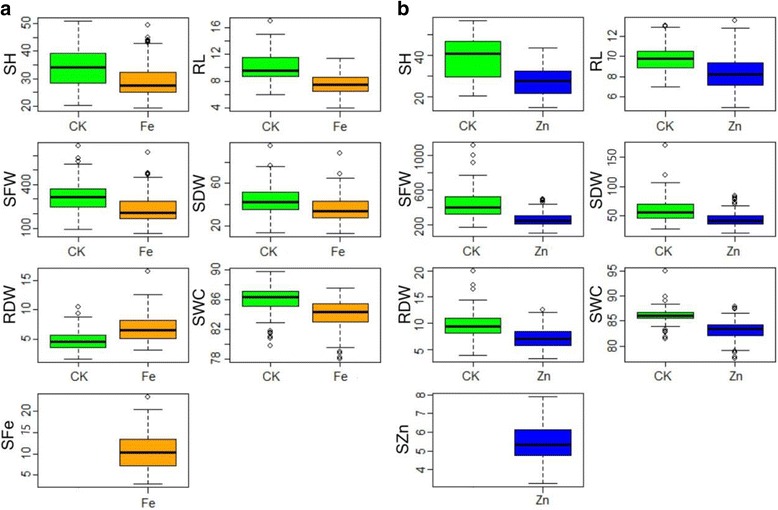
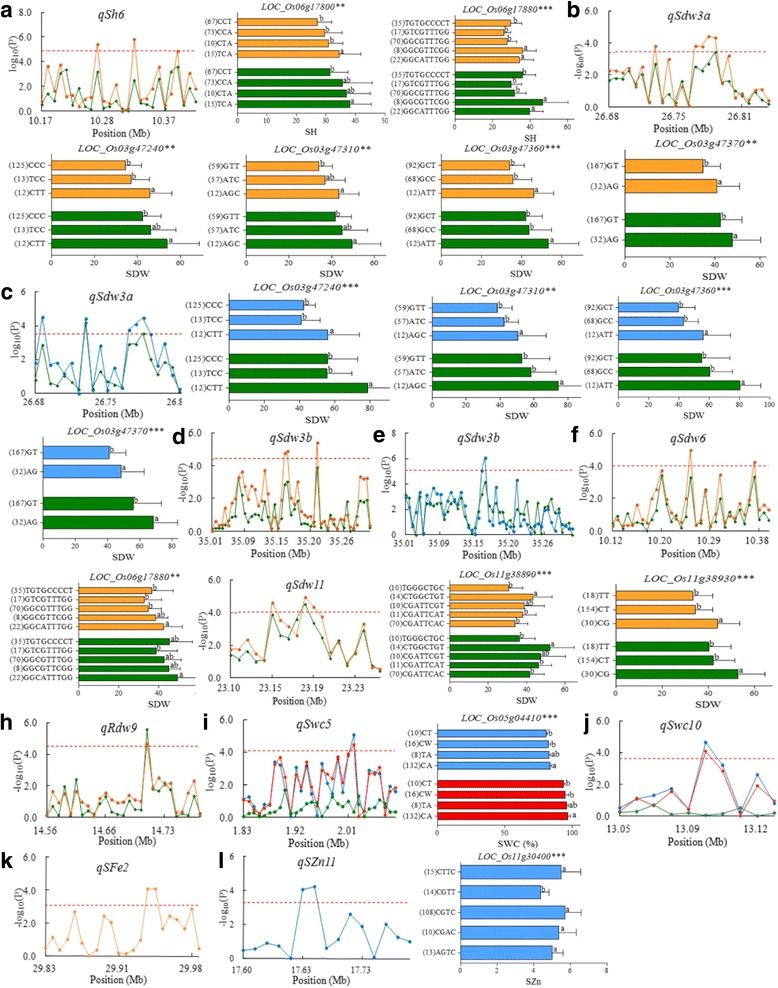
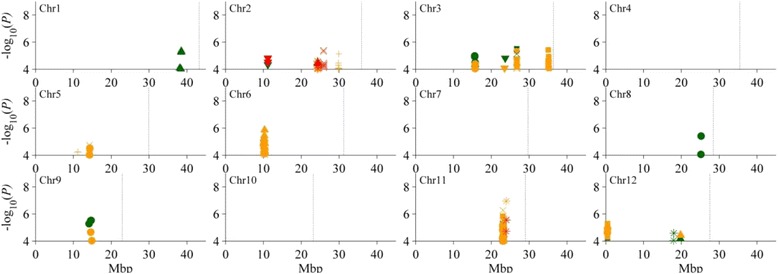
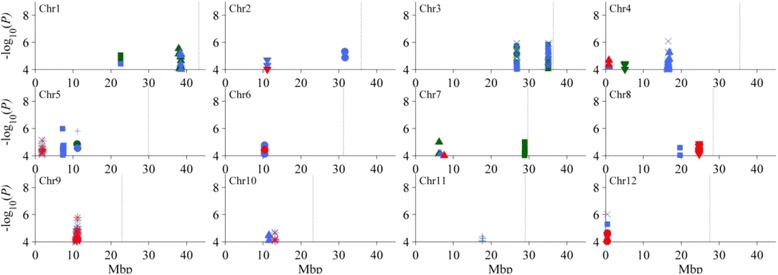
A total of 29 and 31 putative QTL affecting shoot height (SH), root length (RL), shoot fresh weight (SFW), shoot dry weight (SDW), root dry weight (RDW), shoot water content (SWC) and shoot ion concentrations (SFe or SZn) were identified at seedling stage in Fe and Zn experiments, respectively. Five toxicity tolerance QTL (qSdw3a, qSdw3b, qSdw12 and qSFe5 / qSZn5) were detected in the same genomic regions under the two stress conditions and 22 candidate genes for 10 important QTL regions were also determined by haplotype analyses.
Rice plants share partial genetic overlaps of Fe and Zn toxicity tolerance at seedling stage. Candidate genes putatively affecting Fe and Zn toxicity tolerance identified in this study provide valuable information for future functional characterization and improvement of rice tolerance to Fe and Zn toxicity by marker-assisted selection or designed QTL pyramiding.
土壤中高浓度的亚铁(Fe)和锌(Zn)会导致重金属毒性,极大地影响水稻的产量和品质。为了提高水稻的产量,了解水稻对过量 Fe 和 Zn 的遗传和分子抗性机制至关重要。全基因组关联研究(GWAS)是一种有效的方法,可以鉴定控制 Fe 和 Zn 毒性的位点和有利等位基因,并在遗传多样性群体中剖析它们之间的遗传关系。
在 Fe 和 Zn 实验中,分别在幼苗期鉴定出了 29 个和 31 个可能影响株高(SH)、根长(RL)、地上部鲜重(SFW)、地上部干重(SDW)、根干重(RDW)、地上部含水量(SWC)和地上部离子浓度(SFe 或 SZn)的 QTL。在两种胁迫条件下,在相同的基因组区域检测到了 5 个耐毒性 QTL(qSdw3a、qSdw3b、qSdw12 和 qSFe5/qSZn5),通过单倍型分析还确定了 10 个重要 QTL 区域的 22 个候选基因。
水稻幼苗期对 Fe 和 Zn 毒性的耐受性存在部分遗传重叠。本研究中鉴定的候选基因,可能会影响 Fe 和 Zn 毒性的耐受性,为未来通过标记辅助选择或设计 QTL 聚合来提高水稻对 Fe 和 Zn 毒性的耐受性提供了有价值的信息。