Department of Psychology, Arizona State University, Tempe.
Department of Human Development and Family Science, University of Missouri, Columbia.
Dev Psychol. 2018 Feb;54(2):378-384. doi: 10.1037/dev0000436. Epub 2017 Oct 30.
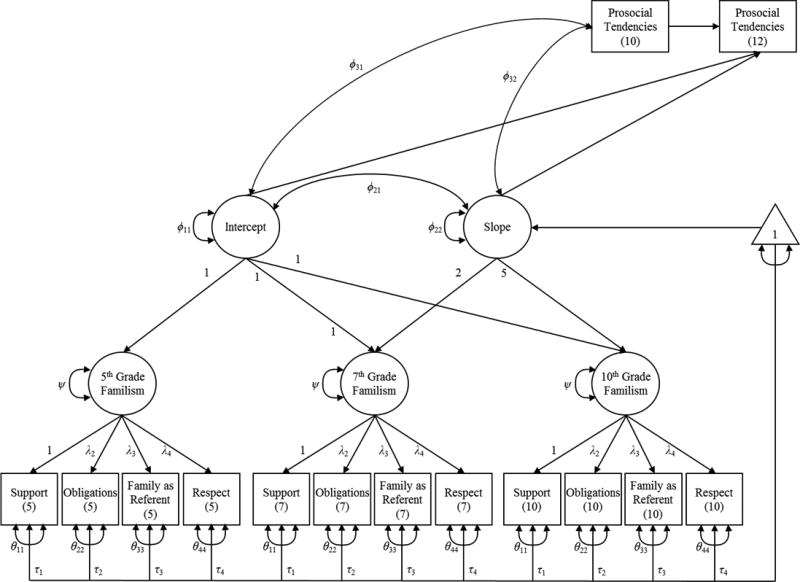
We examined how the development of familism values from 5th to 10th grade relates to 12th-grade prosocial tendencies (after controlling for 10th-grade prosocial tendencies) using a stratified random sample of 749 Mexican American adolescents (M = 10.42 years of age at 5th grade; 48.9% girls) from 35 culturally and economically diverse neighborhoods. Most of the families (44.3%) were at or below $25,000 in annual income. A 2nd-order linear growth model represented adolescents' familism values at 5th grade (intercepts) and change in familism values from 5th to 10th grade (slopes), with the vast majority of slopes being negative. Higher intercepts predicted greater compliant and emotional prosocial tendencies, and higher (i.e., more positive or less negative) slopes predicted greater dire (female adolescents only) and public prosocial tendencies at 12th grade. The results underscore the important role of familism values in prosocial development among Mexican American adolescents. (PsycINFO Database Record
我们使用分层随机抽样调查了 749 名墨西哥裔美国青少年(五年级时的平均年龄为 10.42 岁;48.9%为女孩),从五年级到十年级的家庭观念发展如何与 12 年级的亲社会倾向相关(在控制了 10 年级的亲社会倾向之后),这些青少年来自 35 个文化和经济多样化的社区。大多数家庭(44.3%)的年收入在 25000 美元或以下。二阶线性增长模型代表了青少年五年级时的家庭观念(截距)和五年级到十年级家庭观念的变化(斜率),大多数斜率为负值。较高的截距预示着更大的顺从和情感亲社会倾向,而更高(即更积极或更不消极)的斜率预示着 12 年级时更大的直接(女性青少年仅)和公共亲社会倾向。研究结果强调了家庭观念在墨西哥裔美国青少年亲社会发展中的重要作用。