Koenig Kristi L, Shastry Siri, Burns Michael J
Medical Director, EMS, County of San Diego, Health & Human Services Agency.
University of California Irvine, Department of Emergency Medicine, Orange, California.
West J Emerg Med. 2017 Oct;18(6):1000-1007. doi: 10.5811/westjem.2017.10.35983. Epub 2017 Oct 18.
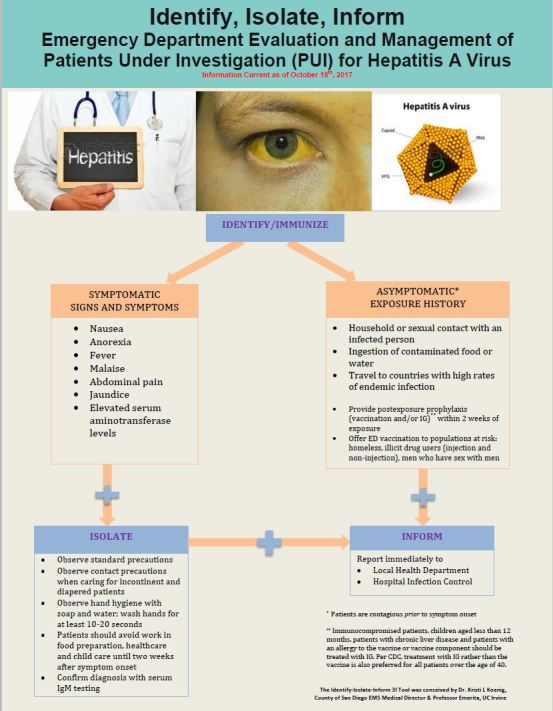
Infection with hepatitis A virus (HAV) causes a highly contagious illness that can lead to serious morbidity and occasional mortality. Although the overall incidence of HAV has been declining since the introduction of the HAV vaccine, there have been an increasing number of outbreaks within the United States and elsewhere between 2016 and 2017. These outbreaks have had far-reaching consequences, with a large number of patients requiring hospitalization and several deaths. Accordingly, HAV is proving to present a renewed public health challenge. Through use of the "Identify-Isolate-Inform" tool as adapted for HAV, emergency physicians can become more familiar with the identification and management of patients presenting to the emergency department (ED) with exposure, infection, or risk of contracting disease. While it can be asymptomatic, HAV typically presents with a prodrome of fever, nausea/vomiting, and abdominal pain followed by jaundice. Healthcare providers should maintain strict standard precautions for all patients suspected of having HAV infection as well as contact precautions in special cases. Hand hygiene with soap and warm water should be emphasized, and affected patients should be counseled to avoid food preparation and close contact with vulnerable populations. Additionally, ED providers should offer post-exposure prophylaxis to exposed contacts and encourage vaccination as well as other preventive measures for at-risk individuals. ED personnel should inform local public health departments of any suspected case.
甲型肝炎病毒(HAV)感染会引发一种具有高度传染性的疾病,可能导致严重发病,偶尔还会导致死亡。尽管自甲型肝炎疫苗推出以来,HAV的总体发病率一直在下降,但在2016年至2017年期间,美国及其他地区的疫情爆发却越来越多。这些疫情产生了深远影响,大量患者需要住院治疗,并有数人死亡。因此,HAV正成为一个新的公共卫生挑战。通过使用适用于HAV的“识别-隔离-告知”工具,急诊医生可以更加熟悉对因接触、感染或有感染疾病风险而前来急诊科(ED)就诊的患者的识别和管理。虽然HAV感染可能无症状,但通常会先出现发热、恶心/呕吐和腹痛的前驱症状,随后出现黄疸。医疗保健提供者应对所有疑似感染HAV的患者保持严格的标准预防措施,在特殊情况下还应采取接触预防措施。应强调用肥皂和温水洗手,应对受影响的患者进行劝告,使其避免准备食物以及与弱势群体密切接触。此外,急诊科工作人员应为接触过的人员提供暴露后预防措施,并鼓励高危个体接种疫苗以及采取其他预防措施。急诊部门工作人员应将任何疑似病例通知当地公共卫生部门。