County of San Diego, Health & Human Services Agency, Emergency Medical Services, San Diego, California.
University of California Irvine, Department of Emergency Medicine, Orange, California.
West J Emerg Med. 2020 Jan 31;21(2):184-190. doi: 10.5811/westjem.2020.1.46760.
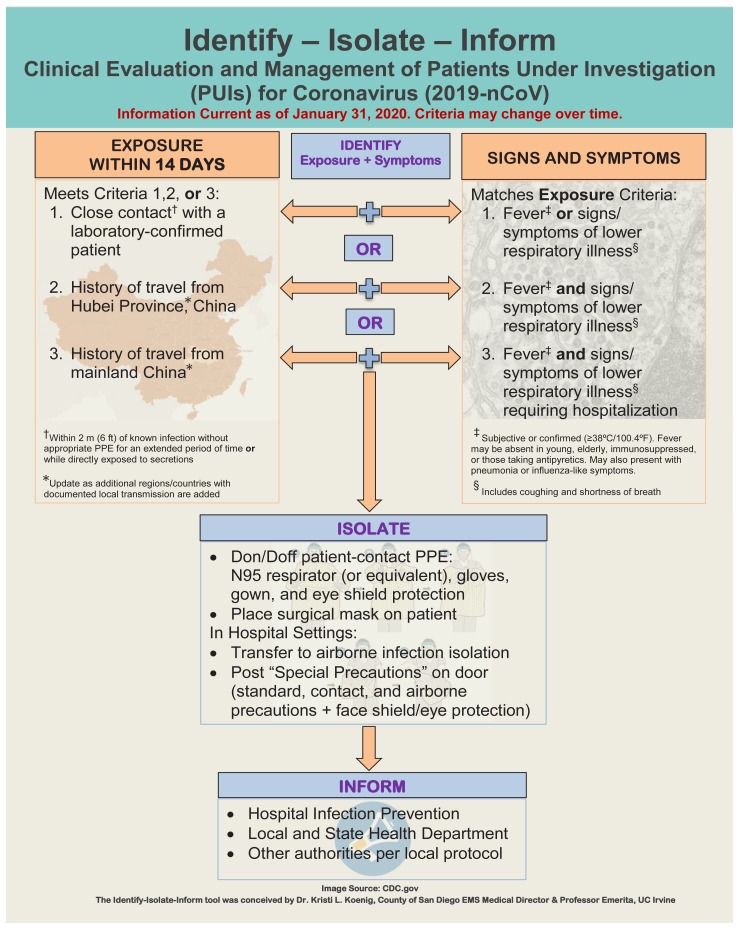
2019 Novel Coronavirus (2019-nCoV) is an emerging infectious disease closely related to MERS-CoV and SARS-CoV that was first reported in Wuhan City, Hubei Province, China in December 2019. As of January 2020, cases of 2019-nCoV are continuing to be reported in other Eastern Asian countries as well as in the United States, Europe, Australia, and numerous other countries. An unusually high volume of domestic and international travel corresponding to the beginning of the 2020 Chinese New Year complicated initial identification and containment of infected persons. Due to the rapidly rising number of cases and reported deaths, all countries should be considered at risk of imported 2019-nCoV. Therefore, it is essential for prehospital, clinic, and emergency department personnel to be able to rapidly assess 2019-nCoV risk and take immediate actions if indicated. The Identify-Isolate-Inform (3I) Tool, originally conceived for the initial detection and management of Ebola virus and later adjusted for other infectious agents, can be adapted for any emerging infectious disease. This paper reports a modification of the 3I Tool for use in the initial detection and management of patients under investigation for 2019-nCoV. After initial assessment for symptoms and epidemiological risk factors, including travel to affected areas and exposure to confirmed 2019-nCoV patients within 14 days, patients are classified in a risk-stratified system. Upon confirmation of a suspected 2019-nCoV case, affected persons must immediately be placed in airborne infection isolation and the appropriate public health agencies notified. This modified 3I Tool will assist emergency and primary care clinicians, as well as out-of-hospital providers, in effectively managing persons with suspected or confirmed 2019-nCoV.
2019 年新型冠状病毒(2019-nCoV)是一种新发传染病,与中东呼吸综合征冠状病毒(MERS-CoV)和严重急性呼吸综合征冠状病毒(SARS-CoV)密切相关,于 2019 年 12 月在中国湖北省武汉市首次报告。截至 2020 年 1 月,2019-nCoV 病例继续在东亚其他国家以及美国、欧洲、澳大利亚和其他许多国家报告。由于恰逢 2020 年中国新年伊始,国内和国际间的旅行量异常高,这使得最初确定和隔离感染者的工作变得复杂。由于病例和报告死亡人数迅速增加,所有国家都应被视为存在输入 2019-nCoV 的风险。因此,对于院前、诊所和急诊科人员来说,迅速评估 2019-nCoV 风险并在必要时立即采取行动是至关重要的。最初为埃博拉病毒的初步检测和管理而设想的识别-隔离-告知(3I)工具,后来经过调整,也可用于其他传染病。本文报告了对 3I 工具的修改,用于对疑似 2019-nCoV 患者的初步检测和管理。在对症状和流行病学危险因素进行初步评估后,包括前往受影响地区和在 14 天内接触确诊的 2019-nCoV 患者,患者将根据风险分层系统进行分类。在疑似 2019-nCoV 病例得到确认后,必须立即将受影响的人置于空气传播感染隔离中,并通知适当的公共卫生机构。经过修改的 3I 工具将协助急诊和初级保健临床医生以及院外提供者有效地管理疑似或确诊 2019-nCoV 患者。