Adams Aaron M, VanDusen Keith W, Kostrominova Tatiana Y, Mertens Jacob P, Larkin Lisa M
Department of Molecular and Integrated Physiology, University of Michigan, Ann Arbor, MI, USA.
Department of Anatomy and Cell Biology, Indiana University School of Medicine, Northwest, Gary, IN, USA.
Neural Regen Res. 2017 Sep;12(9):1529-1537. doi: 10.4103/1673-5374.215265.
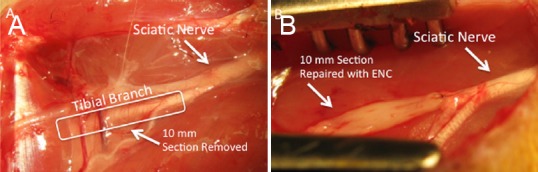
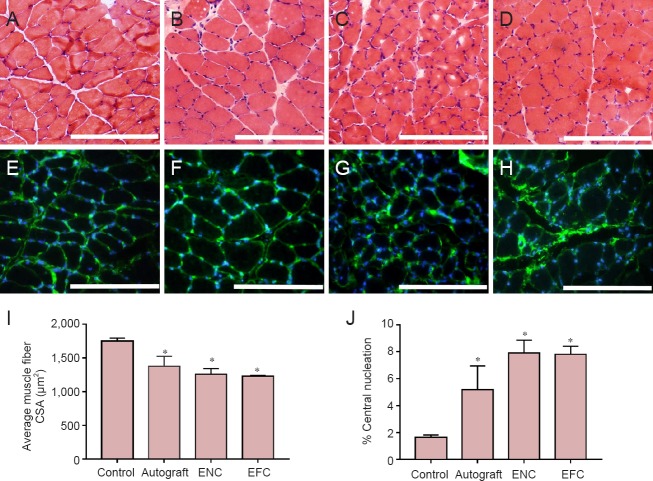
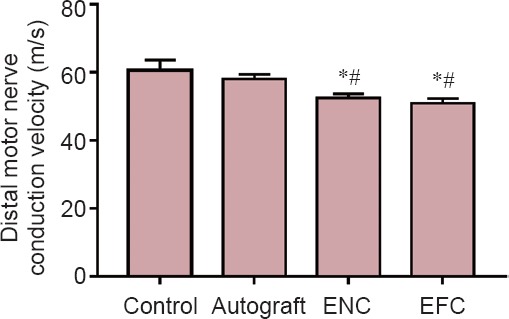
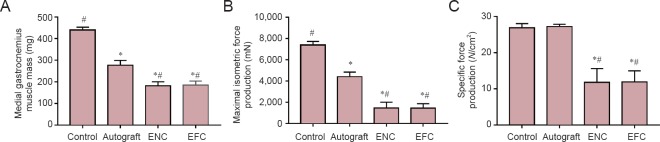
Damage to peripheral nerve tissue may cause loss of function in both the nerve and the targeted muscles it innervates. This study compared the repair capability of engineered nerve conduit (ENC), engineered fibroblast conduit (EFC), and autograft in a 10-mm tibial nerve gap. ENCs were fabricated utilizing primary fibroblasts and the nerve cells of rats on embryonic day 15 (E15). EFCs were fabricated utilizing primary fibroblasts only. Following a 12-week recovery, nerve repair was assessed by measuring contractile properties in the medial gastrocnemius muscle, distal motor nerve conduction velocity in the lateral gastrocnemius, and histology of muscle and nerve. The autografts, ENCs and EFCs reestablished 96%, 87% and 84% of native distal motor nerve conduction velocity in the lateral gastrocnemius, 100%, 44% and 44% of native specific force of medical gastrocnemius, and 63%, 61% and 67% of native medial gastrocnemius mass, respectively. Histology of the repaired nerve revealed large axons in the autograft, larger but fewer axons in the ENC repair, and many smaller axons in the EFC repair. Muscle histology revealed similar muscle fiber cross-sectional areas among autograft, ENC and EFC repairs. In conclusion, both ENCs and EFCs promoted nerve regeneration in a 10-mm tibial nerve gap repair, suggesting that the E15 rat nerve cells may not be necessary for nerve regeneration, and EFC alone can suffice for peripheral nerve injury repair.
周围神经组织损伤可能导致神经及其所支配的目标肌肉功能丧失。本研究比较了工程化神经导管(ENC)、工程化成纤维细胞导管(EFC)和自体移植在10毫米胫神经缺损中的修复能力。ENC利用原代成纤维细胞和胚胎第15天(E15)大鼠的神经细胞制备。EFC仅利用原代成纤维细胞制备。经过12周的恢复后,通过测量腓肠肌内侧的收缩特性、腓肠肌外侧的远端运动神经传导速度以及肌肉和神经的组织学来评估神经修复情况。自体移植组、ENC组和EFC组分别恢复了腓肠肌外侧96%、87%和84%的天然远端运动神经传导速度,腓肠肌内侧100%、44%和44%的天然比力,以及63%、61%和67%的天然腓肠肌内侧质量。修复神经的组织学显示,自体移植组有大轴突,ENC修复组轴突更大但数量更少,EFC修复组有许多较小的轴突。肌肉组织学显示,自体移植组、ENC组和EFC组的肌肉纤维横截面积相似。总之,ENC和EFC在10毫米胫神经缺损修复中均促进了神经再生,这表明E15大鼠神经细胞可能不是神经再生所必需的,仅EFC就足以修复周围神经损伤。