KU Leuven, Herestraat 49, 3000, Leuven, Belgium.
Modus Outcomes, Letchworth Garden City, UK.
Orphanet J Rare Dis. 2017 Nov 2;12(1):171. doi: 10.1186/s13023-017-0718-x.
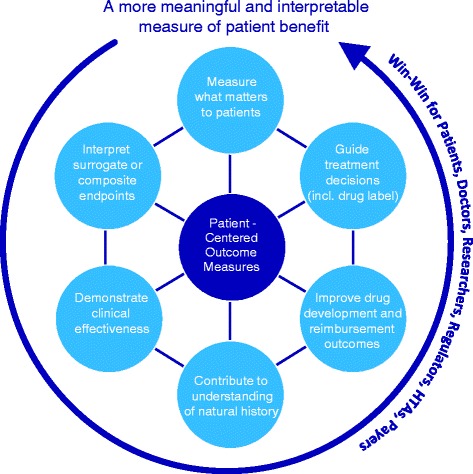
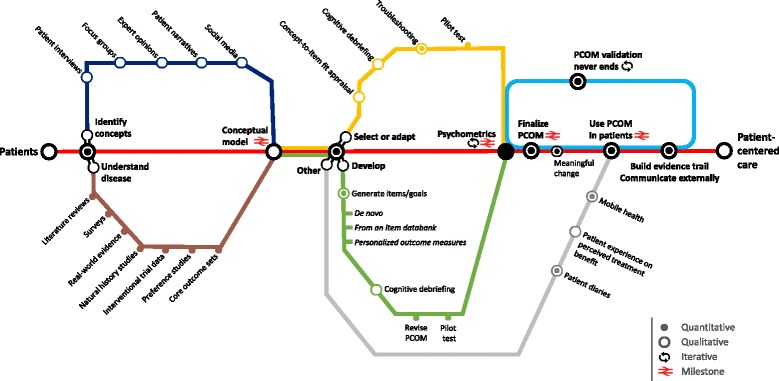
Our ability to evaluate outcomes which genuinely reflect patients' unmet needs, hopes and concerns is of pivotal importance. However, much current clinical research and practice falls short of this objective by selecting outcome measures which do not capture patient value to the fullest. In this Opinion, we discuss Patient-Centered Outcomes Measures (PCOMs), which have the potential to systematically incorporate patient perspectives to measure those outcomes that matter most to patients. We argue for greater multi-stakeholder collaboration to develop PCOMs, with rare disease patients and families at the center. Beyond advancing the science of patient input, PCOMs are powerful tools to translate care or observed treatment benefit into an 'interpretable' measure of patient benefit, and thereby help demonstrate clinical effectiveness. We propose mixed methods psychometric research as the best route to deliver fit-for-purpose PCOMs in rare diseases, as this methodology brings together qualitative and quantitative research methods in tandem with the explicit aim to efficiently utilise data from small samples. And, whether one opts to develop a brand-new PCOM or to select or adapt an existing outcome measure for use in a rare disease, the anchors remain the same: patients, their daily experience of the rare disease, their preferences, core concepts and values. Ultimately, existing value frameworks, registries, and outcomes-based contracts largely fall short of consistently measuring the full range of outcomes that matter to patients. We argue that greater use of PCOMs in rare diseases would enable a fast track to Patient-Centered Care.
我们评估真正反映患者未满足需求、希望和关注点的结果的能力至关重要。然而,目前许多临床研究和实践都未能达到这一目标,因为他们选择的结果衡量指标并不能充分体现患者的价值。在本观点中,我们讨论了以患者为中心的结局测量指标(PCOMs),它有潜力系统地纳入患者的观点,以衡量对患者最重要的那些结果。我们主张加强多利益相关者合作,以开发以罕见病患者和家庭为中心的 PCOMs。除了推进患者投入的科学研究外,PCOMs 还是将护理或观察到的治疗益处转化为患者获益的可解释衡量指标的有力工具,从而有助于证明临床疗效。我们提出混合方法心理测量研究是在罕见病中提供合适的 PCOMs 的最佳途径,因为这种方法将定性和定量研究方法结合在一起,明确旨在有效地利用小样本数据。而且,无论选择开发全新的 PCOM 还是选择或改编现有的用于罕见病的结局测量指标,锚点都是相同的:患者、他们对罕见病的日常体验、他们的偏好、核心概念和价值观。最终,现有的价值框架、登记册和基于结果的合同在很大程度上未能始终如一地衡量对患者重要的所有结果。我们认为,在罕见病中更多地使用 PCOMs 将能够实现以患者为中心的护理的快速发展。