Guangxi Key Laboratory of AIDS Prevention and Treatment, School of Public Health, Guangxi Medical University, Guangxi, China.
Department of Microbiology & Immunology University of North Carolina at Chapel Hill, Chapel Hill, North Carolina, USA.
Sci Rep. 2017 Nov 2;7(1):14931. doi: 10.1038/s41598-017-13995-9.
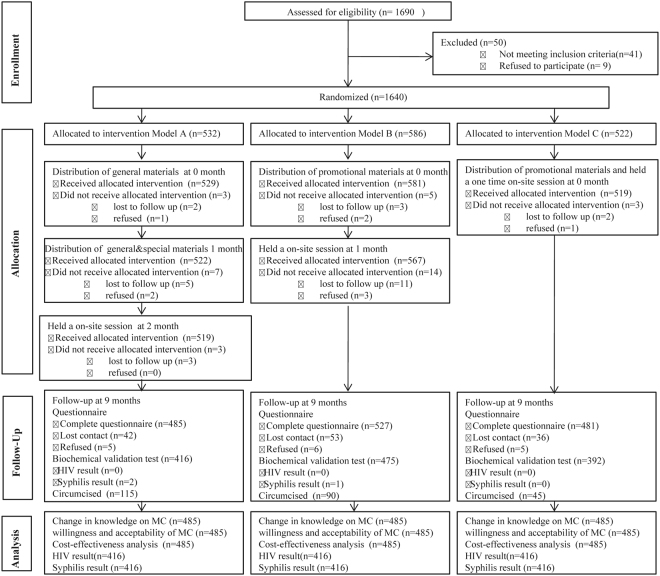
To compare different intervention models for promoting male circumcision (MC) to prevent HIV transmission in Western China. A total of 1690 male participants from multiple study sites were cluster randomly allocated to three-stage (Model A), two-stage (Model B), and one-stage (Model C) educational interventions. In all three interventions models, knowledge about MC significantly increased and the reported willingness to accept MC increased to 52.6% (255/485), 67.0% (353/527), and 45.5% (219/481) after intervention, respectively (P < 0.05). Rate of MC surgery uptake was highest (23.7%; 115/485) among those who received Model A intervention, compared to those who received Model B (17.1%; 90/527) or Model C (9.4%; 45/481) interventions (P < 0.05). Multivariable Cox regression analysis identified that Model A or Model B had twice the effect of Model C on MC uptake, with relative risks of 2.4 (95%CI, 1.5-3.8) and 2.2 (95%CI, 1.3-3.6), respectively. Model B was the most effective model for improving participants' willingness to accept MC, while Model A was most successful at increasing uptake of MC surgery. Self-reported attitude towards MC uptake was not strongly correlated with actual behavior in this study focusing on the general male population in Western China.
为了比较不同的干预模式,以促进男性割礼(MC)在中国西部预防 HIV 传播。共有来自多个研究地点的 1690 名男性参与者被随机分为三阶段(模型 A)、两阶段(模型 B)和一阶段(模型 C)教育干预组。在所有三种干预模式中,MC 相关知识均显著增加,报告愿意接受 MC 的比例分别增加到 52.6%(255/485)、67.0%(353/527)和 45.5%(219/481)(P<0.05)。接受模型 A 干预的人中,MC 手术接受率最高(23.7%;115/485),其次是接受模型 B(17.1%;90/527)或模型 C(9.4%;45/481)干预的人(P<0.05)。多变量 Cox 回归分析表明,模型 A 或模型 B 对 MC 接受度的影响是模型 C 的两倍,相对风险分别为 2.4(95%CI,1.5-3.8)和 2.2(95%CI,1.3-3.6)。模型 B 是提高参与者接受 MC 意愿的最有效模式,而模型 A 则是提高 MC 手术接受率最有效的模式。在这项针对中国西部普通男性人群的研究中,自我报告的对 MC 接受度的态度与实际行为没有很强的相关性。