Plant Biology and Systematics, CSIR - Central Institute of Medicinal and Aromatic Plants, Research Center, Allalsandra, GKVK Post, Bengaluru, 560065, Karnataka, India.
Biotechnology Division, CSIR - Central Institute of Medicinal and Aromatic Plants, P.O. CIMAP, Lucknow, 226015, Uttar Pradesh, India.
Sci Rep. 2017 Nov 2;7(1):14910. doi: 10.1038/s41598-017-14887-8.
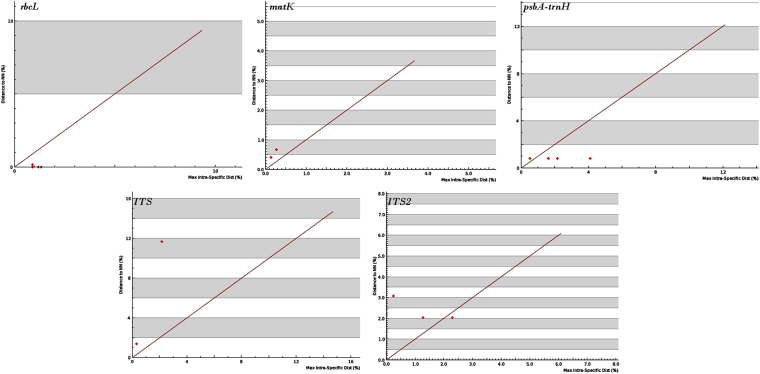
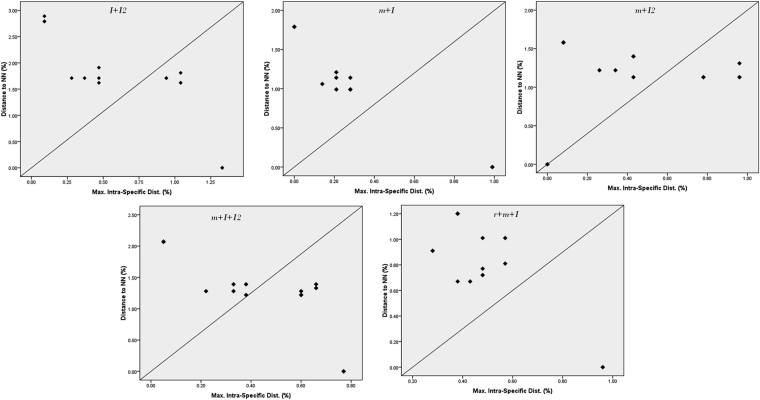
The steno-endemic species of genus Decalepis are highly threatened by destructive wild harvesting. The medicinally important fleshy tuberous roots of Decalepis hamiltonii are traded as substitute, to meet the international market demand of Hemidesmus indicus. In addition, the tuberous roots of all three species of Decalepis possess similar exudates and texture, which challenges the ability of conventional techniques alone to perform accurate species authentication. This study was undertaken to generate DNA barcodes that could be utilized in monitoring and curtailing the illegal trade of these endangered species. The DNA barcode reference library was developed in BOLD database platform for candidate barcodes rbcL, matK, psbA-trnH, ITS and ITS2. The average intra-specific variations (0-0.27%) were less than the distance to nearest neighbour (0.4-11.67%) with matK and ITS. Anchoring the coding region rbcL in multigene tiered approach, the combination rbcL + matK + ITS yielded 100% species resolution, using the least number of loci combinations either with PAUP or BLOG methods to support a character-based approach. Species-specific SNP position (230 bp) in the matK region that is characteristic of D. hamiltonii could be used to design specific assays, enhancing its applicability for direct use in CITES enforcement for distinguishing it from H. indicus.
stenogénicas 属的地方性物种受到破坏性野生采集的严重威胁。药用重要的肉质块根 Decalepis hamiltonii 作为替代品进行交易,以满足国际市场对 Hemidesmus indicus 的需求。此外,这三种 Decalepis 物种的块根都具有相似的分泌物和质地,这使得单凭常规技术难以准确进行物种鉴定。本研究旨在生成 DNA 条码,用于监测和遏制这些濒危物种的非法贸易。候选条码 rbcL、matK、psbA-trnH、ITS 和 ITS2 的 DNA 条码参考库在 BOLD 数据库平台中开发。种内变异(0-0.27%)小于最近邻距离(0.4-11.67%),matK 和 ITS 也是如此。将编码区 rbcL 锚定在多基因分层方法中,使用最少数量的基因座组合,无论是使用 PAUP 还是 BLOG 方法,都可以支持基于字符的方法,rbcL + matK + ITS 的组合可实现 100%的物种分辨率。matK 区域中特有的 D. hamiltonii 物种特异性 SNP 位置(230bp)可用于设计特定的检测,增强其在 CITES 执法中的直接适用性,用于将其与 H. indicus 区分开来。