Linard Catherine, Kabaria Caroline W, Gilbert Marius, Tatem Andrew J, Gaughan Andrea E, Stevens Forrest R, Sorichetta Alessandro, Noor Abdisalan M, Snow Robert W
Spatial Epidemiology Lab (SpELL), Université Libre de Bruxelles, Brussels, Belgium.
Department of Geography, Université de Namur, Namur, Belgium.
Int J Digit Earth. 2017 Oct 3;10(10):1017-1029. doi: 10.1080/17538947.2016.1275829. Epub 2017 Jan 11.
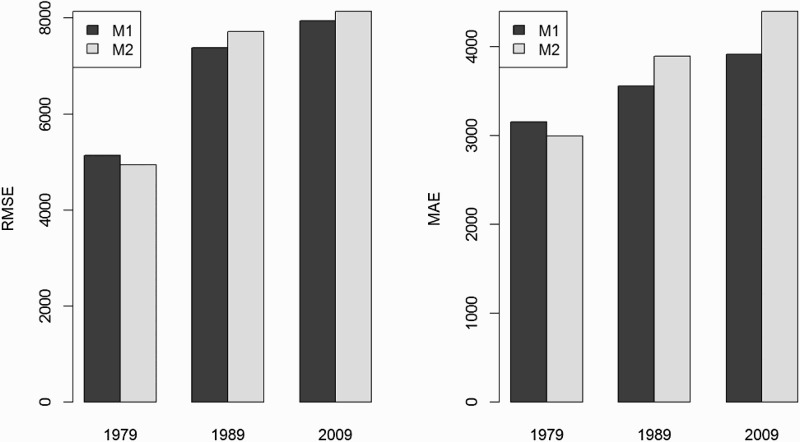
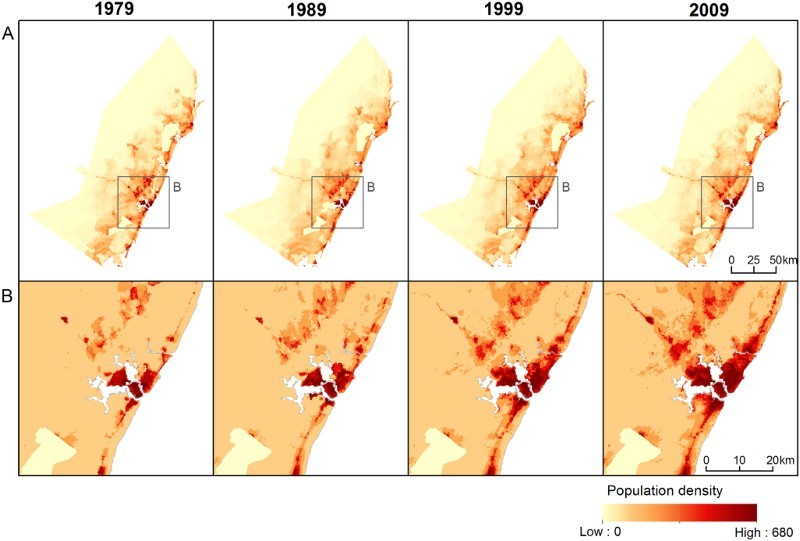
Large-scale gridded population datasets are usually produced for the year of input census data using a top-down approach and projected backward and forward in time using national growth rates. Such temporal projections do not include any subnational variation in population distribution trends and ignore changes in geographical covariates such as urban land cover changes. Improved predictions of population distribution changes over time require the use of a limited number of covariates that are time-invariant or temporally explicit. Here we make use of recently released multi-temporal high-resolution global settlement layers, historical census data and latest developments in population distribution modelling methods to reconstruct population distribution changes over 30 years across the Kenyan Coast. We explore the methodological challenges associated with the production of gridded population distribution time-series in data-scarce countries and show that trade-offs have to be found between spatial and temporal resolutions when selecting the best modelling approach. Strategies used to fill data gaps may vary according to the local context and the objective of the study. This work will hopefully serve as a benchmark for future developments of population distribution time-series that are increasingly required for population-at-risk estimations and spatial modelling in various fields.
大规模网格化人口数据集通常采用自上而下的方法,根据输入的人口普查数据年份生成,并使用国家增长率在时间上进行前后推算。这种时间推算不包括人口分布趋势的任何次国家层面的变化,并且忽略了地理协变量的变化,如城市土地覆盖变化。要更好地预测人口分布随时间的变化,需要使用数量有限的随时间不变或具有时间明确性的协变量。在此,我们利用最近发布的多时态高分辨率全球住区图层、历史人口普查数据以及人口分布建模方法的最新进展,来重建肯尼亚海岸30年来的人口分布变化。我们探讨了数据稀缺国家在生成网格化人口分布时间序列过程中面临的方法学挑战,并表明在选择最佳建模方法时,必须在空间和时间分辨率之间进行权衡。用于填补数据空白的策略可能因当地情况和研究目标而异。这项工作有望为人口分布时间序列的未来发展提供一个基准,而人口分布时间序列在各个领域的风险人群估计和空间建模中越来越需要。