Language and Genetics Department, Max Planck Institute for Psycholinguistics, The Netherlands; Donders Institute for Brain, Cognition and Behaviour, Radboud University, Nijmegen, The Netherlands; Medical Research Council Integrative Epidemiology Unit, University of Bristol, Bristol, United Kingdom.
Department of Human and Molecular Genetics, Institute for Psychiatric and Behavioral Genetics, Commonwealth University School of Medicine, Richmond, Virginia.
Biol Psychiatry. 2018 Apr 1;83(7):598-606. doi: 10.1016/j.biopsych.2017.09.020. Epub 2017 Sep 28.
Recent analyses of trait-disorder overlap suggest that psychiatric dimensions may relate to distinct sets of genes that exert maximum influence during different periods of development. This includes analyses of social communication difficulties that share, depending on their developmental stage, stronger genetic links with either autism spectrum disorder or schizophrenia. We developed a multivariate analysis framework in unrelated individuals to model directly the developmental profile of genetic influences contributing to complex traits, such as social communication difficulties, during an approximately 10-year period spanning childhood and adolescence.
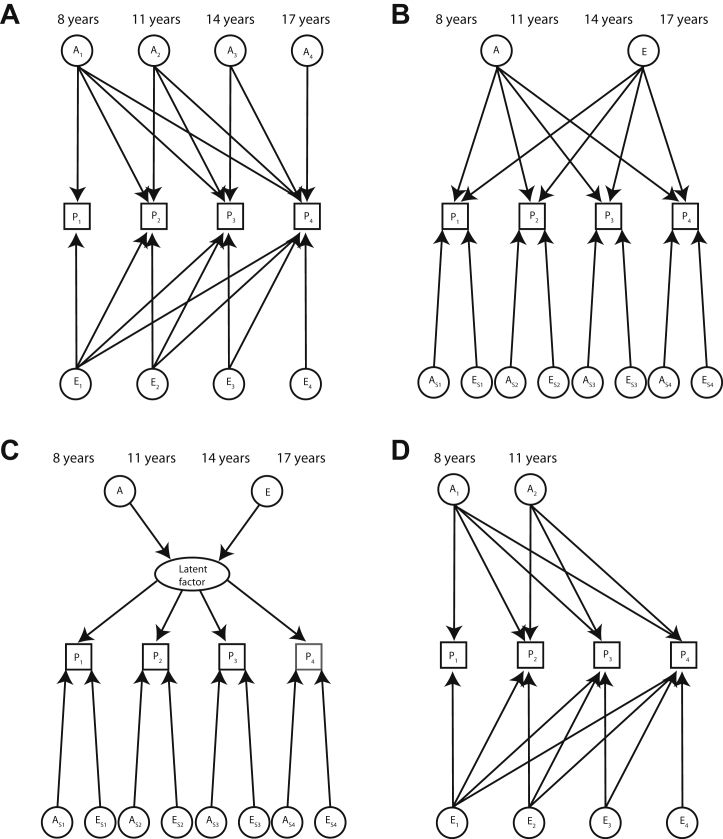
Longitudinally assessed quantitative social communication problems (N ≤ 5551) were studied in participants from a United Kingdom birth cohort (Avon Longitudinal Study of Parents and Children; age range, 8-17 years). Using standardized measures, genetic architectures were investigated with novel multivariate genetic-relationship-matrix structural equation models incorporating whole-genome genotyping information. Analogous to twin research, genetic-relationship-matrix structural equation models included Cholesky decomposition, common pathway, and independent pathway models.
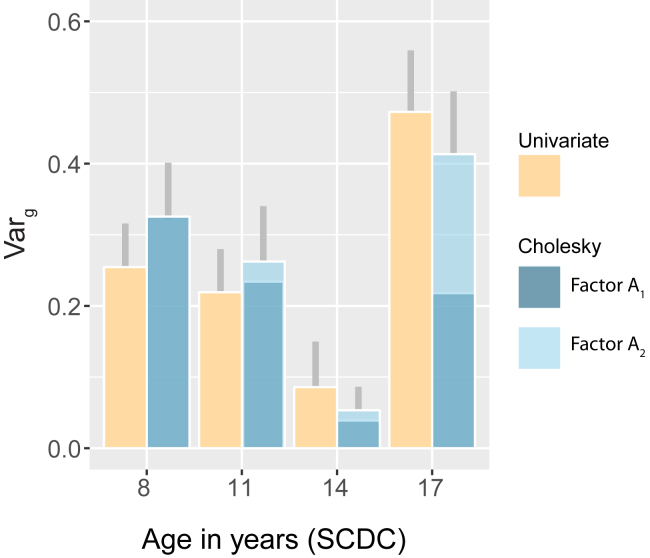
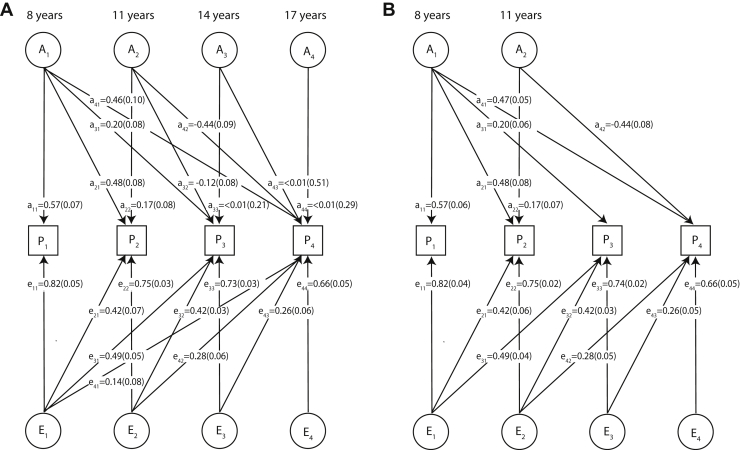
A two-factor Cholesky decomposition model described the data best. One genetic factor was common to Social Communication Disorder Checklist measures across development; the other accounted for independent variation at 11 years and later, consistent with distinct developmental profiles in trait-disorder overlap. Importantly, genetic factors operating at 8 years explained only approximately 50% of genetic variation at 17 years.
Using latent factor models, we identified developmental changes in the genetic architecture of social communication difficulties that enhance the understanding of autism spectrum disorder- and schizophrenia-related dimensions. More generally, genetic-relationship-matrix structural equation models present a framework for modeling shared genetic etiologies between phenotypes and can provide prior information with respect to patterns and continuity of trait-disorder overlap.
最近对特质-障碍重叠的分析表明,精神科维度可能与不同的基因集相关,这些基因在不同的发育阶段发挥最大的影响。这包括对社会交流困难的分析,这些困难根据其发育阶段,与自闭症谱系障碍或精神分裂症有更强的遗传联系。我们在无亲缘关系的个体中开发了一种多变量分析框架,以直接模拟在大约 10 年的儿童期和青春期期间对复杂特质(如社会交流困难)有贡献的遗传影响的发育特征。
在来自英国出生队列(阿冯纵向研究父母和儿童;年龄范围为 8-17 岁)的参与者中,纵向评估了定量的社会交流问题(N≤5551)。使用标准化的测量方法,使用包含全基因组基因分型信息的新型多变量遗传关系矩阵结构方程模型来研究遗传结构。类似于双胞胎研究,遗传关系矩阵结构方程模型包括 Cholesky 分解、共同途径和独立途径模型。
双因素 Cholesky 分解模型最能描述数据。一个遗传因素是社会沟通障碍检查表测量在整个发育过程中的共同因素;另一个因素解释了 11 岁及以后的独立变异,与特质-障碍重叠的不同发育特征一致。重要的是,8 岁时起作用的遗传因素仅解释了 17 岁时遗传变异的大约 50%。
使用潜在因子模型,我们确定了社会交流困难的遗传结构在发育过程中的变化,增强了对自闭症谱系障碍和精神分裂症相关维度的理解。更一般地说,遗传关系矩阵结构方程模型为模型之间的共享遗传病因提供了一个框架表型和特质-障碍重叠的模式和连续性。