Center for Behavioral Cardiovascular Health, Department of Medicine, Columbia University, New York, NY, USA.
Institute of Human Nutrition, Columbia University, New York, NY, USA.
J Psychiatr Res. 2018 Jan;96:196-202. doi: 10.1016/j.jpsychires.2017.10.015. Epub 2017 Oct 21.
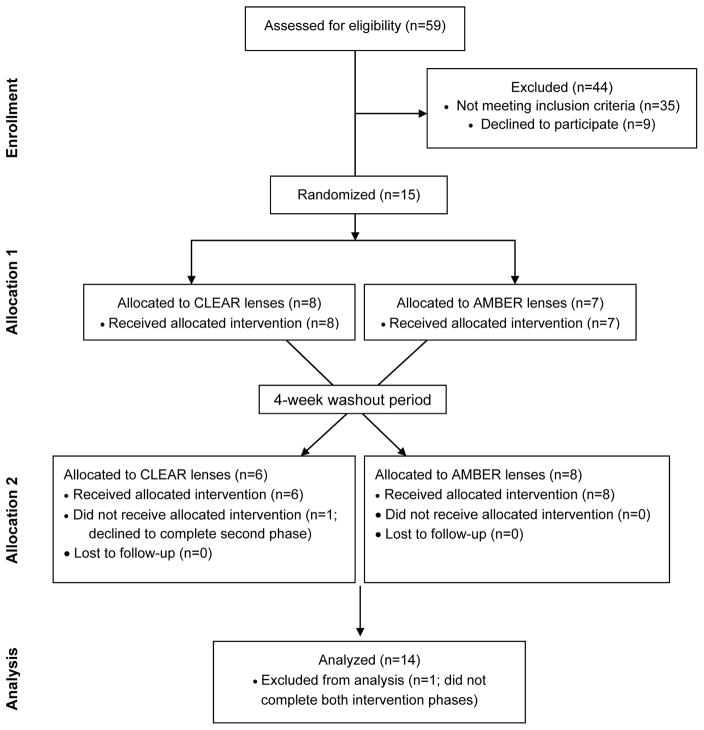
The use of light-emitting electronic devices before bedtime may contribute to or exacerbate sleep problems. Exposure to blue-wavelength light in particular from these devices may affect sleep by suppressing melatonin and causing neurophysiologic arousal. We aimed to determine if wearing amber-tinted blue light-blocking lenses before bedtime improves sleep in individuals with insomnia. Fourteen individuals (n = 8 females; age ± SD 46.6 ± 11.5 y) with insomnia symptoms wore blue light-blocking amber lenses or clear placebo lenses in lightweight wraparound frames for 2 h immediately preceding bedtime for 7 consecutive nights in a randomized crossover trial (4-wk washout). Ambulatory sleep measures included the Pittsburgh Insomnia Rating Scale (PIRS) completed at the end of each intervention period, and daily post-sleep questionnaire and wrist-actigraphy. PIRS total scores, and Quality of Life, Distress, and Sleep Parameter subscales, were improved in amber vs. clear lenses condition (p-values <0.05). Reported wake-time was significantly delayed, and mean subjective total sleep time (TST), overall quality, and soundness of sleep were significantly higher (p-values <0.05) in amber vs. clear lenses condition over the 7-d intervention period. Actigraphic measures of TST only were significantly higher in amber vs. clear lenses condition (p = 0.035). Wearing amber vs. clear lenses for 2-h preceding bedtime for 1 week improved sleep in individuals with insomnia symptoms. These findings have health relevance given the broad use of light-emitting devices before bedtime and prevalence of insomnia. Amber lenses represent a safe, affordable, and easily implemented therapeutic intervention for insomnia symptoms.
ClinicalTrials.gov Identifier: NCT02698800.
目的:在睡前使用发光电子设备可能会导致或加重睡眠问题。这些设备发出的蓝光尤其会通过抑制褪黑素和引起神经生理唤醒而影响睡眠。本研究旨在确定在睡前佩戴琥珀色滤光蓝光阻断镜片是否能改善失眠患者的睡眠。
方法:14 名(8 名女性;年龄±标准差 46.6±11.5 岁)失眠症状患者参加了一项随机交叉试验(4 周洗脱期),在连续 7 晚睡前 2 小时内,他们分别佩戴轻便的全包式蓝光阻断琥珀色镜片或透明安慰剂镜片。在每个干预期结束时,通过匹兹堡睡眠质量指数(PIRS)评估睡眠,每天进行睡眠后问卷调查和腕动图监测。
结果:与透明镜片相比,琥珀色镜片组的 PIRS 总分、生活质量、痛苦和睡眠参数亚量表评分均有改善(p 值<0.05)。报告的醒来时间显著延迟,主观总睡眠时间(TST)、整体睡眠质量和睡眠的安稳度在琥珀色镜片组显著高于透明镜片组(p 值<0.05)。在 7 天的干预期间,琥珀色镜片组的 TST 等 actigraphic 测量指标也显著高于透明镜片组(p=0.035)。
结论:与透明镜片相比,在睡前 2 小时内佩戴琥珀色镜片可改善失眠患者的睡眠。鉴于睡前发光设备的广泛使用和失眠的高发病率,这些发现具有重要的健康意义。琥珀色镜片是一种安全、经济且易于实施的失眠治疗干预手段。