Oxford University Clinical Research Unit, Wellcome Trust Major Overseas Programme, Ho Chi Minh City, Vietnam.
Mahidol Oxford Tropical Medicine Research Unit, Faculty of Tropical Medicine, Mahidol University, Bangkok, Thailand.
Malar J. 2017 Nov 6;16(1):444. doi: 10.1186/s12936-017-2091-6.
Prophylaxis for high-risk populations, such as forest workers, could be one component for malaria elimination in the Greater Mekong Sub-region. A study was conducted to assess the malaria incidence in forest rangers and the feasibility of malaria prophylaxis for rangers sleeping in forest camps.
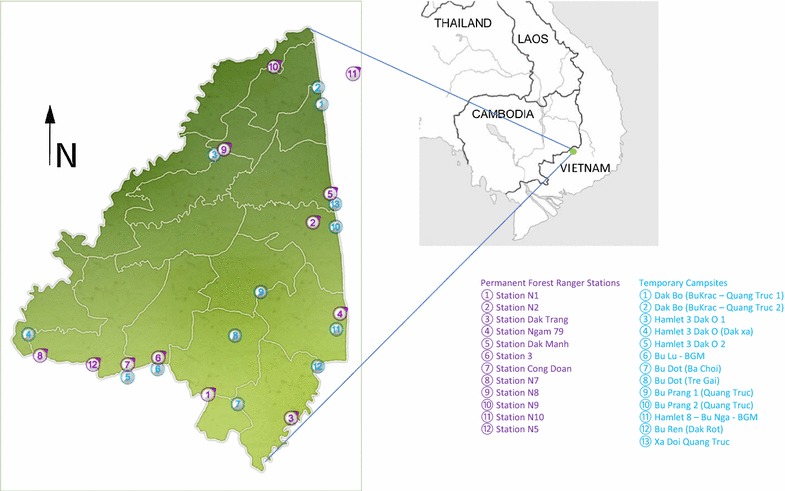
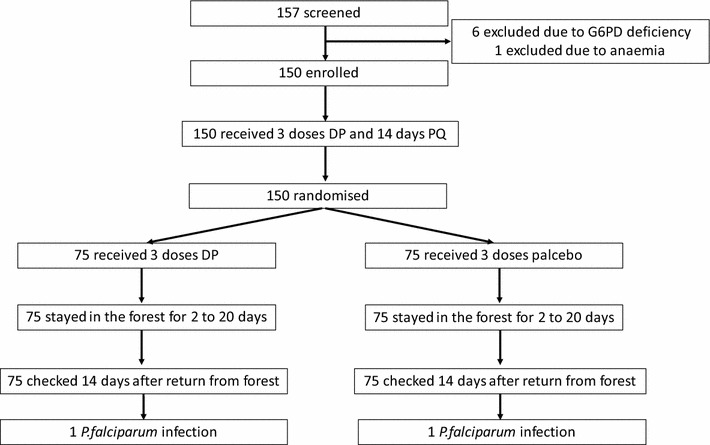
Forest rangers deployed in the Bu Gia Map National Park, Vietnam were invited to participate in the study. Plasmodium infections were cleared using presumptive treatment, irrespective of malaria status, with a 3-day course dihydroartemisinin/piperaquine (DP) and a 14-day course of primaquine. Before returning to the forest, study participants were randomly allocated to a 3-day course of DP or placebo. Fifteen days after returning from their forest deployment the participants were tested for Plasmodium infections using uPCR.
Prior to treatment, 30 of 150 study participants (20%) were found to be infected with Plasmodium. Seventeen days (median) after enrolment the rangers were randomized to DP or placebo 2 days before returning to forest camps where they stayed between 2 and 20 days (median 9.5 days). One ranger in the DP-prophylaxis arm and one in the placebo arm were found to be infected with Plasmodium falciparum 15 days (median) after returning from the forest. The evaluable P. falciparum isolates had molecular markers indicating resistance to artemisinins (K13-C580Y) and piperaquine (plasmepsin), but none had multiple copies of pfmdr1 associated with mefloquine resistance.
Anti-malarial prophylaxis in forest rangers is feasible. The findings of the study highlight the threat of multidrug-resistant malaria. Trial registration NCT02788864.
为高危人群(如森林工作者)进行预防措施可能是大湄公河次区域消除疟疾的一个组成部分。本研究旨在评估护林员的疟疾发病率以及为在森林营地睡觉的护林员进行疟疾预防的可行性。
邀请部署在越南Bu Gia Map 国家公园的护林员参加研究。所有参与者均接受了为期 3 天的双氢青蒿素/哌喹(DP)和 14 天的伯氨喹的假定治疗,无论疟疾状态如何,以清除疟原虫感染。在返回森林之前,研究参与者被随机分配到 DP 或安慰剂组。返回森林 15 天后,使用 uPCR 检测参与者是否存在疟原虫感染。
在治疗前,150 名研究参与者中有 30 人(20%)被发现感染了疟原虫。登记后 17 天(中位数),护林员被随机分为 DP 或安慰剂组,在返回森林营地前 2 天开始服用药物,他们在森林营地停留 2 至 20 天(中位数 9.5 天)。在返回森林 15 天后,DP 预防组和安慰剂组各有一名护林员被发现感染恶性疟原虫。可评估的恶性疟原虫分离株具有对青蒿素(K13-C580Y)和哌喹(质体)的耐药性分子标记,但均无与氯喹耐药相关的 pfmdr1 多重拷贝。
为护林员提供抗疟预防措施是可行的。该研究结果突显了耐多药疟疾的威胁。试验注册 NCT02788864。