Faculty of Infectious and Tropical Diseases, London School of Hygiene and Tropical Medicine, London, UK.
Mahidol Oxford Tropical Medicine Research Unit, Faculty of Tropical Medicine, Mahidol University, Bangkok, Thailand.
Malar J. 2019 Feb 1;18(1):32. doi: 10.1186/s12936-019-2666-5.
Despite decreases in incidence and related mortality, malaria remains a major public health challenge in the Greater Mekong Sub-region (GMS). The emergence of artemisinin resistance threatens these gains and has prompted efforts to accelerate elimination in the region. In the GMS, transmission now clusters in hotspots along international borders and among high-risk populations, including forest-goers. To eliminate malaria in the region, interventions must target such hard-to-reach populations. This review provides a comprehensive overview of the qualitative research on behaviours and perceptions that influence uptake of and adherence to malaria interventions among forest-goers in the GMS.
A systematic search strategy was used to identify relevant sources, including database (OVID SP, PubMed, ISI Web of Knowledge) and bibliographic searches. Relevant findings from qualitative research methods were extracted and thematic analysis undertaken.
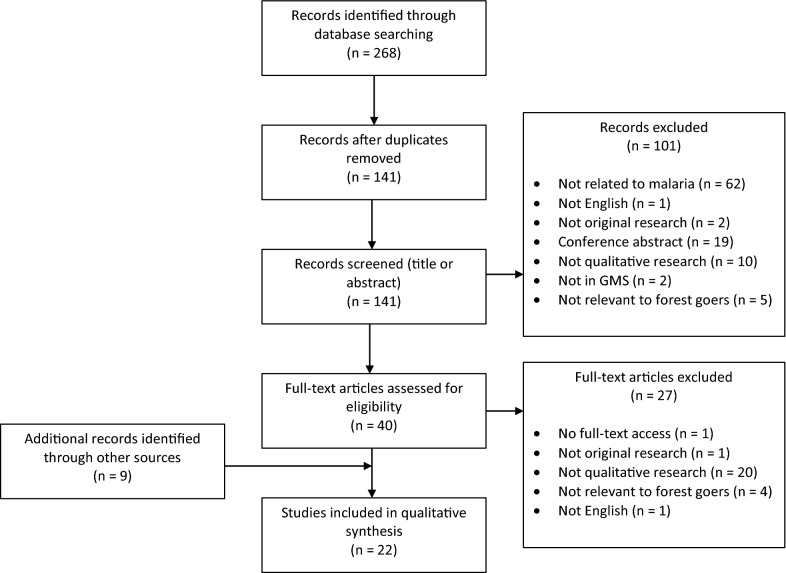
Of 268 sources retrieved in searches twenty-two were reviewed. Most reported studies were conducted in Cambodia (n = 10), and were published after 2014 (n = 16). Four major themes emerged that are particularly relevant to the design of intervention packages targeted at forest-goers: (1) understanding of malaria and perceived risk; (2) preventive measures used when visiting the forest; (3) behaviours that put forest-goers at risk of infection; and, (4) malaria-related treatment seeking. There were notable differences across the reviewed articles that suggest the need for a locally tailored approach.
A more detailed characterization of forest activities is needed but research on this topic raises methodological challenges. Current vector control measures have limitations, with use of insecticidal-treated nets, hammocks and repellents influenced by the type of forest activities and the characteristics of these measures. In contrast, anti-malarial drugs, for example, as chemoprophylaxis, hold promise but require further evaluation.
尽管发病率和相关死亡率有所下降,但疟疾仍是大湄公河次区域(GMS)的主要公共卫生挑战。青蒿素耐药性的出现威胁到这些成果,并促使该地区加快消除疟疾。在 GMS,传播现在集中在沿国际边界和高危人群(包括森林工作者)中的热点地区。为了在该地区消除疟疾,干预措施必须针对这些难以到达的人群。本综述全面概述了影响 GMS 森林工作者对疟疾干预措施的接受和坚持的行为和认知的定性研究。
使用系统搜索策略来识别相关来源,包括数据库(OVID SP、PubMed、ISI Web of Knowledge)和文献检索。从定性研究方法中提取相关发现并进行主题分析。
在搜索中检索到的 268 个来源中有 22 个进行了审查。大多数报告的研究是在柬埔寨进行的(n=10),并且是在 2014 年之后发表的(n=16)。出现了四个主要主题,这些主题特别与针对森林工作者设计干预措施包相关:(1)对疟疾的理解和感知风险;(2)在访问森林时使用的预防措施;(3)使森林工作者面临感染风险的行为;以及,(4)与疟疾相关的治疗寻求。在审查的文章中存在显著差异,这表明需要采用本地化的方法。
需要更详细地描述森林活动,但该主题的研究提出了方法学挑战。目前的病媒控制措施存在局限性,使用经杀虫剂处理的蚊帐、吊床和驱虫剂受到森林活动类型和这些措施特点的影响。相比之下,抗疟药物,例如化学预防,有希望但需要进一步评估。