Li Yan, Bian Wei, Larson Peder, Crane Jason C, Parvathaneni Prasanna, Nagarajan Srikantan, Nelson Sarah J
Department of Radiology and Biomedical Imaging, University of California, San Francisco, San Francisco, CA, United States.
Department of Radiology, Stanford University, Palo Alto, CA, United States.
Front Hum Neurosci. 2017 Oct 25;11:506. doi: 10.3389/fnhum.2017.00506. eCollection 2017.
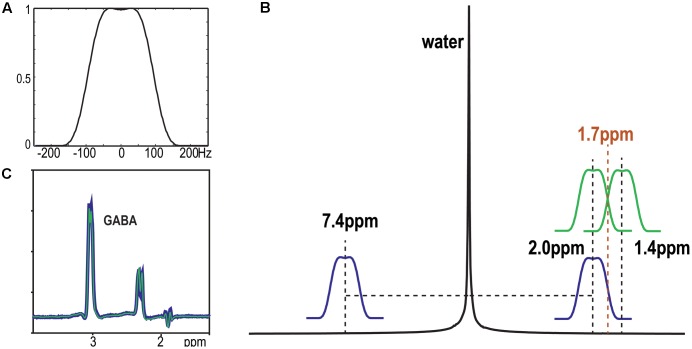
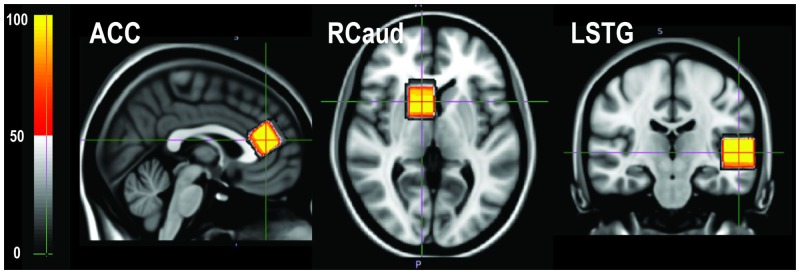
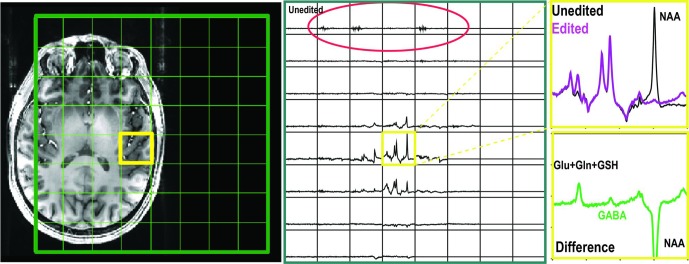
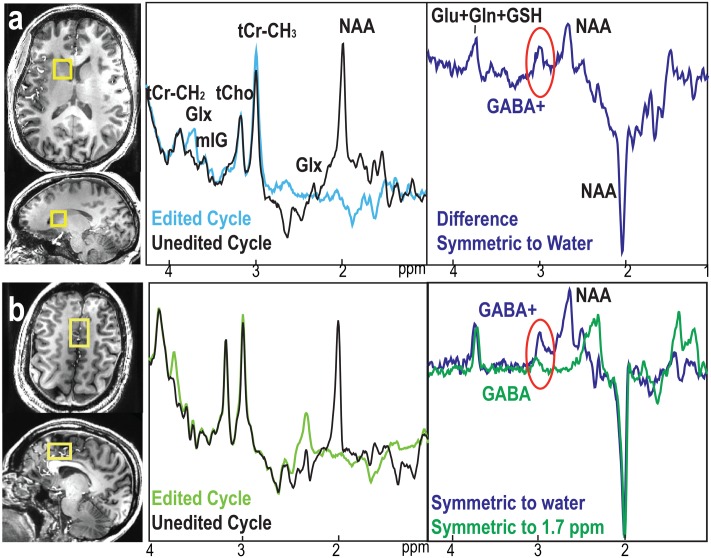
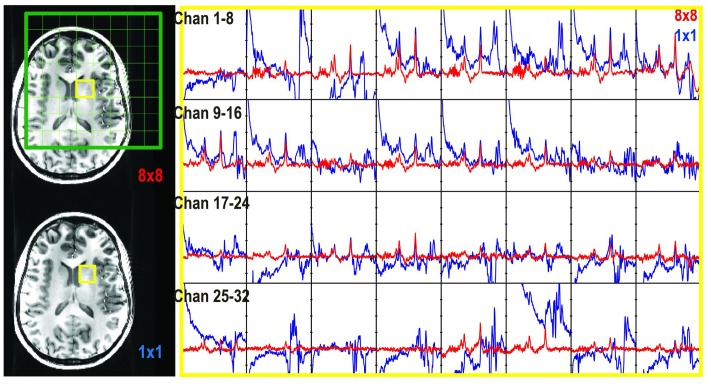
To evaluate spectral acquisition processes important for obtaining reliable and reproducible γ-aminobutyric acid (GABA) signals from volunteers in brain regions that are frequently used for neuroimaging studies [anterior cingulate cortex (ACC), superior temporal gyrus, and caudate] at ultra-high field. Ten healthy volunteers were studied using a single-voxel Point-RESolved Spectrosocpy (PRESS) sequence with band selective inversion with gradient dephasing pulses (BASING). The editing pulse was designed to be symmetrically placed at 2.0 and 1.4 ppm in the two cycles to reduce the co-editing of macro-molecules (MM). Spectral data were obtained with phase encoding matrix 8 × 8 × 1 and two editing cycles or 1 × 1 × 1 and 64 editing/64 non-editing. The total acquisition time was approximately 4.5 min for each acquisition. An automated MRS prescription method was utilized for the placement of the GABA scan location in 5/10 subjects. Three regions of interest were predefined in the MNI152 space and then registered and transformed to subject space. These volunteers also had repeat scans to examine between-session reproducibility. The placement of editing pulses symmetrically at 1.7 ppm reduced the effect of MM contributions and provided more accurate GABA estimation. Chemical shift misregistration errors caused by classic PRESS localization sequence are more significant at ultra-high field strength. Therefore, a large over-excitation factor was needed to reduce this error. Furthermore, the inefficiency of saturation bands and unspoiled coherence could also interfere with the quality of the data. Reliable recovery of metabolite signals resulted from the implementation of 8 × 8 × 1 phase encoding that successfully removed artifacts and errors, without compromising the total acquisition time. Between successive scans on the same subject, dice overlap ratios of the excited spectral volume between the two scans were in the range of 92-95%. Within subject variability of metabolites between two repeat scans was smaller in the ACC and left superior temporal gyrus when compared to that in the right caudate, with averaged coefficients of variation being 3.6, 6.0, and 16.9%, respectively. This study demonstrated the feasibility of obtaining reliable and reproducible GABA measurements at ultra-high field.
为了评估光谱采集过程,该过程对于在超高场强下从常用于神经成像研究的脑区(前扣带回皮质(ACC)、颞上回和尾状核)的志愿者中获取可靠且可重复的γ-氨基丁酸(GABA)信号非常重要。使用具有带选择性反转和梯度去相脉冲(BASING)的单体素点分辨光谱学(PRESS)序列对10名健康志愿者进行了研究。编辑脉冲设计为在两个周期中对称地置于2.0和1.4 ppm处,以减少大分子(MM)的共编辑。光谱数据通过相位编码矩阵8×8×1和两个编辑周期或1×1×1和64次编辑/64次非编辑获得。每次采集的总采集时间约为4.5分钟。在5/10名受试者中,采用自动磁共振波谱处方方法来确定GABA扫描位置。在MNI152空间中预先定义了三个感兴趣区域,然后将其配准并转换到受试者空间。这些志愿者还进行了重复扫描以检查不同扫描间的可重复性。将编辑脉冲对称地置于1.7 ppm处可降低MM贡献的影响,并提供更准确的GABA估计。经典PRESS定位序列引起的化学位移配准误差在超高场强下更为显著。因此,需要一个大的过激发因子来减少此误差。此外,饱和带的低效性和未破坏的相干性也可能干扰数据质量。8×8×1相位编码的实施成功消除了伪影和误差,在不影响总采集时间的情况下实现了代谢物信号的可靠恢复。在同一受试者的连续扫描之间,两次扫描之间激发光谱体积的骰子重叠率在92 - 95%范围内。与右侧尾状核相比,前扣带回皮质和左侧颞上回两次重复扫描之间代谢物的受试者内变异性较小,平均变异系数分别为3.6%、6.0%和16.9%。这项研究证明了在超高场强下获得可靠且可重复的GABA测量值的可行性。