Liu Yu-Chi, Williams Geraint P, George Ben L, Soh Yu Qiang, Seah Xin Yi, Peh Gary Swee Lim, Yam Gary Hin Fai, Mehta Jodhbir S
Tissue Engineering and Stem Cell Group, Singapore Eye Research Institute, Singapore.
Singapore National Eye Centre, Singapore.
Mol Vis. 2017 Oct 27;23:753-764. eCollection 2017.
To explore the optimal lenticule storage conditions that maintain lenticule integrity and clarity.
A total of 99 lenticules obtained from myopic patients undergoing small incision lenticule extraction (SMILE) were divided into four combinations for short-term storage conditions: PBS, Dulbecco's Modified Eagle's Medium (DMEM), Optisol GS, or anhydrous glycerol. Two thirds of the lenticules were further stored for 4 weeks under eight different conditions. Clarity evaluation with transmittance measurements, cell-death assays with terminal deoxynucleotidyl transferase-mediated nick end labeling assay (TUNEL), collagen fibril spacing and necrotic response assessed with transmission electron microscopy (TEM), and immunohistochemistry analysis for human leukocyte antigens (HLAs) and CD45 for immunogenicity, and matrix metalloproteinase (MMP)-2 for keratocyte response, were undertaken at baseline, 48 h (short term), and 4 weeks (long term).
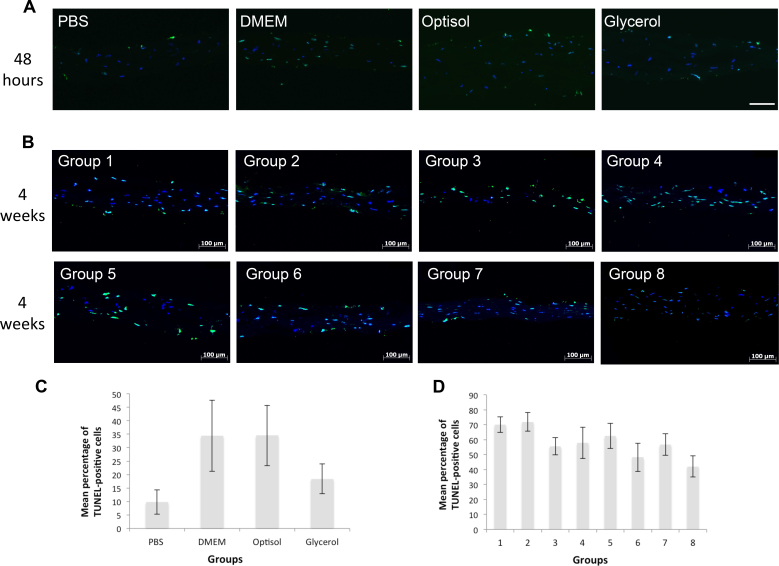
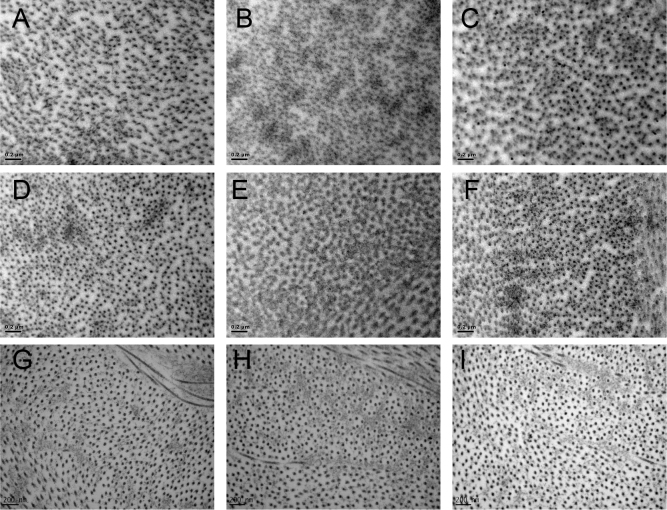
The TUNEL and immunogenicity results were comparable among the groups. The mean percentage of TUNEL-positive cells across all groups was 24.3% ± 11.8% and 62.9% ± 20.7% at the 48 h and 4 week time points, respectively. HLA-ABC+, HLA-DR+, and CD45+ cells were extremely rare, and MMP-2 expression ranged from non-detectable to minimal, under all conditions at all time points. Transmittance at 4 weeks was significantly different among groups with the greatest maintenance of clarity seen in the lenticules stored initially in DMEM at 4 °C for 48 h followed by cryopreservation in serum-free medium or glycerol at 4 °C followed by storage at room temperature. At TEM analysis at 4 weeks, the lenticules cryopreserved in liquid nitrogen, regardless of storage solutions, had significantly narrower inter-fibrillar distance than controls, while glycerol-preserved lenticules, at either room temperature or -80 °C, maintained the inter-fibrillar distance.
Clarity, structural integrity, and low immunogenicity under various conditions, at 4 °C or room temperature for short-term storage, offer encouragement for lenticule storage. It can be undertaken without access to s specialized and potentially expensive laboratory setup at least within the first 48 h before transportation to larger facilities for long-term storage.
探索能维持晶状体完整性和透明度的最佳晶状体储存条件。
从接受小切口晶状体摘除术(SMILE)的近视患者中获取的99个晶状体被分为四组,用于短期储存条件:磷酸盐缓冲液(PBS)、杜氏改良伊格尔培养基(DMEM)、Optisol GS或无水甘油。三分之二的晶状体在八种不同条件下进一步储存4周。在基线、48小时(短期)和4周(长期)时,通过透射率测量进行透明度评估,通过末端脱氧核苷酸转移酶介导的缺口末端标记法(TUNEL)进行细胞死亡检测,通过透射电子显微镜(TEM)评估胶原纤维间距和坏死反应,通过免疫组织化学分析人白细胞抗原(HLAs)和CD45的免疫原性以及基质金属蛋白酶(MMP)-2的角膜细胞反应。
各实验组间TUNEL和免疫原性结果具有可比性。在48小时和4周时间点,所有组中TUNEL阳性细胞的平均百分比分别为24.3%±11.8%和62.9%±20.7%。在所有条件下的所有时间点,HLA-ABC +、HLA-DR +和CD45 +细胞极为罕见,MMP-2表达范围从不可检测到最低。4周时,各实验组间的透射率存在显著差异,最初在4°C下于DMEM中储存48小时,随后在4°C下于无血清培养基或甘油中冷冻保存,然后在室温下储存的晶状体透明度维持最佳。在4周时的TEM分析中,无论储存溶液如何,液氮冷冻保存的晶状体的纤维间距离均显著窄于对照组,而在室温或-80°C下甘油保存的晶状体则保持了纤维间距离。
在4°C或室温下短期储存的各种条件下,晶状体具有透明度、结构完整性和低免疫原性,这为晶状体储存提供了支持。至少在运输到大型设施进行长期储存之前的前48小时内,无需专门且可能昂贵的实验室设备即可进行储存。