Mezuk Briana, Ratliff Scott, Concha Jeannie B, Abdou Cleopatra M, Rafferty Jane, Lee Hedwig, Jackson James S
Department of Epidemiology, University of Michigan School of Public Health, Ann Arbor, MI USA.
Institute for Social Research, University of Michigan, Ann Arbor MI USA.
SSM Popul Health. 2017 Dec;3:455-463. doi: 10.1016/j.ssmph.2017.05.004. Epub 2017 May 6.
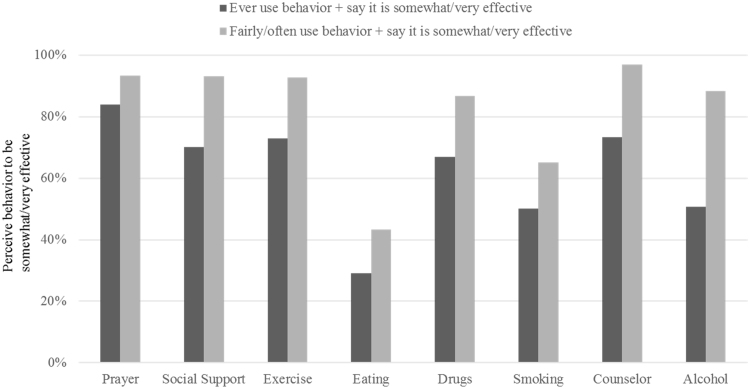
Health-related behaviors, such as smoking, alcohol use, exercise, and diet, are major determinants of physical health and health disparities. However, a growing body of experimental research in humans and animals also suggests these behaviors can impact the ways our bodies respond to stress, such that they modulate (that is, serve as a means to self-regulate or cope with) the deleterious impact of stressful experiences on mental health. A handful of epidemiologic studies have investigated the intersection between stress and health behaviors on health disparities (both mental and physical), with mixed results. In this study we use a novel instrument designed to explicitly measure the self-regulatory motivations and perceived effectiveness of eight health-related self-regulatory behaviors (smoking, alcohol, drug use, overeating, prayer, exercise, social support, talking with a councilor) in a subset of the Health and Retirement Study (N=1,354, Mean age=67, 54% female). We find that these behaviors are commonly endorsed as self-regulatory stress-coping strategies, with prayer, social support, exercise, and overeating used most frequently. The likelihood of using particular behaviors as self-regulatory strategies varied significantly by sex, but not by race/ethnicity, education, or wealth. We also find that greater stress exposure is associated with higher likelihood of using these behaviors to self-regulate feelings of emotional distress, particularly health-harming behaviors like smoking, alcohol, and overeating. These findings provide an important link between sociological and psychological theoretical models on stress and empirical epidemiological research on social determinants of health and health disparities.
与健康相关的行为,如吸烟、饮酒、运动和饮食,是身体健康和健康差异的主要决定因素。然而,越来越多的人类和动物实验研究也表明,这些行为会影响我们身体对压力的反应方式,从而调节(即作为一种自我调节或应对的手段)压力经历对心理健康的有害影响。一些流行病学研究调查了压力与健康行为在健康差异(包括心理和身体方面)上的交叉点,结果不一。在本研究中,我们使用了一种新颖的工具,旨在明确测量健康与退休研究(Health and Retirement Study)子集中八种与健康相关的自我调节行为(吸烟、饮酒、吸毒、暴饮暴食、祈祷、运动、社会支持、与顾问交谈)的自我调节动机和感知效果(N = 1354,平均年龄 = 67岁,54%为女性)。我们发现,这些行为通常被认可为自我调节压力的应对策略,其中祈祷、社会支持、运动和暴饮暴食使用最为频繁。将特定行为用作自我调节策略的可能性因性别而异,但不因种族/民族、教育程度或财富而有所不同。我们还发现,更大的压力暴露与使用这些行为来自我调节情绪困扰的可能性更高有关,尤其是吸烟、饮酒和暴饮暴食等有害健康的行为。这些发现为关于压力的社会学和心理学理论模型与关于健康和健康差异的社会决定因素的实证流行病学研究之间提供了重要联系。