Huang Jer-Shyung, Yang Cheng-Mei, Wang Jyh-Seng, Liou Huei-Han, Hsieh I-Chien, Li Guan-Cheng, Huang Sin-Jhih, Shu Chih-Wen, Fu Ting-Ying, Lin Yun-Chung, Ger Luo-Ping, Liu Pei-Feng
Department of Radiology, Kaohsiung Veterans General Hospital, Kaohsiung, Taiwan.
National Yang-Ming University School of Medicine, Taipei, Taiwan.
Oncotarget. 2017 Aug 24;8(48):84237-84247. doi: 10.18632/oncotarget.20494. eCollection 2017 Oct 13.
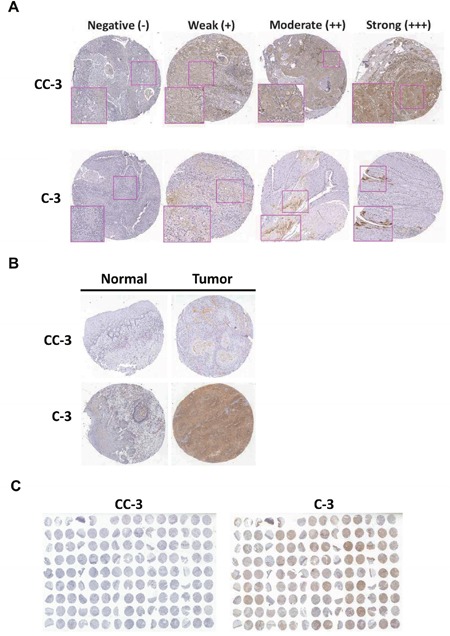
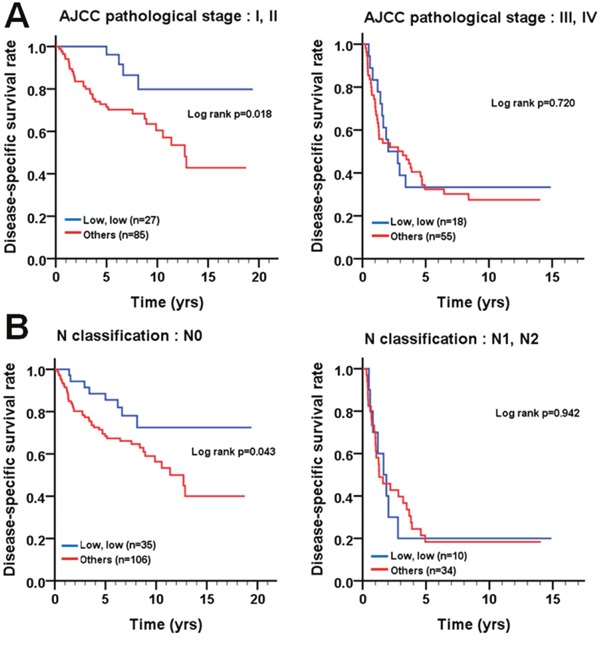
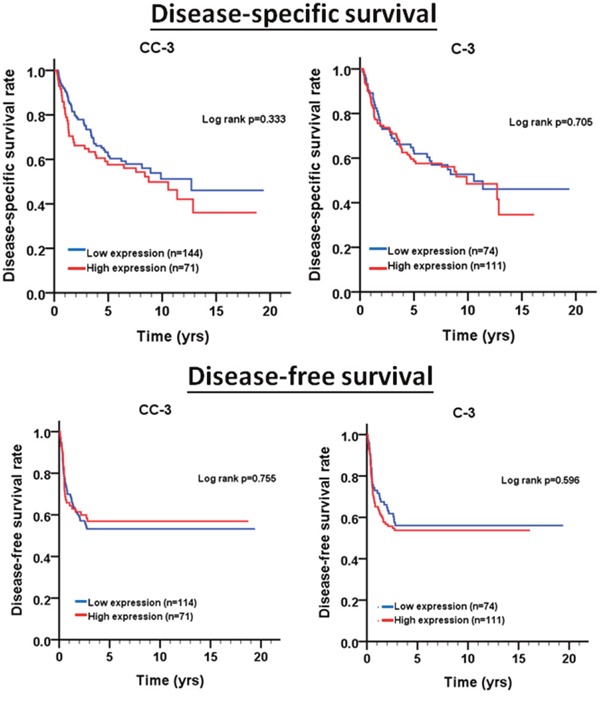
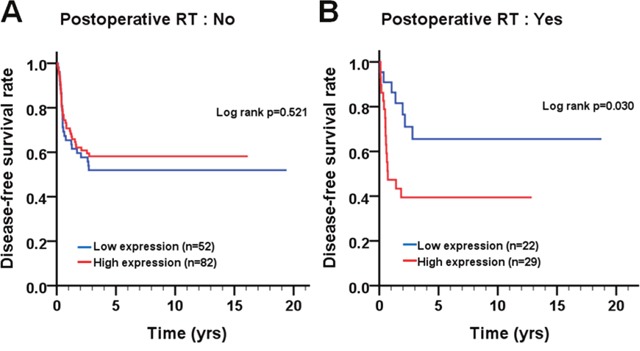
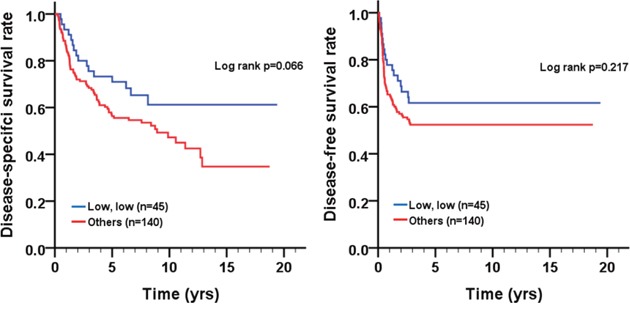
Buccal mucosa squamous cell carcinoma (BMSCC) is the most common oral cancer in Southeast Asia. Caspase-3, a key molecule in regulating apoptosis, promotes the malignancy of various cancers. However, its role in BMSCC is unknown. Herein, we evaluated the association of caspase-3 expression with tumorigenesis and prognosis in BMSCC patients. Immunohistochemical staining indicated that the expression levels of cleaved caspase-3 (<0.001) and caspase-3 (<0.001) in 185 BMSCC tissues were significantly higher compared to those in the tumor adjacent normal tissues. Moreover, the high expression of caspase-3 was associated with poor pathological outcomes [advanced pathological stage (=0.029) and larger tumor size (=0.002)] and poor disease-free survival in patients receiving postoperative radiotherapy (=0.030). Moreover, the low co-expression of cleaved caspase-3 and caspase-3 was associated with better disease-specific survival in patients with early pathological stage (I + II, =0.018) or without lymph node invasion (=0.043) compared to the positive/high expression of either or both cleaved caspase-3 and caspase-3. Taken together, cleaved caspase-3 and caspase-3 could be biomarkers for tumorigenesis in BMSCC patients. Cleaved caspase-3 and/or caspase-3 might be prognostic biomarkers for certain stages of BMSCC.
颊黏膜鳞状细胞癌(BMSCC)是东南亚最常见的口腔癌。半胱天冬酶-3是调节细胞凋亡的关键分子,可促进各种癌症的恶性发展。然而,其在BMSCC中的作用尚不清楚。在此,我们评估了半胱天冬酶-3表达与BMSCC患者肿瘤发生及预后的相关性。免疫组织化学染色显示,185例BMSCC组织中裂解型半胱天冬酶-3(<0.001)和半胱天冬酶-3(<0.001)的表达水平显著高于肿瘤旁正常组织。此外,半胱天冬酶-3的高表达与不良病理结果[晚期病理分期(=0.029)和更大肿瘤大小(=0.002)]以及接受术后放疗患者的无病生存期较差(=0.030)相关。此外,与裂解型半胱天冬酶-3和半胱天冬酶-3之一或两者的阳性/高表达相比,裂解型半胱天冬酶-3和半胱天冬酶-3的低共表达与早期病理分期(I + II,=0.018)或无淋巴结浸润(=0.043)患者更好的疾病特异性生存期相关。综上所述,裂解型半胱天冬酶-3和半胱天冬酶-3可能是BMSCC患者肿瘤发生的生物标志物。裂解型半胱天冬酶-3和/或半胱天冬酶-3可能是BMSCC某些阶段的预后生物标志物。