From the Center for Family Research (Brody, Yu), University of Georgia, Athens; Department of Psychology and Institute for Policy Research (Miller, Chen), Northwestern University, Evanston, Illinois; and Department of Psychology and Center for Family Research (Ehrlich), University of Georgia, Athens.
Psychosom Med. 2018 Feb-Mar;80(2):216-221. doi: 10.1097/PSY.0000000000000540.
The aim of the study was to test the novel hypothesis that, among black Americans who used John Henryism coping, those from low socioeconomic status backgrounds would be more likely to develop metabolic syndrome than those from higher socioeconomic backgrounds.
This is an ancillary analysis of Strong African American Families Healthy Adult Program, a longitudinal cohort of 391 black youths and their caregivers. From ages 11 to 18 years, family socioeconomic status was assessed. At age 25 years, John Henryism was assessed, blood samples were drawn, and measurements were taken of blood pressure and waist circumference. Metabolic syndrome status was based on International Diabetes Federation guidelines.
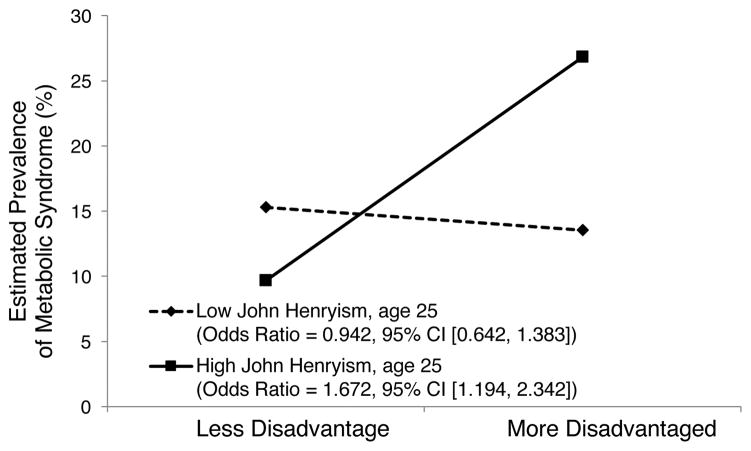
A significant interaction emerged between family socioeconomic disadvantage and John Henryism coping in predicting metabolic syndrome diagnosis (odds ratio = 1.047, 95% confidence interval = 1.004-1.091). Participants who were high in John Henryism coping were more likely to display metabolic syndrome if they were from disadvantaged backgrounds (predicted prevalence of 26.7%) than if they were from more privileged backgrounds (predicted prevalence of 9.6%).
These patterns illustrate for the first time that John Henryism coping can undermine cardiometabolic health among black youths from disadvantaged backgrounds.
本研究旨在检验一个新假设,即在使用约翰·亨利主义应对方式的美国黑人中,社会经济地位较低的人群比社会经济地位较高的人群更有可能患上代谢综合征。
这是对“强壮的非裔美国家庭健康成人计划”的辅助分析,该计划是一个由 391 名黑人和他们的照顾者组成的纵向队列。从 11 岁到 18 岁,评估家庭的社会经济地位。在 25 岁时,评估约翰·亨利主义,抽取血样,并测量血压和腰围。代谢综合征的状况基于国际糖尿病联合会的指导方针。
家庭社会经济劣势和约翰·亨利主义应对方式在预测代谢综合征诊断方面存在显著的交互作用(优势比=1.047,95%置信区间=1.004-1.091)。在来自劣势背景的参与者中(预测患病率为 26.7%),高约翰·亨利主义应对方式的参与者更有可能出现代谢综合征,而在来自较优越背景的参与者中(预测患病率为 9.6%)则不太可能出现代谢综合征。
这些模式首次表明,约翰·亨利主义应对方式可能会破坏来自劣势背景的黑人青年的心血管代谢健康。