Hummel Christiaan, Provenzale Antonello, van der Meer Jaap, Wijnhoven Sander, Nolte Arno, Poursanidis Dimitris, Janss Guyonne, Jurek Matthias, Andresen Magnus, Poulin Brigitte, Kobler Johannes, Beierkuhnlein Carl, Honrado João, Razinkovas Arturas, Stritih Ana, Bargmann Tessa, Ziemba Alex, Bonet-García Francisco, Adamescu Mihai Cristian, Janssen Gerard, Hummel Herman
Department of Estuarine and Delta Systems, NIOZ Royal Netherlands Institute for Sea Research and Utrecht University, Yerseke, the Netherlands.
VU University, Amsterdam, the Netherlands.
PLoS One. 2017 Nov 15;12(11):e0187143. doi: 10.1371/journal.pone.0187143. eCollection 2017.
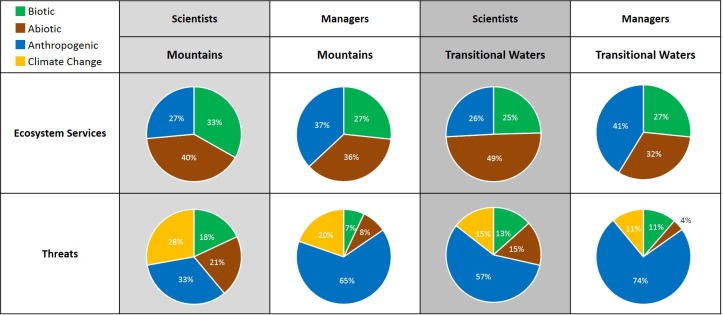
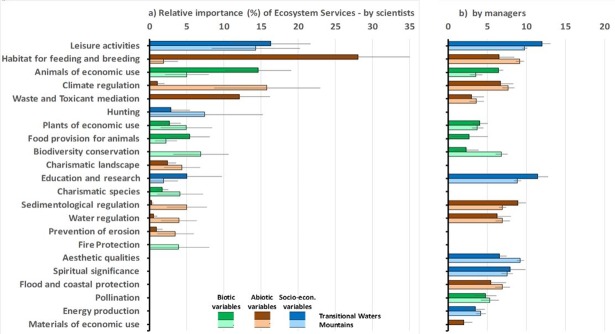
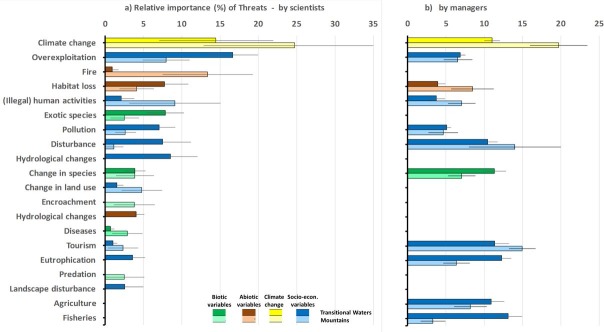
Protected Areas are a key component of nature conservation. They can play an important role in counterbalancing the impacts of ecosystem degradation. For an optimal protection of a Protected Area it is essential to account for the variables underlying the major Ecosystem Services an area delivers, and the threats upon them. Here we show that the perception of these important variables differs markedly between scientists and managers of Protected Areas in mountains and transitional waters. Scientists emphasise variables of abiotic and biotic nature, whereas managers highlight socio-economic, cultural and anthropogenic variables. This indicates fundamental differences in perception. To be able to better protect an area it would be advisable to bring the perception of scientists and managers closer together. Intensified and harmonised communication across disciplinary and professional boundaries will be needed to implement and improve Ecosystem Service oriented management strategies in current and future Protected Areas.
保护区是自然保护的关键组成部分。它们在平衡生态系统退化的影响方面可以发挥重要作用。为了对保护区进行最佳保护,必须考虑一个地区提供的主要生态系统服务背后的变量以及对这些服务的威胁。在这里,我们表明,山区和过渡水域保护区的科学家和管理人员对这些重要变量的认知存在显著差异。科学家强调非生物和生物性质的变量,而管理人员则强调社会经济、文化和人为变量。这表明了认知上的根本差异。为了能够更好地保护一个地区,建议拉近科学家和管理人员的认知。在当前和未来的保护区实施和改进以生态系统服务为导向的管理策略,需要加强跨学科和专业界限的协调沟通。