Mirzad Ahmad Nawid, Tada Takashi, Ano Hitoshi, Kobayashi Ikuo, Yamauchi Takenori, Katamoto Hiromu
Graduate School of Medicine and Veterinary Medicine, University of Miyazaki, 5200, Kihara, Kiyotake, Miyazaki 889-1692, Japan.
Faculty of Veterinary Sciences, Balkh University, Mazar-e-Sharif 1701, Balkh, Afghanistan.
J Vet Med Sci. 2018 Jan 1;80(1):20-27. doi: 10.1292/jvms.17-0321. Epub 2017 Nov 14.
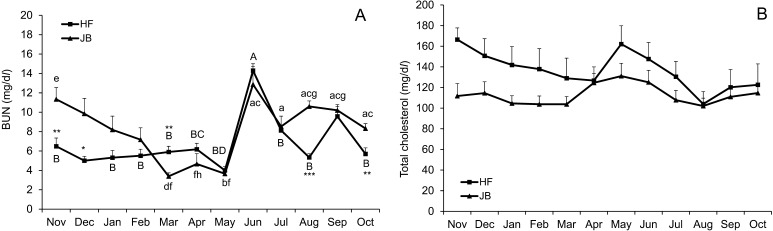
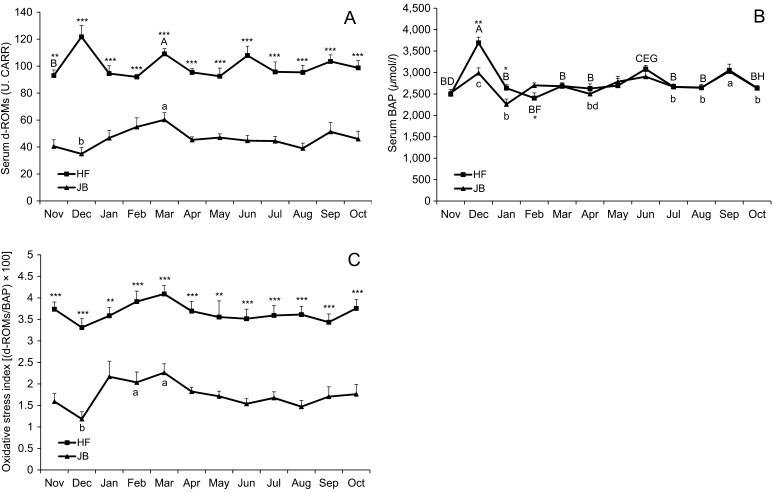
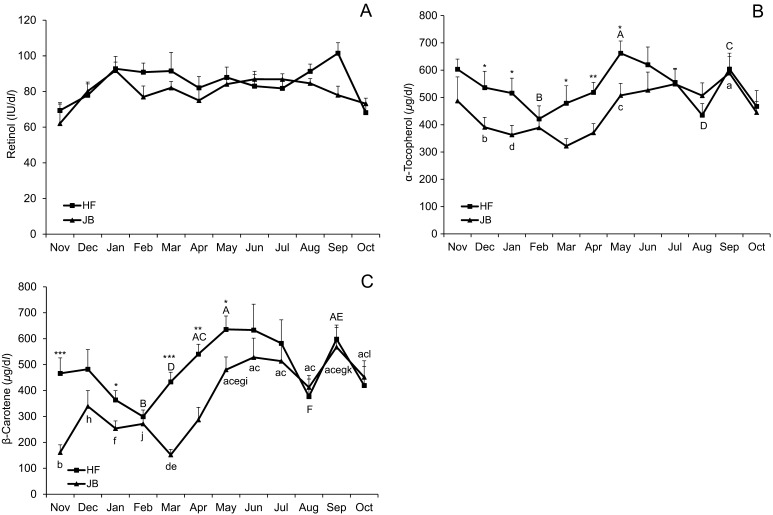
This study aims to evaluate the oxidative stress during hot summer season using serum oxidative stress biomarkers and elucidate the effects of serum antioxidant vitamin levels in dairy and beef cows in a daytime grazing system. Blood samples were collected once a month from eight Holstein Friesian (HF) and 10 Japanese Black (JB) cows from November 2013 to October 2014. Serum values of derivatives of reactive oxygen metabolites (d-ROMs) tended to be higher in March in both breeds and those in HF cows were kept at higher (P<0.001) levels than those in JB cows during the study period. Serum levels of biological antioxidant potential (BAP) in both breeds were maintained at almost the same values during study period. The OSI [(d-ROMs/BAP) × 100] values in both breeds showed similar seasonal changes, i. e. increase from December to March and decrease from March to August or September. In addition, the OSI values in HF cows were kept at higher (P<0.01) levels than those in JB cows during the study period. Serum concentrations of α-tocopherol, β-carotene, blood urea nitrogen and total cholesterol showed similar seasonal changes in both breeds, low in the winter and high from spring to summer, which may be attributed to the pasture grass intake. Opposite changes in OSI values and serum concentrations of α-tocopherol and β-carotene indicated that antioxidant vitamin levels could affect oxidative stress status.
本研究旨在利用血清氧化应激生物标志物评估炎热夏季的氧化应激情况,并阐明在白天放牧系统中血清抗氧化维生素水平对奶牛和肉牛的影响。从2013年11月至2014年10月,每月从8头荷斯坦弗里生(HF)奶牛和10头日本黑毛(JB)奶牛采集一次血样。在两个品种中,活性氧代谢产物衍生物(d-ROMs)的血清值在3月往往较高,并且在研究期间,HF奶牛的d-ROMs血清值一直高于JB奶牛(P<0.001)。在研究期间,两个品种的生物抗氧化能力(BAP)血清水平几乎保持在相同值。两个品种的氧化应激指数(OSI)[(d-ROMs/BAP)×100]值呈现相似的季节性变化,即从12月到3月升高,从3月到8月或9月降低。此外,在研究期间,HF奶牛的OSI值一直高于JB奶牛(P<0.01)。两个品种的α-生育酚、β-胡萝卜素、血尿素氮和总胆固醇的血清浓度呈现相似的季节性变化,冬季较低,从春季到夏季较高,这可能归因于牧草摄入量。OSI值与α-生育酚和β-胡萝卜素血清浓度的相反变化表明,抗氧化维生素水平可能影响氧化应激状态。