Shari Catherine R, Sawe Hendry R, Murray Brittany L, Mwafongo Victor G, Mfinanga Juma A, Runyon Michael S
Emergency Medicine Department Muhimbili University of Health and Allied Sciences, P.O Box 65001, Dar es Salaam, Tanzania.
Emergency Medicine Department, Muhimbili National Hospital, Dar Es Salaam, Tanzania.
BMC Hematol. 2017 Nov 10;17:19. doi: 10.1186/s12878-017-0091-y. eCollection 2017.
Severe anaemia contributes significantly to mortality, especially in children under 5 years of age. Timely blood transfusion is known to improve outcomes. We investigated the magnitude of anaemia and emergency blood transfusion practices amongst children under 5 years presenting to the Emergency Department (ED) of Muhimbili National Hospital (MNH) in Tanzania.
This prospective observational study enrolled children under 5 years old with anaemia, over a 7-week period in August and September of 2015. Anaemia was defined as haemoglobin of <11 g/dL. Demographics, anaemia severity, indications for transfusion, receipt of blood, and door to transfusion time were abstracted from the charts using a standardized data entry form. Anaemia was categorized as severe (Hb <7 g/dL), moderate (Hb 7-9.9 g/dL) or mild (Hb 10-10.9 g/dL).
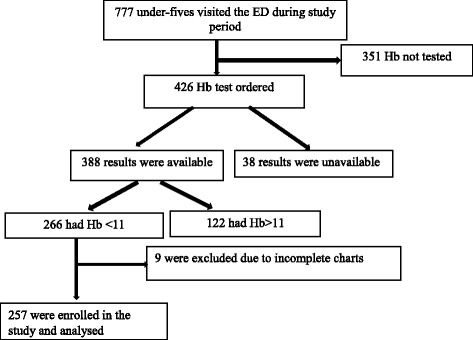
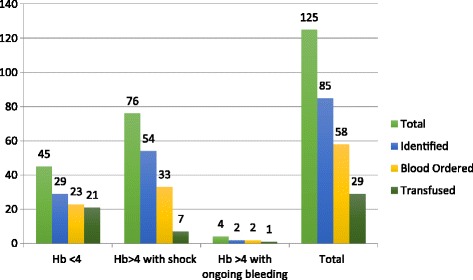
We screened 777 children, of whom 426 (55%) had haemoglobin testing. Test results were available for 388/426 (91%), 266 (69%) of whom had anaemia. Complete data were available for 257 anaemic children, including 42% ( = 108) with severe anaemia, 40% ( = 102) with moderate anaemia and 18% ( = 47) with mild anaemia. Forty-nine percent of children with anaemia ( = 125) had indications for blood transfusion, but only 23% (29/125) were transfused in the ED. Among the non-transfused, the provider did not identify anaemia in 42% ( = 40), blood was not ordered in 28% ( = 27), and blood was ordered, but not available in 30% ( = 29). The median time to transfusion was 7.8 (interquartile range: 1.9) hours. Mortality was higher for the children with severe anemia who were not transfused as compared with those with severe anaemia who were transfused (29% vs 10%, = 0.03).
The burden of anaemia is high among children under 5 presenting to EMD-MNH. Less than a quarter of children with indications for transfusion receive it in the EMD, the median time to transfusion is nearly 8 h, and those not transfused have nearly a 3-fold higher mortality. Future quality improvement and research efforts should focus on eliminating barriers to timely blood transfusion.
严重贫血对死亡率有显著影响,尤其是在5岁以下儿童中。及时输血可改善预后。我们调查了在坦桑尼亚穆希姆比利国家医院(MNH)急诊科就诊的5岁以下儿童的贫血程度和紧急输血情况。
这项前瞻性观察性研究在2015年8月和9月的7周内纳入了5岁以下的贫血儿童。贫血定义为血红蛋白<11g/dL。使用标准化数据录入表格从病历中提取人口统计学信息、贫血严重程度、输血指征、输血情况以及从就诊到输血的时间。贫血分为重度(血红蛋白<7g/dL)、中度(血红蛋白7 - 9.9g/dL)或轻度(血红蛋白10 - 10.9g/dL)。
我们筛查了777名儿童,其中426名(55%)进行了血红蛋白检测。388/426(91%)的检测结果可用,其中266名(69%)患有贫血。257名贫血儿童有完整数据,包括重度贫血42%(n = 108)、中度贫血40%(n = 102)和轻度贫血18%(n = 47)。49%的贫血儿童(n = 125)有输血指征,但在急诊科仅23%(29/125)接受了输血。在未输血的儿童中,42%(n = 40)医生未识别出贫血,28%(n = 27)未开具输血医嘱(未申请用血),30%(n = 29)虽开具了输血医嘱但无血可用。输血的中位时间为7.8小时(四分位间距:(1.9))。未输血的重度贫血儿童的死亡率高于输血的重度贫血儿童(29%对10%,P = 0.03)。
在MNH急诊科就诊的5岁以下儿童中,贫血负担较重。有输血指征的儿童中不到四分之一在急诊科接受了输血,输血中位时间近8小时,未输血儿童的死亡率高出近3倍。未来质量改进和研究工作应侧重于消除及时输血的障碍。