Szulczyński Bartosz, Wasilewski Tomasz, Wojnowski Wojciech, Majchrzak Tomasz, Dymerski Tomasz, Namieśnik Jacek, Gębicki Jacek
Department of Chemical and Process Engineering, Chemical Faculty, Gdansk University of Technology, 11/12 G. Narutowicza Str., 80-233 Gdańsk, Poland.
Department of Inorganic Chemistry, Faculty of Pharmacy, Medical University of Gdańsk, Al. Hallera 107, 80-416 Gdańsk, Poland.
Sensors (Basel). 2017 Nov 19;17(11):2671. doi: 10.3390/s17112671.
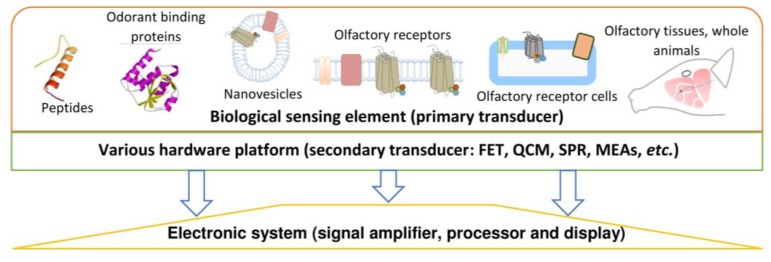
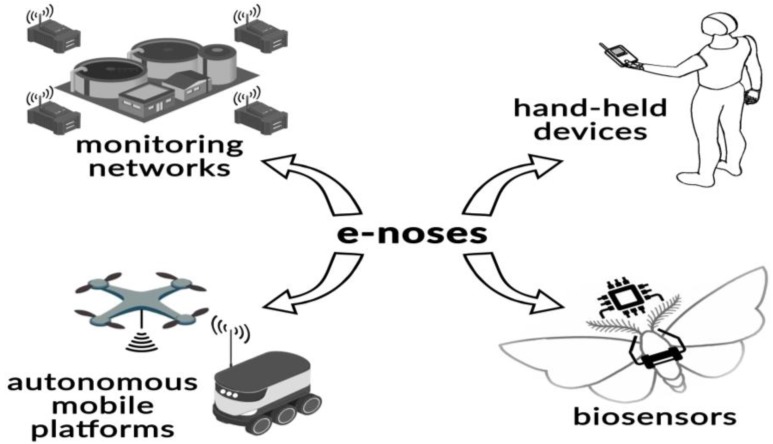
This review paper presents different ways to apply a measurement instrument of e-nose type to evaluate ambient air with respect to detection of the odorants characterized by unpleasant odour in a vicinity of municipal processing plants. An emphasis was put on the following applications of the electronic nose instruments: monitoring networks, remote controlled robots and drones as well as portable devices. Moreover, this paper presents commercially available sensors utilized in the electronic noses and characterized by the limit of quantification below 1 ppm /, which is close to the odour threshold of some odorants. Additionally, information about bioelectronic noses being a possible alternative to electronic noses and their principle of operation and application potential in the field of air evaluation with respect to detection of the odorants characterized by unpleasant odour was provided.
这篇综述论文介绍了应用电子鼻类型测量仪器评估环境空气的不同方法,以检测市政处理厂附近具有难闻气味特征的气味物质。重点介绍了电子鼻仪器的以下应用:监测网络、遥控机器人和无人机以及便携式设备。此外,本文还介绍了电子鼻中使用的市售传感器,其定量限低于1 ppm,接近某些气味物质的气味阈值。此外,还提供了有关生物电子鼻的信息,生物电子鼻可能是电子鼻的替代品,介绍了其工作原理以及在空气评估领域检测具有难闻气味特征的气味物质方面的应用潜力。