Firth Clair L, Käsbohrer Annemarie, Schleicher Corina, Fuchs Klemens, Egger-Danner Christa, Mayerhofer Martin, Schobesberger Hermann, Köfer Josef, Obritzhauser Walter
Institute of Veterinary Public Health, University of Veterinary Medicine, Vienna, Austria.
Data, Statistics and Risk Assessment, Austrian Agency for Health and Food Safety (AGES), Graz, Austria.
PeerJ. 2017 Nov 16;5:e4072. doi: 10.7717/peerj.4072. eCollection 2017.
Antimicrobial use in livestock production is an important contemporary issue, which is of public interest worldwide. Antimicrobials are not freely available to Austrian farmers and can only be administered to livestock by veterinarians, or by farmers who are trained members of the Animal Health Service. Since 2015, veterinarians have been required by law to report antimicrobials dispensed to farmers for use in food-producing animals. The study presented here went further than the statutory framework, and collected data on antimicrobials dispensed to farmers and those administered by veterinarians.
Seventeen veterinary practices were enrolled in the study via convenience sampling. These veterinarians were asked to contact interested dairy farmers regarding participation in the study (respondent-driven sampling). Data were collected from veterinary practice software between 1st October 2015 and 30th September 2016. Electronic data (89.4%) were transferred via an online interface and paper records (10.6%) were entered by the authors. Antimicrobial treatments with respect to udder disease were analysed by number of defined daily doses per cow and year (nDDD/cow/year), based on the European Medicines Agency technical unit, Defined Daily Dose for animals (DDD). Descriptive statistics and the Wilcoxon rank sum test were used to analyse the results.
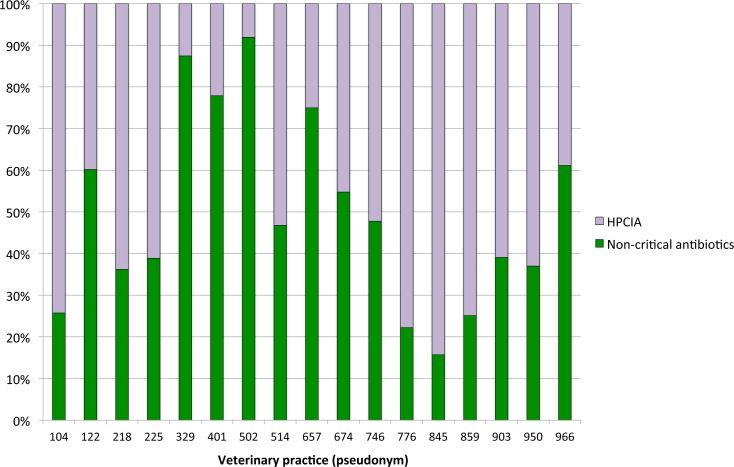
Antimicrobial use data from a total of 248 dairy farms were collected during the study, 232 of these farms treated cows with antibiotics; dry cow therapy was excluded from the current analysis. The mean number of DDD/cow/year for the antimicrobial treatment of all udder disease was 1.33 DDD/cow/year. Of these treatments, 0.73 DDD/cow/year were classed as highest priority critically important antimicrobials (HPCIAs), according to the World Health Organization (WHO) definition. The Wilcoxon rank sum test determined a statistically significant difference between the median number of DDD/cow/year for acute and chronic mastitis treatment ( = 10,734, < 0.001). The most commonly administered antimicrobial class for the treatment of acute mastitis was beta-lactams. Intramammary penicillin was used at a mean of 0.63 DDD/cow/year, followed by the third generation cephalosporin, cefoperazone, (a HPCIA) at 0.60 DDD/cow/year. Systemic antimicrobial treatments were used at a lower overall level than intramammary treatments for acute mastitis.
This study demonstrated that Austrian dairy cows in the study population were treated with antimicrobial substances for udder diseases at a relatively low frequency, however, a substantial proportion of these treatments were with substances considered critically important for human health. While it is vital that sick cows are treated, reductions in the overall use of antimicrobials, and critically important substances in particular, are still possible.
畜牧业生产中抗菌药物的使用是一个重要的当代问题,在全球范围内受到公众关注。奥地利农民无法随意获取抗菌药物,只有兽医或动物卫生服务机构中经过培训的农民才能给牲畜使用。自2015年起,法律要求兽医报告给农民用于食用动物的抗菌药物。本研究超出了法定框架,收集了给农民发放以及兽医使用的抗菌药物数据。
通过便利抽样,选取了17家兽医诊所参与研究。这些兽医被要求联系感兴趣的奶牛养殖户以参与研究(应答者驱动抽样)。在2015年10月1日至2016年9月30日期间,从兽医诊所软件中收集数据。电子数据(89.4%)通过在线接口传输,纸质记录(10.6%)由作者录入。根据欧洲药品管理局技术单位动物限定日剂量(DDD),按每头奶牛每年的限定日剂量数(nDDD/奶牛/年)分析乳房疾病的抗菌治疗情况。使用描述性统计和Wilcoxon秩和检验分析结果。
研究期间共收集了来自248个奶牛场的抗菌药物使用数据,其中232个奶牛场用抗生素治疗奶牛;本次分析排除了干奶期治疗。所有乳房疾病抗菌治疗的平均DDD/奶牛/年数为1.33 DDD/奶牛/年。根据世界卫生组织(WHO)的定义,在这些治疗中,0.73 DDD/奶牛/年被归类为最高优先级的 critically important antimicrobials(HPCIAs)。Wilcoxon秩和检验确定急性和慢性乳腺炎治疗的DDD/奶牛/年中位数之间存在统计学显著差异( = 10,734, < 0.001)。治疗急性乳腺炎最常用的抗菌药物类别是β-内酰胺类。乳房内注射青霉素的平均用量为0.63 DDD/奶牛/年,其次是第三代头孢菌素头孢哌酮(一种HPCIA),用量为0.60 DDD/奶牛/年。急性乳腺炎的全身抗菌治疗总体使用水平低于乳房内治疗。
本研究表明,研究人群中的奥地利奶牛因乳房疾病接受抗菌药物治疗的频率相对较低,然而,这些治疗中有很大一部分使用的是对人类健康至关重要的物质。虽然治疗患病奶牛至关重要,但仍有可能减少抗菌药物的总体使用,特别是至关重要的物质的使用。