MacKenzie Keith D, Palmer Melissa B, Köster Wolfgang L, White Aaron P
Vaccine and Infectious Disease Organization-International Vaccine Centre, Saskatoon, SK, Canada.
Department of Microbiology and Immunology, University of Saskatchewan, Saskatoon, SK, Canada.
Front Vet Sci. 2017 Aug 25;4:138. doi: 10.3389/fvets.2017.00138. eCollection 2017.
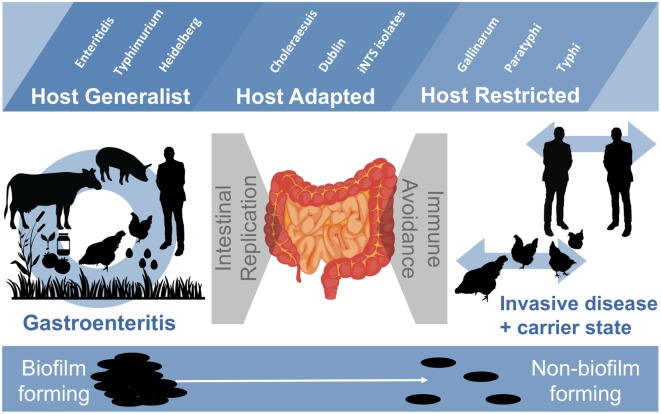
are important pathogens worldwide and a predominant number of human infections are zoonotic in nature. The ability of strains to form biofilms, which is a multicellular behavior characterized by the aggregation of cells, is predicted to be a conserved strategy for increased persistence and survival. It may also contribute to the increasing number of infections caused by ingestion of contaminated fruits and vegetables. There is a correlation between biofilm formation and the ability of strains to colonize and replicate within the intestines of multiple host species. These strains predominantly cause localized gastroenteritis infections in humans. In contrast, there are salmonellae that cause systemic, disseminated infections in a select few host species; these "invasive" strains have a narrowed host range, and most are unable to form biofilms. This includes host-restricted serovar Typhi, which are only able to infect humans, and atypical gastroenteritis strains associated with the opportunistic infection of immunocompromised patients. From the perspective of transmission, biofilm formation is advantageous for ensuring pathogen survival in the environment. However, from an infection point of view, biofilm formation may be an anti-virulence trait. We do not know if the capacity to form biofilms prevents a strain from accessing the systemic compartments within the host or if loss of the biofilm phenotype reflects a change in a strain's interaction with the host. In this review, we examine the connections between biofilm formation, disease states, degrees of host adaptation, and how this might relate to different transmission patterns. A better understanding of the dynamic lifecycle of will allow us to reduce the burden of livestock and human infections caused by these important pathogens.
在全球范围内都是重要的病原体,并且大量的人类感染本质上是人畜共患病。菌株形成生物膜的能力,这是一种以细胞聚集为特征的多细胞行为,预计是一种增加持久性和存活率的保守策略。它也可能导致因摄入受污染的水果和蔬菜而引发的感染数量增加。生物膜形成与菌株在多种宿主物种肠道内定殖和复制的能力之间存在相关性。这些菌株主要导致人类局部胃肠炎感染。相比之下,有一些沙门氏菌会在少数宿主物种中引起全身性、播散性感染;这些“侵袭性”菌株的宿主范围较窄,并且大多数无法形成生物膜。这包括宿主受限的伤寒血清型,它们只能感染人类,以及与免疫功能低下患者的机会性感染相关的非典型胃肠炎菌株。从传播的角度来看,生物膜形成有利于确保病原体在环境中的存活。然而,从感染的角度来看,生物膜形成可能是一种抗毒力特征。我们不知道形成生物膜的能力是否会阻止菌株进入宿主体内的全身腔室,或者生物膜表型的丧失是否反映了菌株与宿主相互作用的变化。在这篇综述中,我们研究了生物膜形成、疾病状态、宿主适应程度之间的联系,以及这可能如何与不同的传播模式相关。更好地理解……的动态生命周期将使我们能够减轻这些重要病原体对牲畜和人类造成的感染负担。 (注:原文中“will”指代不明,推测是某种病原体,但未明确写出,翻译时保留原文表述)